
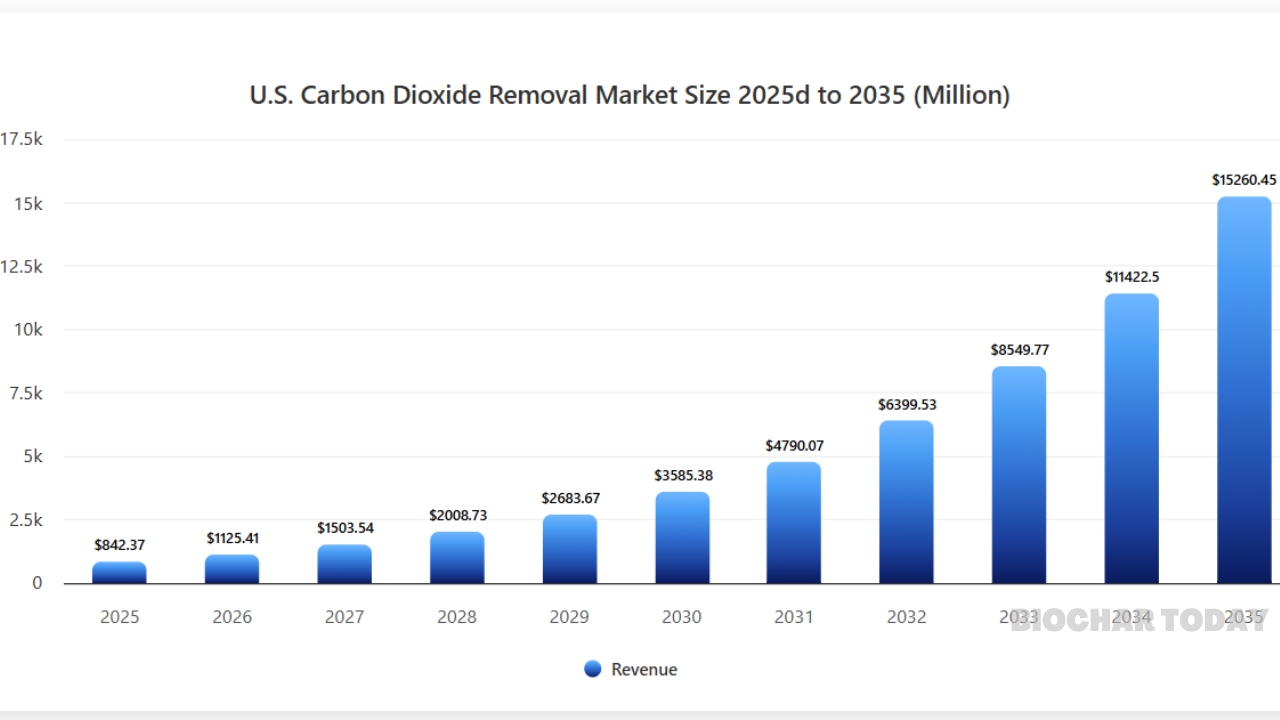
A market report published by Precedence Research reveals that the United States carbon dioxide removal (CDR) sector is experiencing rapid financial acceleration. The market valuation is projected to expand significantly from USD 1,125.41 million in 2026 to USD 15,260.45 million by 2035, driven by a compound annual growth rate of 33.6 percent. This industrial expansion is fueled by federal incentives, such as the Inflation Reduction Act’s Climate Pollution Reduction Grants, alongside structural market commitments from major technological and financial institutions. Within this emerging framework, biocharBiochar is a carbon-rich material created from biomass decomposition in low-oxygen conditions. It has important applications in environmental remediation, soil improvement, agriculture, carbon sequestration, energy storage, and sustainable materials, promoting efficiency and reducing waste in various contexts while addressing climate change challenges. More has established itself as a foundational product category, commanding a 22.80 percent share of the entire domestic CDR market.
The primary challenge addressed by the expanding industry involves the urgent requirement to counter legacy atmospheric pollution and legacy carbon footprints. Achieving mathematical net-zero goals remains fundamentally unfeasible for hard-to-abate heavy industries—such as aviation, shipping, and cement—without rapid infrastructure deployment for durable carbon credits. Furthermore, emerging high-permanence CDR technologies face deep capitalization gaps and require structured corporate framework investments to achieve scalable operation. As the world’s largest historical emitter of carbon dioxide, the United States faces severe economic and environmental pressure to establish stable, verifiable, and highly scalable domestic removal mechanisms that transition away from uncoordinated, over-the-counter transactions.
To mitigate these challenges, industrial actors are deploying commercialized technical frameworks led by nature-based and technological solutions. Wakefield BioChar has positioned itself as a major market participant by scaling the technical conversion of raw biomassBiomass is a complex biological organic or non-organic solid product derived from living or recently living organism and available naturally. Various types of wastes such as animal manure, waste paper, sludge and many industrial wastes are also treated as biomass because like natural biomass these More into agricultural biochar, permanently sequestering carbon while concurrently improving domestic soil health metrics. Concurrently, technical and financial entities are injecting significant capital into infrastructure projects to build a transparent asset class with equitable pricing mechanisms. Technological enterprises like Alphabet, Meta, Stripe, and Shopify are actively securing advanced market commitments for high-quality carbon removal, while financial institutions act as vital intermediaries, providing risk assessment tools and corporate liquidity to transform early-stage infrastructure into bankable projects.
The outcomes of these integrated commercial strategies highlight robust, structural market readiness for the biochar sector. Because biochar represents a highly practical, deployable, and immediate solution, it currently accounts for a substantial percentage of all durable carbon removal credits issued in the United States. Furthermore, the broader national market is establishing clear technological maturity, supported by concurrent developments from companies like Charm Industrial, CarbonCure Technologies, and 1PointFive. This balanced deployment allows biochar to deliver an affordable, immediately scalable mitigation asset that satisfies corporate governance demands, stabilizes pricing within the voluntary carbon market, and secures measurable ecological benefits for domestic agriculture.


![Eucalyptus Wood Waste-Derived Biochar Achieves a Ninety-Eight Percent Removal Efficiency for Benzo[ghi]perylene in Vehicle-Wash Wastewater](https://biochartoday.com/wp-content/uploads/2026/10/SCIENCE-BLOGS-2026-2026-10-19T160523.703.jpg)


Leave a Reply