
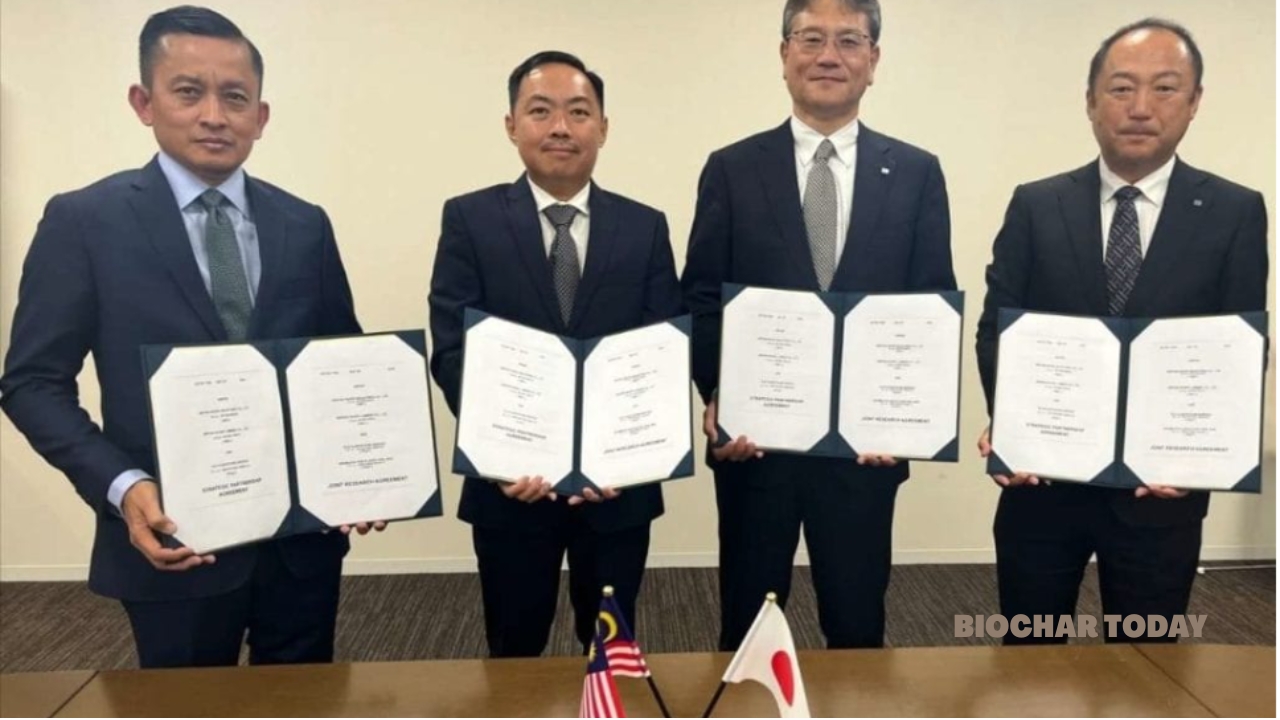
PLS Plantations Bhd and Japan’s Nippon Paper Group have entered into a strategic partnership and joint research agreement to develop a large-scale eucalyptus plantation program in Malaysia. The collaboration targets between 20,000 and 30,000 hectares across Johor and Pahang, combining local land assets with international silvicultural expertise. Central to the agreement is a three-year feasibility study and pilot project at a site in Johor managed by Aramijaya Agri & Agro Sdn Bhd, a subsidiary of PLS. The partners intend to explore downstream biomassBiomass is a complex biological organic or non-organic solid product derived from living or recently living organism and available naturally. Various types of wastes such as animal manure, waste paper, sludge and many industrial wastes are also treated as biomass because like natural biomass these More applications, specifically identifying biocharBiochar is a carbon-rich material created from biomass decomposition in low-oxygen conditions. It has important applications in environmental remediation, soil improvement, agriculture, carbon sequestration, energy storage, and sustainable materials, promoting efficiency and reducing waste in various contexts while addressing climate change challenges. More and black pellets as key avenues for industrial innovation and carbon sequestration.
A primary challenge addressed by this partnership is the historical difficulty of establishing high-productivity eucalyptus plantations within the specific natural environment of Malaysia. While eucalyptus is a fast-growing species, achieving the yields necessary for industrial-scale biomass and timber operations requires precise genetic selection and management frameworks adapted to local soil and climatic conditions. Furthermore, the project aims to address the growing need for ESG-aligned forestry practices that can generate environmental value, such as carbon credits, while maintaining commercial viability in a region transitioning toward sustainable land use.
To resolve these complexities, the organizations are implementing a joint research framework where Nippon Paper Group provides technical guidance on genetic resources, seedling production, and forest management. PLS contributes the necessary land, nursery infrastructure, and field operational resources to facilitate large-scale trials. This technical integration focuses on improving the Mean Annual Increment (MAI) of the trees through selection breeding and hybridisation, utilizing Nippon Paper’s global afforestation technologies. By evaluating potential downstream wood-related applications during this research phase, the partners are designing a supply chain that specifically accounts for biomass-to-biochar conversion.
The anticipated outcomes of this collaboration include the establishment of a platform for long-term value creation through sustainable forestry and industrial commercialization. Successful research and feasibility testing are expected to lead to a formal joint venture for full-scale plantation development and the production of woodchips, pellets, and biochar. Beyond direct industrial outputs, the project is designed to generate job opportunities, enhance local talent in silviculture, and support Malaysia’s broader carbon neutrality goals through responsible forest stewardship.





Leave a Reply