
Key Takeaways
- Ball-milled wood chip nano-biochar reduces toxic silver ions into metallic silver nanoparticles exclusively under weakly alkaline conditions.
- Low-temperature nano-biochar achieves a reaction rate constant 2.5 times higher than high-temperature nano-biochar.
- Abundant phenolic hydroxyl groups boost electron-donating capacity to drive superoxide radical generation.
- Persistent free radicals and deprotonated surface groups act synergistically as key electron mediators.
- Excessive biocharBiochar is a carbon-rich material created from biomass decomposition in low-oxygen conditions. It has important applications in environmental remediation, soil improvement, agriculture, carbon sequestration, energy storage, and sustainable materials, promoting efficiency and reducing waste in various contexts while addressing climate change challenges. More dosages above threshold limits suppress nanoparticle formation through reactive oxygen species self-consumption.
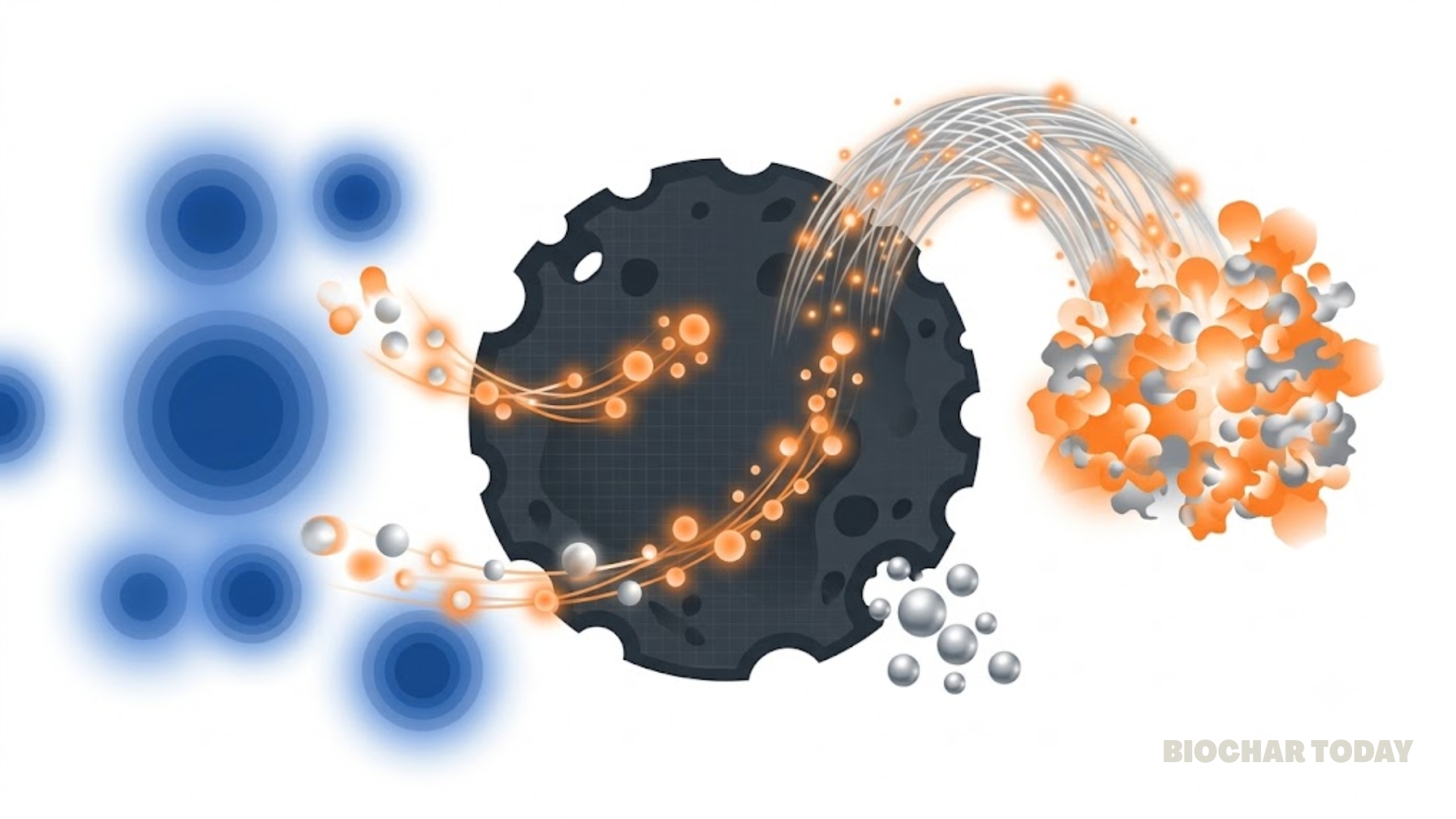
A recent study in Biochar by Shiguo Gu, Dandan Wang, Tongtong Wang, and Wei Zhu investigates the pH-dependent reduction of silver ions into metallic silver nanoparticles using nano-biochar. The research team synthesized two distinct nano-biochar materials via planetary ball milling of wood chip-derived bulk biochar pyrolyzed at four hundred degrees Celsius and seven hundred degrees Celsius. Experimental evaluations across a wide range of solution conditions demonstrated that the transformation of silver ions into silver nanoparticles is strictly governed by ambient pHpH is a measure of how acidic or alkaline a substance is. A pH of 7 is neutral, while lower pH values indicate acidity and higher values indicate alkalinity. Biochars are normally alkaline and can influence soil pH, often increasing it, which can be beneficial More levels. Under acidic to neutral aquatic conditions, no nanoparticle formation occurs because protonation of surface functional groups restricts electron transfer and limits reactive surface sites. Conversely, weakly alkaline environments trigger efficient silver ion reduction, achieving optimal conversion yields at pH nine point five.
The structural and chemical properties of the biochar materials directly dictate their catalytic performance. Low-temperature nano-biochar exhibits significantly faster reaction kinetics, displaying a pseudo-first-order rate constant approximately two point five times higher than its high-temperature counterpart. Quantitative characterization confirms that low-temperature pyrolysisPyrolysis is a thermochemical process that converts waste biomass into bio-char, bio-oil, and pyro-gas. It offers significant advantages in waste valorization, turning low-value materials into economically valuable resources. Its versatility allows for tailored products based on operational conditions, presenting itself as a cost-effective and efficient More preserves an abundance of oxygen-containing functional groups, including phenolic hydroxyl content measured at three point zero one millimoles per gram. This high density of phenolic moieties endows the low-temperature material with an intrinsic electron-donating capacity one point five six times greater than that of high-temperature biochar, providing the necessary driving force for rapid interfacial electron transfer.
Mechanistic investigations demonstrate that superoxide radicals serve as the essential reductive intermediates driving silver nanoparticle synthesis. Under alkaline conditions, deprotonated surface functional groups work synergistically with persistent free radicals stabilized within the biochar carbon matrix to reduce dissolved oxygen into superoxide radicals. These generated superoxide species continuously mediate the reduction of surface-bound silver ions into metallic silver nanoparticles. Anoxic control experiments and enzyme-targeted quenching assays confirmed that direct electron transfer from surface phenolic groups without oxygen is negligible, proving that superoxide radicals are the exclusive key driver of the transformation. Transmission electron microscopy and energy-dispersive X-ray spectroscopy verified the synthesis of well-dispersed, quasi-spherical metallic nanoparticles with face-centered cubic crystalline structures ranging between five point eight eight and twenty-three point five three nanometers.
The study also identified critical dosage constraints governing the reduction system. Increasing biochar concentration beyond ten milligrams per liter for low-temperature biochar or twenty milligrams per liter for high-temperature biochar severely suppresses nanoparticle yields. High particle concentrations promote colloidal aggregation, reduce available interfacial reactive sites, and induce competitive self-consumption of reactive oxygen species through secondary radical transformation pathways. These insights establish precise operational boundaries for utilizing engineered carbon nanomaterials in water remediation, demonstrating a sustainable pathway to convert toxic dissolved silver into valuable metallic nanoparticles.
Source: Gu, S., Wang, D., Wang, T., & Zhu, W. (2026). pH-regulated surface chemistry of nano-biochar for selective silver ion reduction: the pivotal role of superoxide radicals. Biochar, 8, Article 133.



Leave a Reply