
Key Takeaways
- Water filters using activated carbonActivated carbon is a form of carbon that has been processed to create a vast network of tiny pores, increasing its surface area significantly. This extensive surface area makes activated carbon exceptionally effective at trapping and holding impurities, like a molecular sponge. It is commonly More and biocharBiochar is a carbon-rich material created from biomass decomposition in low-oxygen conditions. It has important applications in environmental remediation, soil improvement, agriculture, carbon sequestration, energy storage, and sustainable materials, promoting efficiency and reducing waste in various contexts while addressing climate change challenges. More can shed tiny carbon particles into the filtered water.
- These microscopic carbon bits carry heavy metal pollutants like lead straight through sand and fine membrane filters.
- Up to ninety percent of lead left in filtered water is tied to tiny floating carbon particles rather than being dissolved in the liquid.
- Standard water tests often miss these toxic metals because filtering samples before testing removes the particles carrying them.
- Stopping toxic transport requires extra fine filtration layers or stronger bonding methods to prevent carbon filters from crumbling.
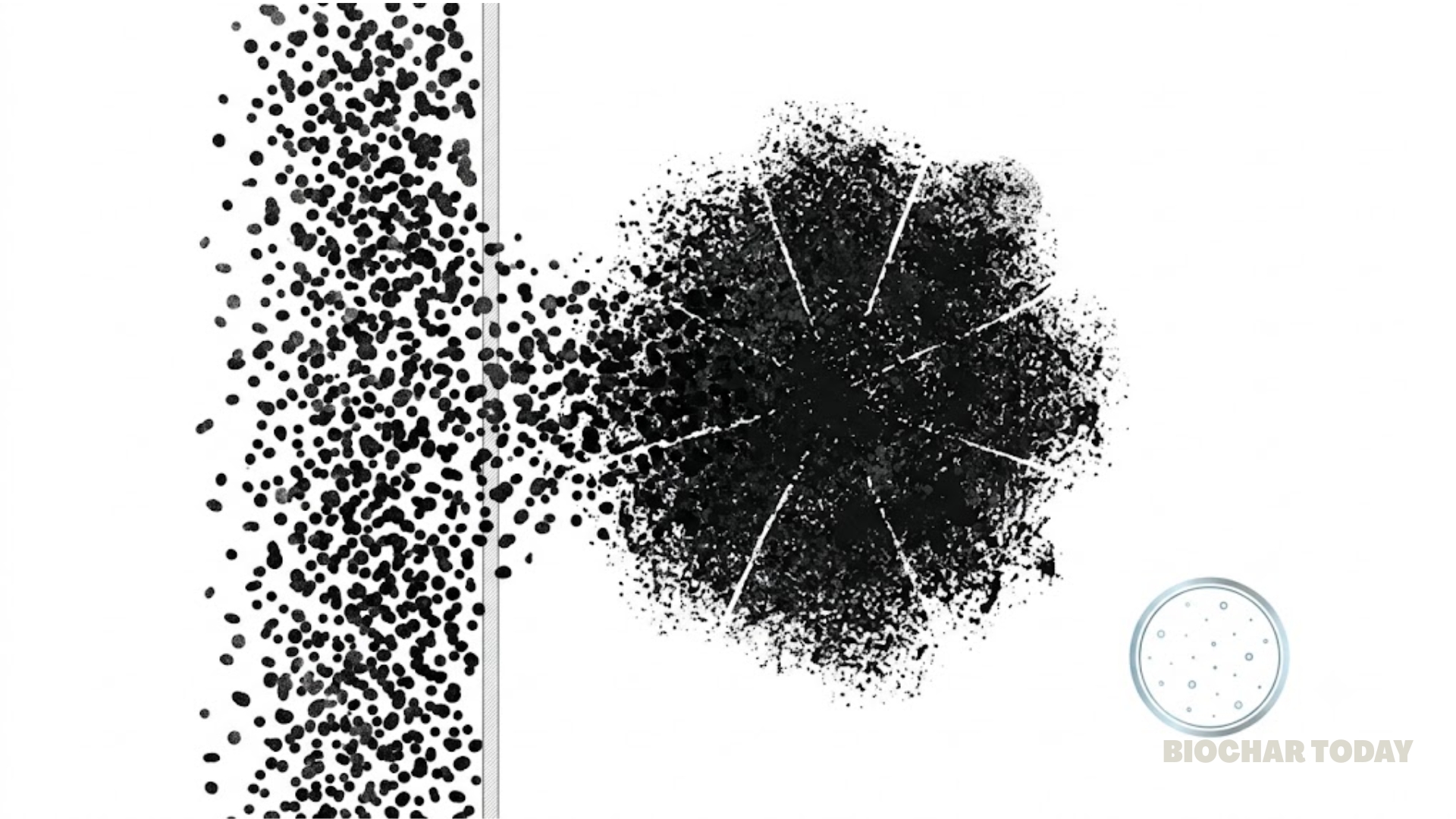
In the journal Biochar, researchers Ziheng Wang and Majid Sedighi investigated how carbon-based adsorbents break down during water treatment and release microscopic particles into filtered water. Activated carbon and sustainable alternatives like biochar effectively pull heavy metals out of contaminated liquid, but physical erosion releases superfine bits of carbon into the flow. These microscopic fragments can act as vehicles, carrying absorbed pollutants through downstream filtration units that are meant to ensure final water purity.
To track this process, the authors conducted fixed-bed column and stirred-tank tests using lead as a tracer contaminant across activated carbon and three types of biochar. The team passed the resulting liquid through a series of post-filtration barriers, including coarse sand, fine sand, a 0.45-micrometer membrane, and a ultra-fine 0.02-micrometer membrane. While traditional water tests on filtered liquid showed that dissolved lead was successfully removed, additional spectroscopic and chemical analyses revealed a hidden stream of contamination bound directly to tiny floating carbon bits.
The physical characterization of the filtered liquid demonstrated distinct particle size clusters around 5 micrometers, 0.5 to 1 micrometer, and 100 to 200 nanometers. Scanning electron microscopy coupled with energy-dispersive X-ray spectroscopy confirmed that lead was physically attached to the surfaces of these escaping particles. Particles in the 100 to 200 nanometer range easily glided through sand filters and 0.45-micrometer membranes, while larger detected clusters resulted from smaller particles clumping together after passing through filter pores.
Quantitative acid digestion testing showed that particle-bound lead made up 84.5% to 90.2% of the total lead found in fine sand filter outputs, with biochar shedding higher proportions of lead-bearing particles than activated carbon. Even after passing through a standard 0.45-micrometer membrane filter, substantial amounts of lead remained attached to microscopic carbon colloids, reaching levels up to 11.3 micrograms per liter. This level exceeds strict international drinking water quality standards, proving that standard dissolved-phase water quality testing drastically underestimates total heavy metal transport.
Only the ultra-dense 0.02-micrometer membrane successfully blocked the microscopic carbon particles and reduced lead levels down near baseline distilled water measurements. However, operating such dense membrane systems requires significantly higher energy and pump pressure, making widespread adoption in large-scale municipal plants challenging. The researchers emphasized that future water treatment designs must focus on pre-washing carbon media, engineering stronger non-crumbling biochar granules, or optimizing chemical coagulation to lock these tiny particles in place before they reach consumers.
Source: Wang, Z., & Sedighi, M. (2026). Co-transport of contaminants by disintegrated and residual superfine particles in biocarbon-based adsorbents. Biochar, 8(1), 137.



Leave a Reply