

Key Takeaways
- Adding rice husk biocharBiochar is a carbon-rich material created from biomass decomposition in low-oxygen conditions. It has important applications in environmental remediation, soil improvement, agriculture, carbon sequestration, energy storage, and sustainable materials, promoting efficiency and reducing waste in various contexts while addressing climate change challenges. More to agricultural soil significantly increases organic carbon levels and overall soil health.
- Essential plant nutrients like phosphorus and potassium become far more available to growing crops when biochar is applied.
- Wheat grain yield peaks at a specific biochar application rate before extra additions begin to diminish returns.
- The natural structure of the soil improves, allowing it to hold more water and support beneficial underground biological activity.
- Applying biochar at an optimal rate offers a practical way to restore depleted farmland and support food production.
In a study published in Scientific Records, researcher Hina Firdous investigated how incorporating varying levels of rice husk biochar into depleted agricultural soil impacts long term fertility and crop productivity. Intensely cultivated farmland frequently suffers from severe organic matter depletion, reduced nutrient retention, and poor physical structure. Biochar, a carbon rich material produced through the low oxygen heating of agricultural residues like rice husks, provides a stable framework to reverse these degradation trends. By examining application rates ranging from zero to four percent, the investigation evaluated key shifts in chemical composition, physical stability, and biological activity alongside wheat performance.
The results show a direct linear growth in soil organic carbon as biochar concentrations increase. Starting from a baseline of less than half a percent in untreated soil, organic carbon levels more than tripled at the highest application rate. This steady accumulation highlights the exceptional stability of rice husk biochar, which locks carbon into the ground rather than allowing it to decompose rapidly back into the atmosphere. Along with carbon enrichment, total nitrogen levels expanded consistently due to improved nutrient holding capacity on the porous biochar surfaces.
Nutrient availability also experienced dramatic improvements, though the response followed a clear curved pattern rather than a continuous increase. Essential plant nutrients like available phosphorus and potassium reached their highest concentrations at the three percent biochar rate. Available phosphorus tripled compared to untreated conditions, while available potassium nearly doubled. This surge in nutrients stems from the high cation exchange capacity of biochar, which creates abundant negatively charged sites that grab onto valuable mineral ions and prevent them from washing away. Additionally, the slight, natural reduction in soil pHpH is a measure of how acidic or alkaline a substance is. A pH of 7 is neutral, while lower pH values indicate acidity and higher values indicate alkalinity. Biochars are normally alkaline and can influence soil pH, often increasing it, which can be beneficial More created an environment where fixed phosphorus could dissolve more easily for root absorption.
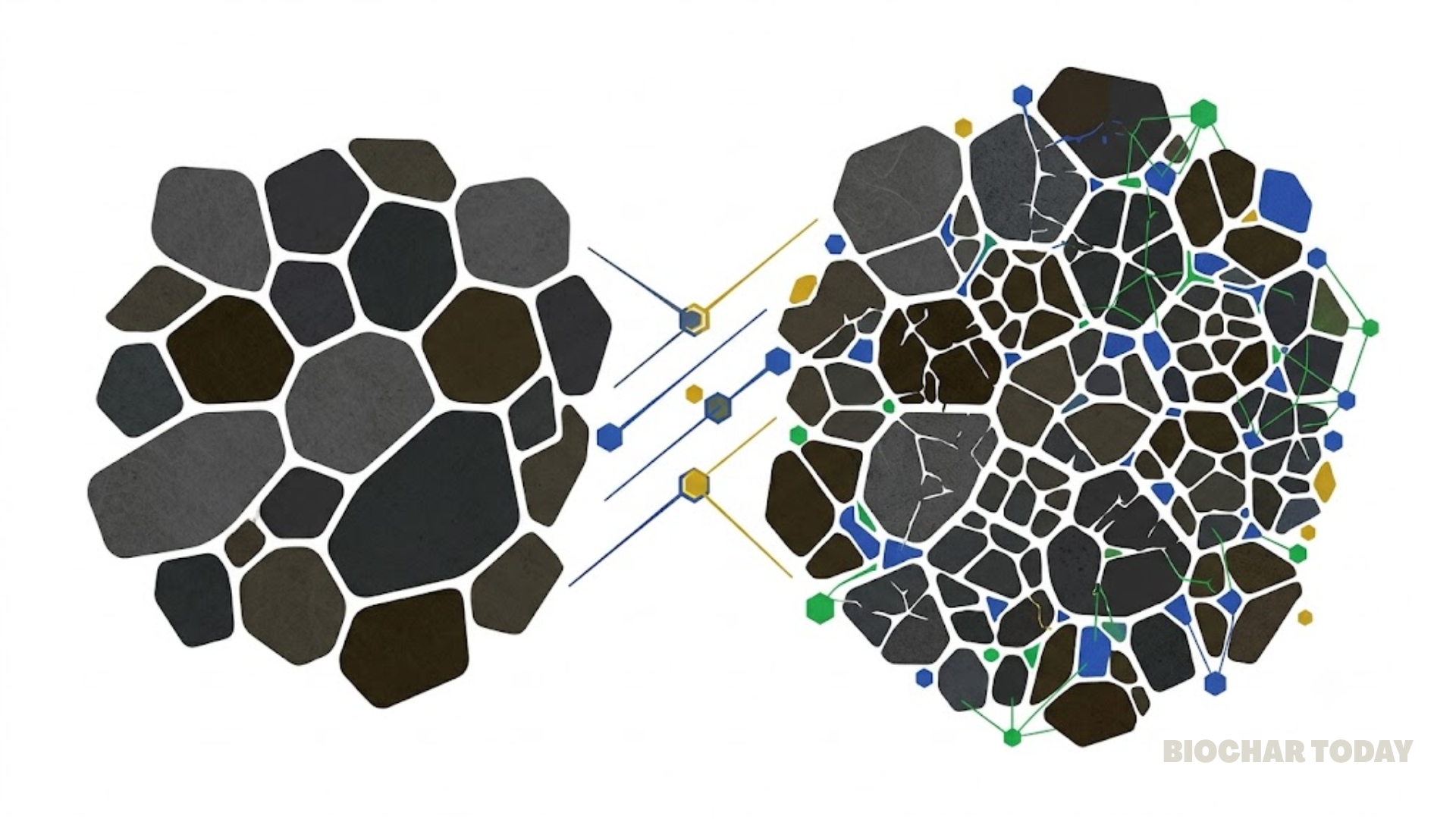
Beyond chemical enrichment, the physical properties of the soil underwent significant structural upgrades. Soil bulk density decreased progressively with higher biochar rates, relieving compaction and making it easier for plant roots to penetrate the earth. The internal water holding capacityWater holding capacity is the amount of water that soil can retain. Biochar can significantly increase the water holding capacity of soil, improving its ability to withstand drought conditions and support plant growth. More expanded substantially, allowing the soil to retain capillary moisture far more effectively during dry periods. At the same time, saturated hydraulic conductivity and aggregate stability both improved dramatically at the three percent application level. The light, porous nature of biochar particles created ideal channels for water movement while encouraging soil particles to bind together into stable aggregates.
Biological activity flourished within this enhanced underground habitat. Microbial biomassBiomass is a complex biological organic or non-organic solid product derived from living or recently living organism and available naturally. Various types of wastes such as animal manure, waste paper, sludge and many industrial wastes are also treated as biomass because like natural biomass these More carbon nearly tripled at the highest biochar addition, demonstrating that micro-organisms rapidly colonized the microscopic pores and protective spaces provided by the biochar. Soil respiration rates similarly peaked at the three percent application level, signaling an active underground ecosystem. These active microbes break down organic compounds and continuously cycle nutrients back into forms that plant roots can absorb.
The cumulative improvements in soil health directly translated into higher crop productivity, where wheat grain yield showed a strong quadratic response. Grain yield increased steadily from the untreated baseline up through the three percent treatment, where it achieved a maximum improvement of nearly sixty five percent. Individual grain weight, spike length, and the total number of grains per spike all hit peak values at this same level. However, pushing the biochar application further to four percent caused a slight but noticeable drop in grain yield. At extremely high loadings, high carbon ratios can temporarily immobilize nitrogen or create excess nutrient binding, demonstrating that agricultural benefits peak at a definitive threshold. Applying rice husk biochar within an optimal window delivers maximum yield gains while rebuilding long term soil resilience.
Source: Firdous, H. (2026). Biochar application impact on soil organic carbon and nutrient availability in wheat under greenhouse conditions. Scientific Records, 3(1), 185-194.



Leave a Reply