
Key Takeaways
- Residue is Gold for Carbon: Returning red pepper crop residues (stems and roots) to the field reduces the necessary woody biocharBiochar is a carbon-rich material created from biomass decomposition in low-oxygen conditions. It has important applications in environmental remediation, soil improvement, agriculture, carbon sequestration, energy storage, and sustainable materials, promoting efficiency and reducing waste in various contexts while addressing climate change challenges. More (WB) amount by 55% to maintain a positive carbon balance (NECB).
- Optimal Biochar Dose: When crop residues are returned, the optimal WB application for maximum carbon sequestration is between 1.8 and 6.7 Mg d.w ha−1.
- Yield Boost: Applying WB significantly increased red pepper fruit yield by up to 18% compared to the unamended control.
- Healthier Soil Structure: The addition of WB improved soil health, increasing soil total carbon content by 15−20%.
- Climate Change Mitigation: Using WB is a sustainable management strategy for mitigating climate change by improving the annual NECB.
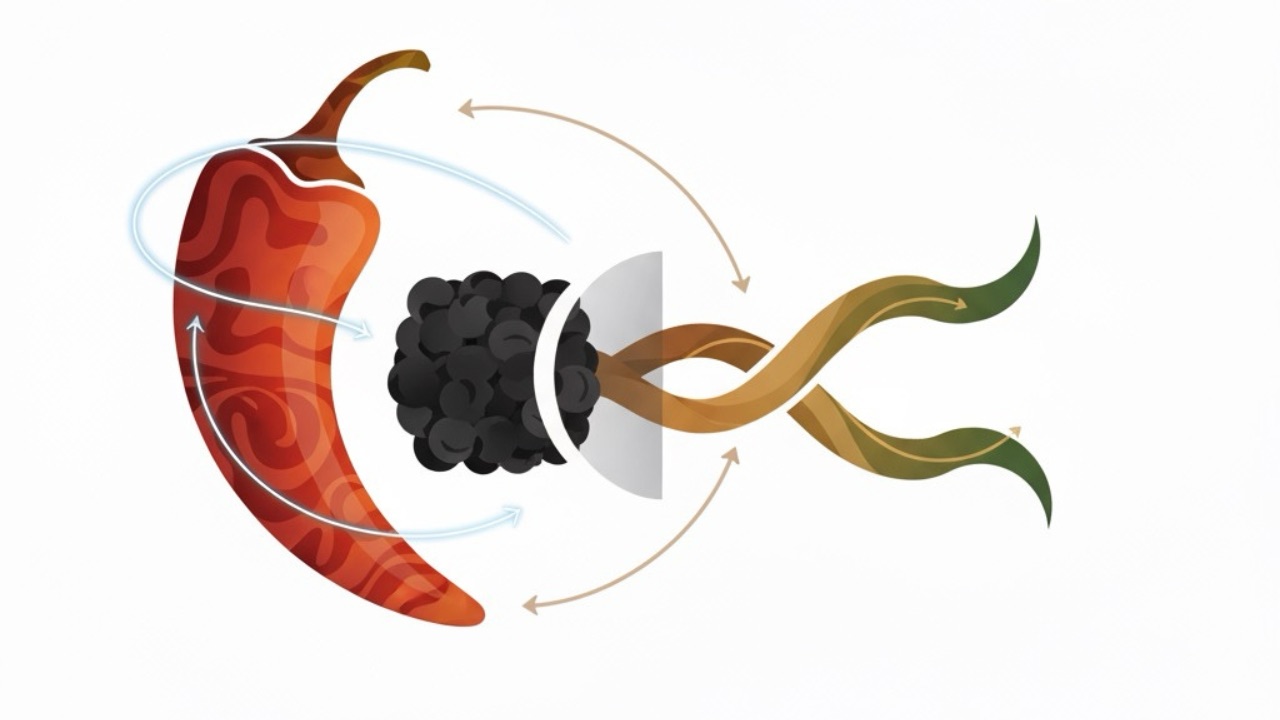
A two-year field study led by Sohee Yoon and published in Biochar investigated the impact of sustainable woody biochar (WB) application on the net ecosystem carbon budget (NECB), yield, and soil properties in red pepper cropping systems. The researchers aimed to identify optimal WB application levels to maximize carbon (C) sequestration while maintaining agricultural productivity. They found that returning crop residue to the soil significantly lowered the amount of WB needed to achieve a positive NECB, thus offering a more efficient and sustainable management strategy.
The research focused on estimating the optimal rates of WB (a low C-emitting and degradation-resistant organic resource) for red pepper cultivation. The study calculated the annual NECB, which accounts for both C inputs (fertilizer, WB, and net primary production (NPP) from the crop) and C outputs (CO2 and CH4 respiration, and C removal at harvest). The experiment applied WB annually at four levels: 0, 2.5, 5, and 10 Mg d.w ha−1. Results showed that the total C input over two years was highest at the 10 Mg d.w ha−1 level. Increasing WB application levels significantly increased CO2 emissions, but CH4 emissions were negligible, showing negative fluxes across all treatments. Overall, WB application significantly improved the annual NECB compared to the control.
The study’s most critical finding was that the optimal WB application level required to maintain a positive annual NECB—where C sequestration exceeds C loss—was highly dependent on how red pepper residues (shoots, roots) were managed after harvest. When all plant biomassBiomass is a complex biological organic or non-organic solid product derived from living or recently living organism and available naturally. Various types of wastes such as animal manure, waste paper, sludge and many industrial wastes are also treated as biomass because like natural biomass these More (shoots, roots, and fruits) was removed, the optimal WB application range for a positive NECB was estimated to be 7.3−11.4 Mg d.w ha−1 (mean value: 9.4 Mg d.w ha−1). When only the fruit was harvested and the plant residues were returned to the soil, the optimal WB application range dropped dramatically to 1.8−6.7 Mg d.w ha−1 (mean value: 4.3 Mg d.w ha−1).
This difference represents a 55% reduction in the WB application level when residues are incorporated. This suggests that returning crop residues is an appropriate way to improve the NECB by reducing C output from harvest removal (approximately 3.7 to 7.2 Mg C ha−1), despite the fresh residue possibly increasing respiration rates.
Beyond carbon sequestration, WB application also significantly improved crop productivity and soil health. Red Pepper Productivity: WB application significantly increased cumulative fruit productivity and total biomass productivity. The highest application rate (10 Mg d.w ha−1) increased overall fruit productivity by up to 18% in the first year and 16% in the second year compared to the control (0 Mg d.w ha−1). Total biomass production increased by 19−34% over the control. Soil Properties: Increasing WB levels improved soil physicochemical properties such as bulk density and Soil Organic Carbon (SOC) content. The soil C content increased by 15−20% compared to the control. Additionally, soil pHpH is a measure of how acidic or alkaline a substance is. A pH of 7 is neutral, while lower pH values indicate acidity and higher values indicate alkalinity. Biochars are normally alkaline and can influence soil pH, often increasing it, which can be beneficial More was improved due to the relatively higher pH of the WB.
Optimizing the WB application level based on the NECB is a tangible strategy to mitigate climate change by enhancing soil C sequestration while simultaneously improving red pepper productivity and soil quality. The results offer guidance for the sustainable optimization of WB application in red pepper cropping systems.
Source: Yoon, S., Lee, Y., An, H., Melendez, J., & Kim, S. Y. (2025). Sustainable woody biochar application for improving net ecosystem carbon budget, yield and soil properties in red pepper cropping systems: a two-year field study. Biochar, 7(1), 112.



Leave a Reply