

In the quest for sustainable agriculture, balancing high crop yields with environmental protection is a significant challenge. A recent study published by J. N. Ding in Applied Ecology and Environmental Research explores a promising solution: combining biocharBiochar is a carbon-rich material created from biomass decomposition in low-oxygen conditions. It has important applications in environmental remediation, soil improvement, agriculture, carbon sequestration, energy storage, and sustainable materials, promoting efficiency and reducing waste in various contexts while addressing climate change challenges. More application with reduced nitrogen fertilization in rice cultivation. This research offers valuable insights into how we can achieve robust yields while mitigating the environmental footprint of farming.
Nitrogen is a cornerstone of rice production, crucial for growth and yield. However, excessive nitrogen use, a common practice in many regions, leads to substantial waste and environmental damage, including increased pest susceptibility, reduced grain quality, and significant nitrogen losses into the environment. The study by Ding addresses this by investigating how biochar, a charcoal-like substance made from agricultural waste, can work synergistically with optimized nitrogen levels to enhance rice productivity sustainably.
The experiment, conducted in Heilongjiang Province, China, evaluated various combinations of biochar and nitrogen. The researchers tested three biochar application rates . They meticulously collected data on key rice growth parameters, including plant height, spike number, grain number per spike, seed setting rate, thousand-grain weight, and overall yield. The findings unequivocally demonstrate biochar’s capacity to significantly enhance rice productivity.
One of the most striking results was the highest rice yield of 8464.18 kg⋅ha−1 achieved with a moderate nitrogen application of 180 kg⋅ha−1 combined with 15 t⋅ha−1 of biochar. This highlights a critical balance: while nitrogen is essential, more isn’t always better. Excessive nitrogen (225 kg⋅ha−1) offered no additional yield benefits and even reduced seed setting rates. Biochar-treated plots consistently outperformed untreated controls, showing superior performance in spike number and grain number per spike. This suggests that biochar improves the efficiency with which rice plants utilize nitrogen, leading to more productive growth.
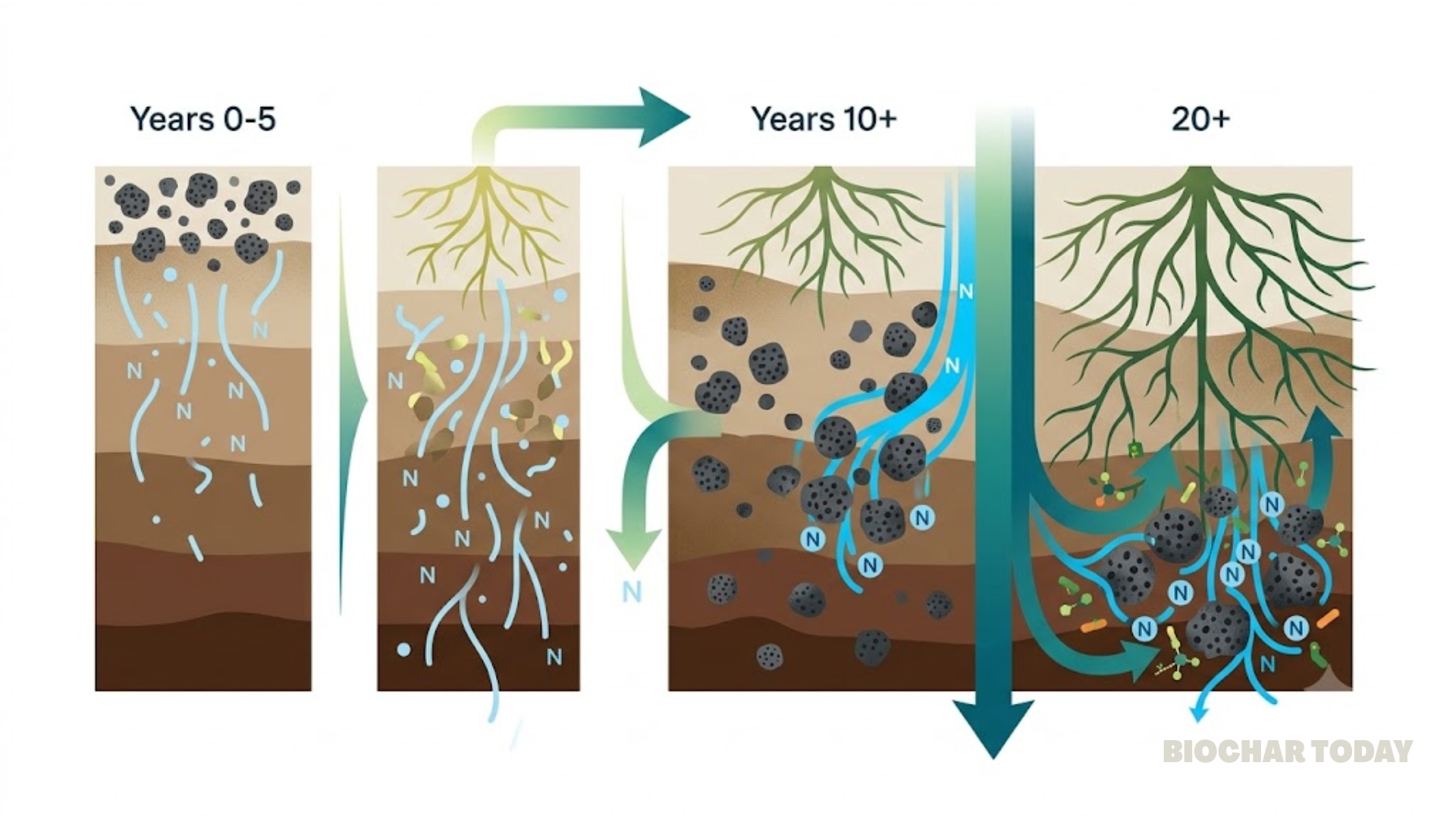
Beyond yield, the study also revealed biochar’s role in nutrient dynamics. Biochar application significantly influenced the nitrogen content in rice stems, leaves, and panicles. It enhanced nitrogen retention in the soil by improving its cation exchange capacity, thereby ensuring a steady supply of nitrogen throughout the rice growth stages. This was particularly evident in the tillering and heading stages, where biochar increased nitrogen content in leaves, boosting photosynthetic capacity. As the plant matured, nitrogen was efficiently remobilized from vegetative parts to the panicles, promoting better grain filling.
Similar positive effects were observed for phosphorus and potassium. Biochar consistently increased the phosphorus content in rice tissues, particularly in the presence of moderate nitrogen levels. This is attributed to biochar’s ability to increase soil pHpH is a measure of how acidic or alkaline a substance is. A pH of 7 is neutral, while lower pH values indicate acidity and higher values indicate alkalinity. Biochars are normally alkaline and can influence soil pH, often increasing it, which can be beneficial More and reduce phosphorus fixation, making this crucial nutrient more accessible to the rice roots. For potassium, biochar enhanced its uptake and distribution within the plant, especially in leaves and panicles. This improved nutrient partitioning is vital for overall plant health and grain development.
In essence, the research underscores that biochar acts as a critical soil amendmentA soil amendment is any material added to the soil to enhance its physical or chemical properties, improving its suitability for plant growth. Biochar is considered a soil amendment as it can improve soil structure, water retention, nutrient availability, and microbial activity. More that improves nutrient availability and uptake efficiency. By creating a more balanced nutrient environment, biochar allows for reduced nitrogen input without compromising yield, thus mitigating environmental issues like nitrate leachingLeaching is the process where nutrients are dissolved and carried away from the soil by water. This can lead to nutrient depletion and environmental pollution. Biochar can help reduce leaching by improving nutrient retention in the soil. More and nitrous oxide emissions. This study paves the way for agricultural practices that are both economically viable and environmentally responsible. Future research will delve into the long-term effects of biochar on soil health and its complex interactions with other nutrients to further optimize sustainable agricultural strategies.
Source: Ding, J. N. (2025). Effects of biochar application and nitrogen fertilizer reduction on nutrient uptake and yield of rice in cold regions. Applied Ecology and Environmental Research, 23(3), 4859-4876. Source




Leave a Reply