

In a recent study published in BiocharBiochar is a carbon-rich material created from biomass decomposition in low-oxygen conditions. It has important applications in environmental remediation, soil improvement, agriculture, carbon sequestration, energy storage, and sustainable materials, promoting efficiency and reducing waste in various contexts while addressing climate change challenges. More, Liu et al., explored how the aging of biochar affects its ability to retain weakly hydrophobic antibiotics in purple soil. Biochar, a carbon-rich substance produced from the pyrolysisPyrolysis is a thermochemical process that converts waste biomass into bio-char, bio-oil, and pyro-gas. It offers significant advantages in waste valorization, turning low-value materials into economically valuable resources. Its versatility allows for tailored products based on operational conditions, presenting itself as a cost-effective and efficient More of biomassBiomass is a complex biological organic or non-organic solid product derived from living or recently living organism and available naturally. Various types of wastes such as animal manure, waste paper, sludge and many industrial wastes are also treated as biomass because like natural biomass these More, has been recognized for its potential to improve soil fertility and remediate contaminated soil. However, biochar’s properties change over time in the field, and these changes can influence its effectiveness.
The researchers compared fresh biochar (FBC) with biochar aged for one year (ABC1) and five years (ABC5) to understand these changes. They conducted batch adsorption and soil column experiments, and used Hydrus 1D modeling to analyze the biochar’s physicochemical properties and its impact on soil porosityPorosity of biochar is a key factor in its effectiveness as a soil amendment and its ability to retain water and nutrients. Biochar’s porosity is influenced by feedstock type and pyrolysis temperature, and it plays a crucial role in microbial activity and overall soil health. Biochar More, dispersion, and antibiotic adsorption. The study focused on two commonly used antibiotics: sulfadiazine (SD) and florfenicol (FF).
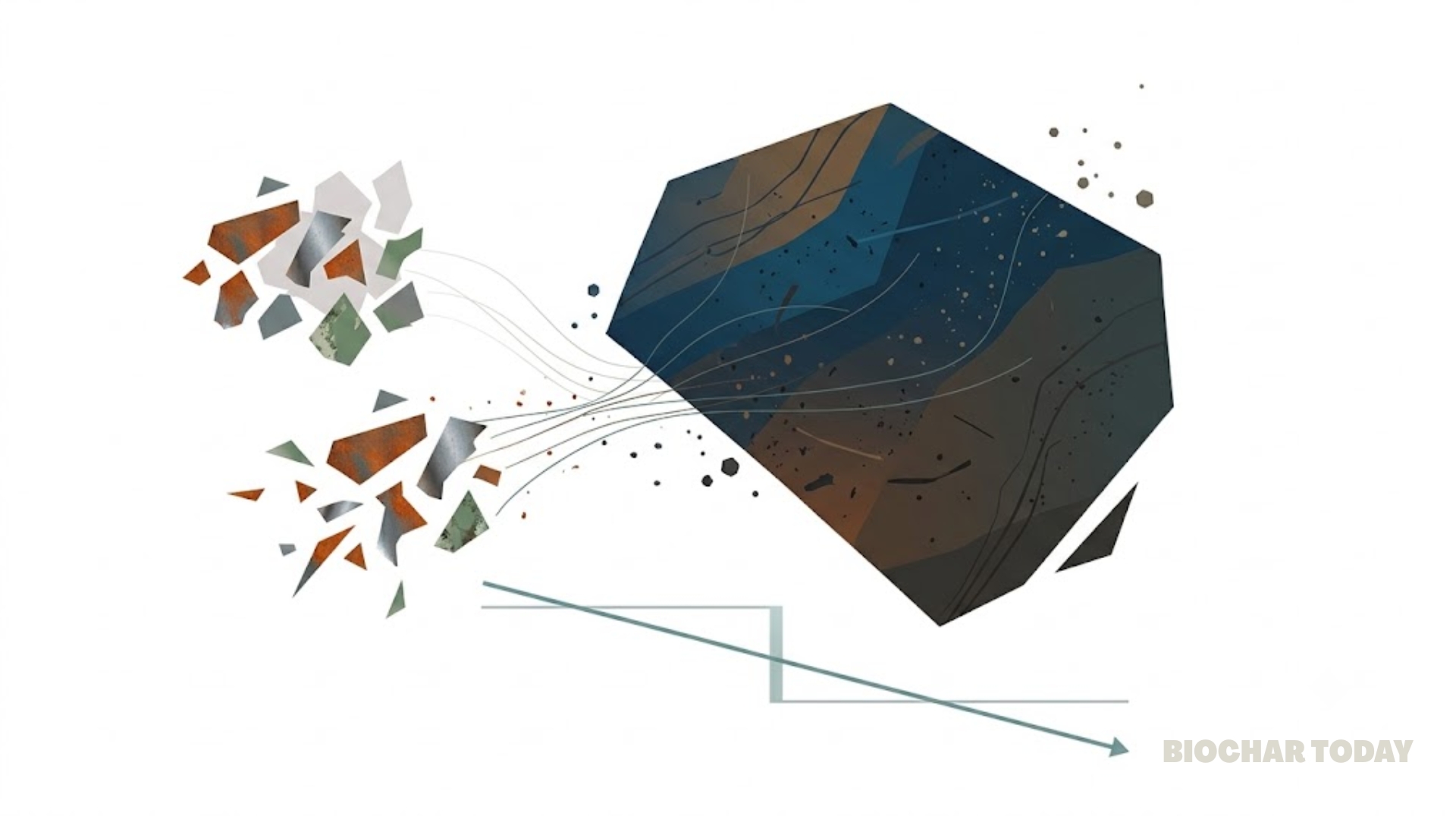
The study revealed significant alterations in biochar characteristics due to aging. Over time, the carbon content in biochar decreased by 10.40%, while oxygen content increased by 40.52%. One-year aged biochar (ABC1) showed the most significant improvement in specific surface area (SSA), with a 99.28% increase, and an increase in oxygen-containing functional groups. This enhancement led to the highest antibiotic retention rates: a 16.57% increase for SD and a 24.78% increase for FF.
Five-year aged biochar (ABC5) showed a decrease in SSA and adsorption capacity compared to ABC1. However, ABC5 still demonstrated stable remediation effects. This was attributed to enhanced biochar-soil interactions, which increased soil dispersivity and the hydrodynamic dispersion coefficient. The study also used the two-site chemical nonequilibrium model (TSM), which showed that the fraction of equilibrium adsorption sites increased from 0.1164 to 0.3514 after aging. This increase indicates that aging improves the soil’s ability to retain antibiotics.
The findings suggest that the aging of biochar influences soil water transport and the interactions between soil and biochar particles. Initially, antibiotic transport is dominated by adsorption, but as biochar ages, dispersion becomes a more significant factor.
In conclusion, the study highlights that one-year aging enhances biochar’s remediation capacity, while five-year aging stabilizes its environmental effects through changes in soil structure. These insights are crucial for optimizing the use of biochar in environmental management and soil remediation.
SOURCE: Liu, X., He, Y., Li, J., Li, J., Zhang, J., & Tang, X. (2025). Does biochar field aging reduce the kinetic retention for weakly hydrophobic antibiotics in purple soil? Biochar, 7(1), 1-15.


Leave a Reply