
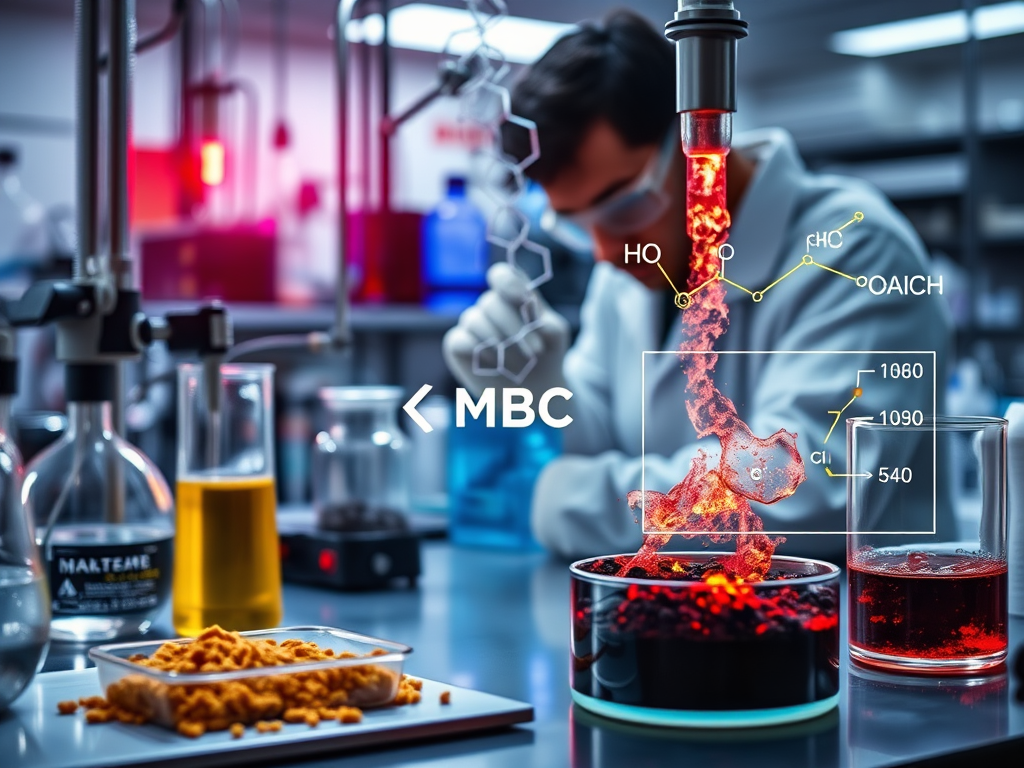
In a recent study published in The Canadian Journal of Chemical Engineering, researchers Soumik Chakma, Shrikanta Sutradhar, Sudip K. Rakshit, Pedram Fatehi, and Kang Kang investigated the most effective method for preparing magnetic biocharBiochar is a carbon-rich material created from biomass decomposition in low-oxygen conditions. It has important applications in environmental remediation, soil improvement, agriculture, carbon sequestration, energy storage, and sustainable materials, promoting efficiency and reducing waste in various contexts while addressing climate change challenges. More (MBC) to remove Remazol Brilliant Blue R (RBBR) dye from water. Their research, titled “Study on iron anchoring methods for magnetic biochar: Characterization, functional mechanism, and RBBR dye removal,” compared three different iron anchoring procedures: impregnation pyrolysisPyrolysis is a thermochemical process that converts waste biomass into bio-char, bio-oil, and pyro-gas. It offers significant advantages in waste valorization, turning low-value materials into economically valuable resources. Its versatility allows for tailored products based on operational conditions, presenting itself as a cost-effective and efficient More, post-treatment with iron salts, and a simplified one-step co-pyrolysis.
The study found that the one-step co-pyrolysis method was the most efficient, particularly when using a 1:1 ratio of iron(II) oxide (FeO) to biomassBiomass is a complex biological organic or non-organic solid product derived from living or recently living organism and available naturally. Various types of wastes such as animal manure, waste paper, sludge and many industrial wastes are also treated as biomass because like natural biomass these More. This method also proved to be energy-efficient, as the MBC produced at 700∘C demonstrated optimal performance, with no significant improvement at higher temperatures. At this optimal temperature, the one-step co-pyrolysis process yielded the highest adsorption efficiency, achieving a 100% removal efficiency of RBBR dye at a dosage of 0.4 grams. This was a marked improvement over the low performance of raw maple wood (28%) and the higher, but less efficient, performance of BC700 (55% at 1 g dosage).
The researchers conducted a series of characterizations to understand the mechanisms behind the MBC’s superior performance. They found that the co-pyrolysis method successfully anchored iron particles into the biochar matrix, creating a material with unique properties. The presence of FeO during co-pyrolysis acts as a catalyst, protecting key functional groups like hydroxyl (-OH) and carboxyl (-COOH) from excessive decomposition. This process results in a material with more active sites for adsorption compared to the other methods tested.
Further analysis using FTIR and XPS confirmed that functional groups such as -OH, C=O, C-O, and Fe-O were present on the MBC surface, which are crucial for dye binding. The high efficiency of the MBC is also attributed to its surface charge and the various adsorption mechanisms at play. At a pHpH is a measure of how acidic or alkaline a substance is. A pH of 7 is neutral, while lower pH values indicate acidity and higher values indicate alkalinity. Biochars are normally alkaline and can influence soil pH, often increasing it, which can be beneficial More below 8.4, the MBC surface is positively charged, creating a strong electrostatic attraction with the negatively charged RBBR dye molecules. The research also identified other key mechanisms, including coordination and surface complexation, which involve the bonding of Fe atoms with oxygen atoms in the dye’s sulfonic groups, and hydrogen bonding between functional groups on the MBC and the dye molecules. Kinetic studies showed that the adsorption process follows a pseudo-second-order model, indicating that chemisorption is the primary mechanism. This suggests that the adsorption involves the sharing or exchange of electrons between the dye molecules and the functional groups on the MBC surface. Furthermore, an isotherm analysis showed that the Langmuir model best describes the adsorption, with a maximum adsorption capacity of 11.33 mg/g. This points to a monolayer adsorption process on a uniform surface with specific, strong binding sites.
The study’s findings are a significant step toward developing sustainable and cost-effective solutions for water pollution. The one-step co-pyrolysis method not only simplifies production but also creates a highly effective adsorbent from readily available biomass and iron oxide. The authors acknowledge that future research should focus on testing this material in complex, real-world wastewater samples, evaluating its reusability, and assessing the potential for commercial-scale application.
Source: Source: Wang, Q., Xu, C., Pan, K., Wu, X., Pan, Y., Duan, C., & Geng, Z. (2025). P-modified biochar alters the microbial community in heavy metal-contaminated soils by regulating nutrient supply balance. Biochar, 7(93).




Leave a Reply