
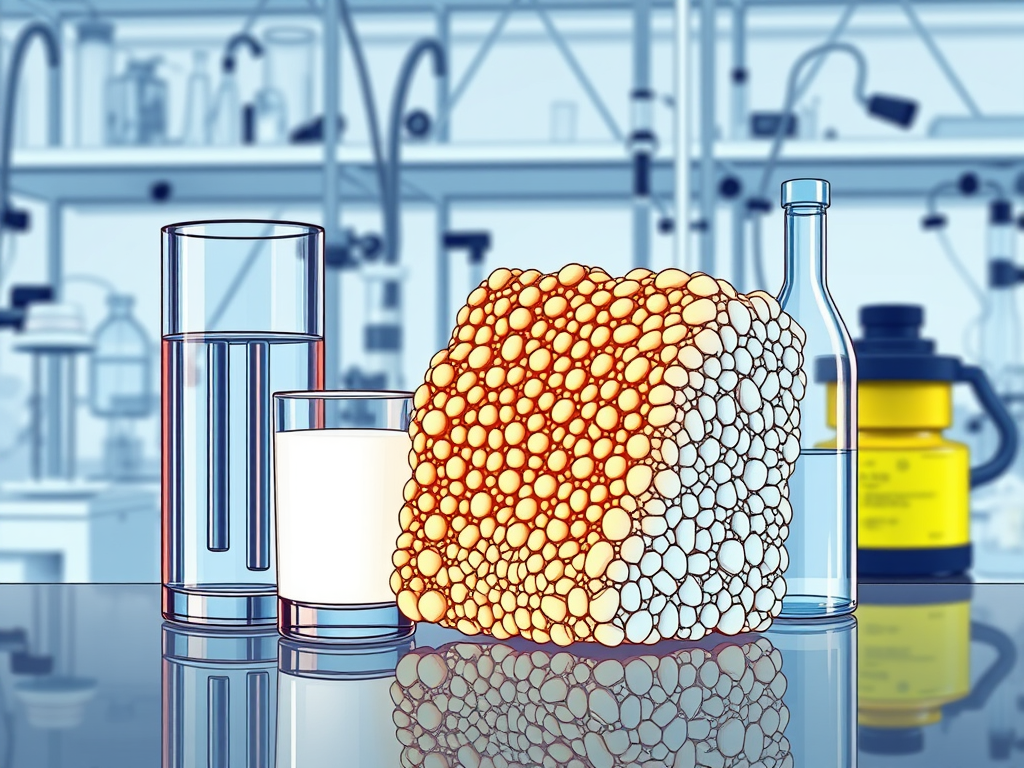
In a pioneering study published in Water Environment Research, Muradiye Şahin and colleagues introduce a novel hybrid composite designed to tackle heavy metal contamination in both water and milk samples. The research addresses the critical need for sustainable and effective methods to remove pollutants like lead (Pb(II)), cadmium (Cd(II)), copper (Cu(II)), and manganese (Mn(II)), which pose significant environmental and public health risks.
The innovative adsorbent, named CmBC-Fe3O4@ZnMOF, is a hybrid material derived from cow manure biocharBiochar is a carbon-rich material created from biomass decomposition in low-oxygen conditions. It has important applications in environmental remediation, soil improvement, agriculture, carbon sequestration, energy storage, and sustainable materials, promoting efficiency and reducing waste in various contexts while addressing climate change challenges. More (CmBC), reinforced with magnetic iron oxide (Fe3O4) nanoparticles, and further modified with a zinc(II)-based coordination polymer (ZnMOF). This unique combination leverages the benefits of biochar’s porous structure and functional groups, the magnetic separability of Fe3O4, and the strong coordination capabilities of ZnMOF. The synthesis involved a two-stage in situ method for CmBC-Fe3O4, followed by solvothermal modification with ZnMOF.
The performance of CmBC-Fe3O4@ZnMOF was rigorously tested for its ability to remove heavy metals from synthetic water and milk samples. The results are compelling: the hybrid material achieved removal efficiencies of 81.39% for Pb(II), 69.52% for Cd(II), 58.47% for Cu(II), and 32.53% for Mn(II) in synthetic water. While slightly lower, the removal efficiencies in milk samples were still substantial: 64.63% for Pb(II), 43.02% for Cd(II), 30.62% for Cu(II), and 19.27% for Mn(II). This demonstrates the adsorbent’s effectiveness even in complex matrices like milk, which contains fats and proteins that can interfere with adsorption.
The study also investigated the adsorption mechanism, revealing a multifaceted interaction. Despite having a lower surface area compared to its individual components, the hybrid material exhibited superior adsorption performance, indicating that interactions with surface functional groups played a more crucial role than pore filling. The adsorption process largely fits the Ho-McKay second-order rate equation and the Freundlich isotherm model, suggesting a chemisorption process on heterogeneous surfaces. The hybrid adsorbent showed particular selectivity for Pb(II) and Cd(II) ions, even in competitive environments with other metals, attributed to their larger ionic radii and lower hydration energies, which facilitate easier coordination with the adsorbent’s active sites.
Beyond its impressive removal capabilities, the CmBC-Fe3O4@ZnMOF hybrid material also demonstrated excellent reusability, maintaining its efficiency over three adsorption-desorption cycles. This reusability, coupled with its low-cost production from agricultural waste like cow manure, positions it as a promising and sustainable solution for heavy metal remediation, contributing to both environmental safety and circular bioeconomy principles. The researchers suggest future work could explore its applicability in even more complex food and environmental media, potentially enhancing its design with different ZnMOF types or magnetic recovery strategies.
Source: Şahin, M., Arslan, Y., Atasoy, M., & Sillanpää, M. (2025). Adsorption Performance of Zn(II)-Based Coordination Polymer (ZnMOF) Reinforced Magnetic Activated Biochar (CmBC-Fe3O4@ZnMOF) Hybrid Composites. Water Environment Research, 97(6), e70113.


![Eucalyptus Wood Waste-Derived Biochar Achieves a Ninety-Eight Percent Removal Efficiency for Benzo[ghi]perylene in Vehicle-Wash Wastewater](https://biochartoday.com/wp-content/uploads/2026/10/SCIENCE-BLOGS-2026-2026-10-19T160523.703.jpg)

Leave a Reply