
Key Takeaways
- Agricultural waste from cotton hulls can be successfully recycled into an eco-friendly and highly efficient catalyst for purifying polluted water. PDF
- The new biocharBiochar is a carbon-rich material created from biomass decomposition in low-oxygen conditions. It has important applications in environmental remediation, soil improvement, agriculture, carbon sequestration, energy storage, and sustainable materials, promoting efficiency and reducing waste in various contexts while addressing climate change challenges. More catalyst increases the breakdown speed of tough water pollutants by more than 100 times when paired with standard ozone treatments. PDF
- Special nitrogen and oxygen spots on the biochar surface work together to transform regular ozone into much stronger cleaning molecules. PDF
- This water treatment method functions effectively across different types of natural water and varied acidity levels while keeping a stable structure. PDF
- The chemical breakdown process successfully neutralizes the target pollutants and significantly lowers the overall biological toxicity of the treated water. PDF
A recent study published in the journal Biochar by authors Chaozhong Wang, Yu Gao, Zhuang Guo, Xinyue Xie, Jian Wei, Zhiwei Song, and Yonghui Song highlights a sustainable resource utilization method that converts agricultural waste cotton hulls into a high-performance catalyst for water purification. The research focuses on removing N,N-diethyl-meta-toluamide (DEET), a persistent insect repellent that widely contaminates aquatic ecosystems due to its resistance to conventional wastewater treatment. While standard biochar carriers frequently suffer from limited surface areas and insufficient active sites, the integration of nitrogen atoms directly into the carbon framework via a two-step pyrolysisPyrolysis is a thermochemical process that converts waste biomass into bio-char, bio-oil, and pyro-gas. It offers significant advantages in waste valorization, turning low-value materials into economically valuable resources. Its versatility allows for tailored products based on operational conditions, presenting itself as a cost-effective and efficient More process fundamentally restructures the material. The resulting non-metallic, nitrogen-doped biochar catalyst provides a highly efficient and structurally stable advanced oxidation platform that safely degrades trace micropollutants without the ecological risks or secondary pollution associated with typical metal-loaded catalysts.
The experimental results demonstrate that the newly developed nitrogen-doped catalyst reveals an outstanding ability to accelerate chemical degradation kinetics. When evaluating the ozone-catalyzed oxidation of DEET, the apparent second-order reaction rate constant reached 2358 M−1 s⁻¹, marking a 106-fold increase compared to using ozone alone and a 25-fold increase compared to an undoped ozone-biochar system. The catalyst successfully achieved a total DEET removal efficiency of 94% within 20 minutes of reaction time, while simple physical adsorption accounted for less than 5% of pollutant removal. This extraordinary kinetic enhancement proves that the structural defects and altered electron distribution caused by proper nitrogen doping allow the catalyst to maximize ozone utilization, outperforming common metal oxides and similar carbonaceous materials in chemical output and destruction speed.
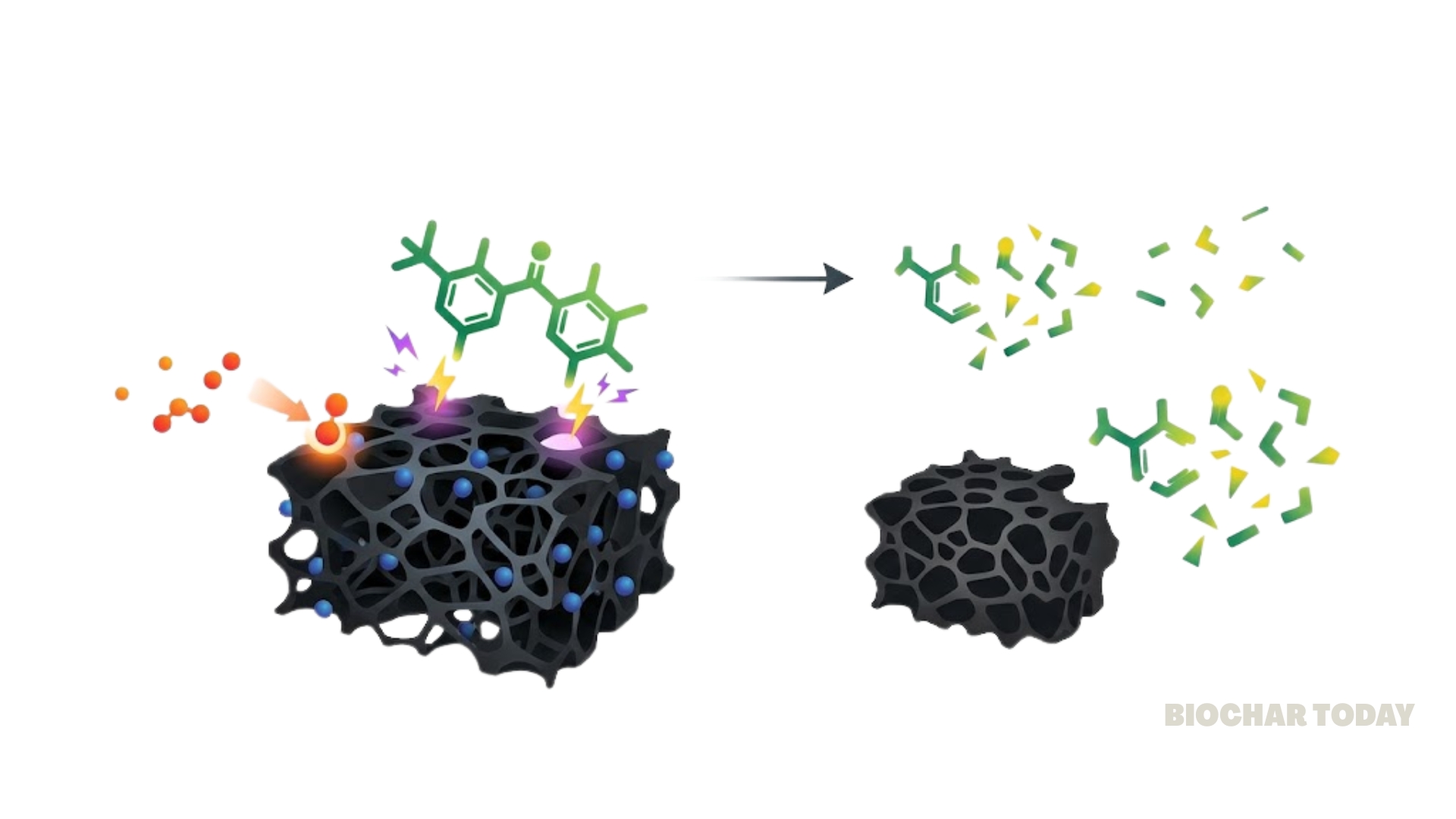
This major performance increase stems directly from the specific combination and distribution of active chemical structures across the material’s optimized internal pores. Advanced surface characterizations and density functional theory calculations show that pyridinic nitrogen and surface carbonyl groups serve as the primary catalytic active sites. Positioned along exposed edge defect domains, these two functionalities operate as a coupled donor-polarization unit that strongly chemisorbs ozone molecules. The pyridinic nitrogen acts as a powerful electron donor, while the adjacent carbonyl groups polarize the local electronic environment to weaken and break the internal bonds of the ozone. This collaborative electron transfer converts the ozone into highly reactive peroxy intermediates, which then rapidly transform into abundant superoxide radicals and hydroxyl radicals to drive non-selective pollutant destruction.
Beyond its targeted performance against DEET, the nitrogen-doped catalyst exhibits exceptional broad-spectrum efficiency and adaptability under real-world operational conditions. Testing against a variety of structurally diverse organic contaminants, including the herbicide atrazine and common anti-inflammatory pharmaceuticals, revealed substantial removal improvements across the board. Furthermore, the catalyst maintains its high degradation efficiency across a wide pHpH is a measure of how acidic or alkaline a substance is. A pH of 7 is neutral, while lower pH values indicate acidity and higher values indicate alkalinity. Biochars are normally alkaline and can influence soil pH, often increasing it, which can be beneficial More range spanning from 4.5 to 9.0, demonstrating excellent resistance to interference from natural organic matter and common background inorganic anions like sulfates and chlorides. When deployed in complex real-world water matrices such as municipal wastewater treatment plant effluent and river water, the system successfully removed background dissolved organic matter, significantly decreased total organic carbon and chemical oxygen demand, and enhanced the overall biodegradability of the treated water.
The catalyst also offers exceptional mechanical durability and environmental safety for long-term field operations. Throughout five consecutive reaction cycles in complex secondary sewage effluent, the material retained approximately 73% of its initial catalytic activity without undergoing any crystalline structural changes or phase transformations. Crucially, mass spectrometry and toxicological analysis confirmed that the multi-pathway degradation process breaks DEET down into harmless byproducts via sequential steps of hydroxylation, dealkylation, and decarboxylation. These transitional intermediate products carry minimal bioaccumulation potential and pose virtually no mutagenic or developmental risks. This environmental safety profile was verified by real luminescent bacteria assays, which showed a massive reduction in residual biological toxicity following treatment, establishing the nitrogen-doped biochar as a highly effective, safe, and durable tool for industrial wastewater decontamination.
Source: Wang, C., Gao, Y., Guo, Z., Xie, X., Wei, J., Song, Z., & Song, Y. (2026). Synergistic catalytic ozonation by pyridinic N and C=O groups on cotton hulls biochar for efficient DEET degradation. Biochar, 8(84).



Leave a Reply