
Key Takeaways
- Coarsening the size of biocharBiochar is a carbon-rich material created from biomass decomposition in low-oxygen conditions. It has important applications in environmental remediation, soil improvement, agriculture, carbon sequestration, energy storage, and sustainable materials, promoting efficiency and reducing waste in various contexts while addressing climate change challenges. More particles slows down their rapid burning rate to better control internal heat distribution.
- Combining larger particles with targeted oxygen injection solves the problem of incomplete fuel combustion in the upper bed layer.
- Injecting concentrated oxygen at the material inlet accelerates solid fuel combustion rates by more than ninety-three percent.
- Integrating advanced gas fuel injection with alternative biochar increases overall product yields to nearly sixty-two percent.
- Using clean biomassBiomass is a complex biological organic or non-organic solid product derived from living or recently living organism and available naturally. Various types of wastes such as animal manure, waste paper, sludge and many industrial wastes are also treated as biomass because like natural biomass these More alternatives in steel manufacturing significantly lowers total greenhouse gas and nitrogen oxide emissions.
The global iron and steel industry represents one of the most energy and carbon-intensive sectors, with traditional blast furnace preparation methods relying heavily on fossil fuels such as coal and coke breeze. In an effort to advance green production and reduce industrial carbon emissions, carbon-neutral alternatives like biomass-based fuels have attracted significant interest from metallurgists. However, as detailed by researchers Zecheng Wang, Jin Cai, Xiangwei Kong, Mingzhu Yu, Liang Zhao, Chunwen Yan, Ailing Liu, and Hao Wu in the journal ACS Omega, introducing high proportions of low-grade biochar into the sintering bed typically triggers a severe deterioration in structural quality. Because biomass fuels possess an exceptionally fast combustion reaction rate, they cause insufficient heat retention and uneven flame fronts. To counteract these obstacles and lower usage costs, the authors simulated a multi-process model that intentionally utilizes larger biochar particle diameters alongside targeted oxygen adjustments.
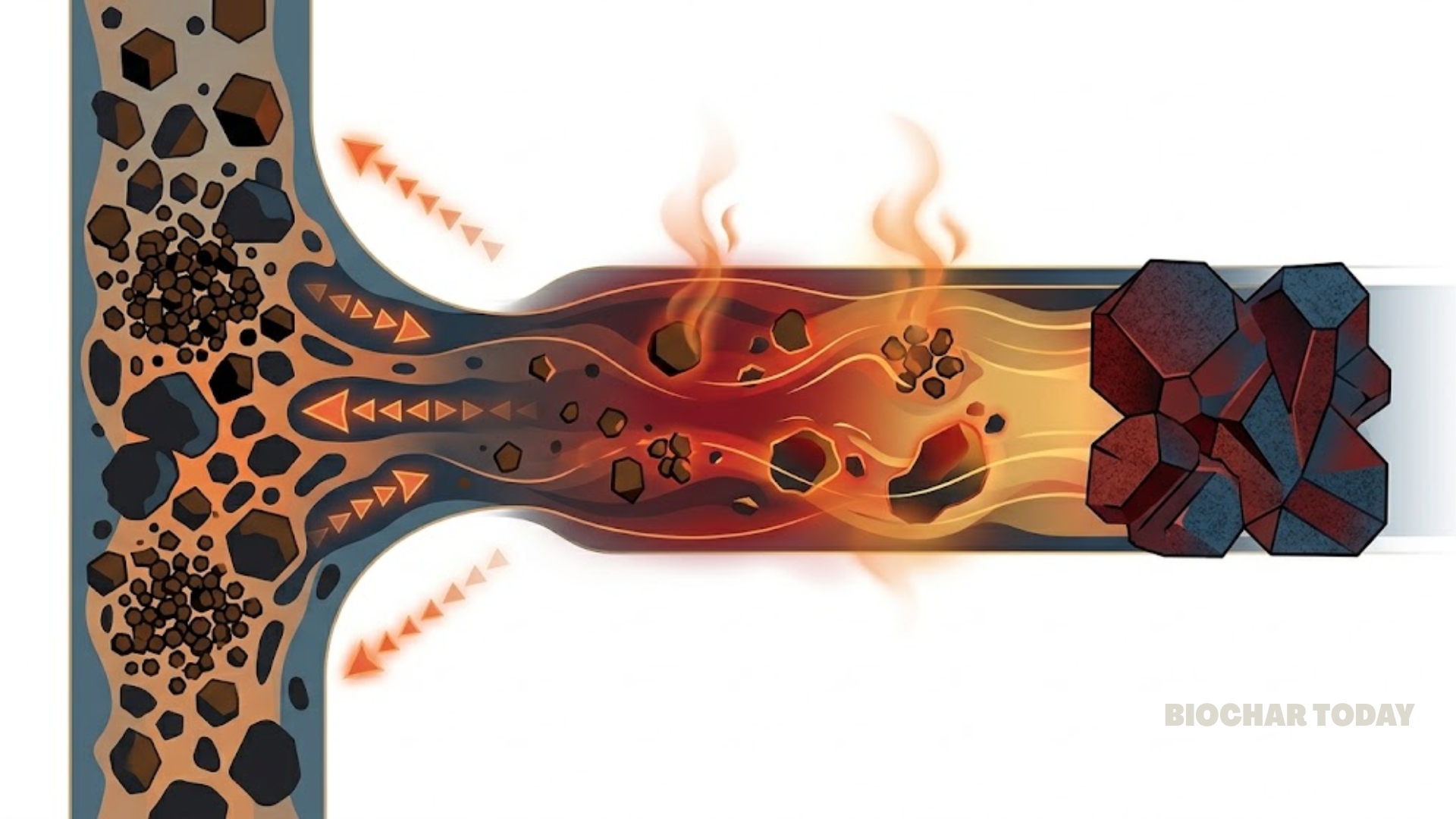
The central focus of the investigation reveals that adjusting the physical dimensions of the biochar serves as a powerful mechanism for regulating fuel reactivity and slowing down combustion speeds. When standard small-diameter biochar is utilized at a high sixty percent substitution rate, the flame front moves too quickly, destroying vital thermal indicator curves and leaving the final product yield at zero percent. By increasing the biochar particle size into a range between 1.6 millimeters and 4.8 millimeters, the researchers successfully stabilized the downward movement of the flame front and enhanced the system’s structural holding temperatures. This coarsening strategy allowed the total production yield to rise significantly to forty-five percent. However, the simulation also noted that relying exclusively on oversized particles introduces a secondary challenge, as an unburned zone of incomplete fuel combustion begins expanding through the upper layers of the sintering bed.
To eliminate this cold-zone bottleneck and maximize solid fuel utilization, the research team integrated selective oxygen enrichment directly at the material inlet area of the bed. This targeted gas injection selectively penetrates the precise zones where unburned coarse biochar accumulates on the surface layer. By combining this regional oxygen delivery with concentration segregation, the intensity of contact between the gas phase and the solid carbon particles increased dramatically. This deliberate process modification accelerated the combustion of surface fuels and released a substantial wave of latent thermal energy, effectively reinforcing the inner temperature profile of the material matrix without requiring expensive separate coating equipment.
The quantitative findings of the study demonstrate that the introduction of targeted oxygen adjustments yields profound improvements in the overall chemical reaction rates. Under the optimized selective oxygen enrichment configuration, the maximum combustion rate of conventional coke increased by 93.46 percent, while the corresponding combustion rate of the biochar spiked by 95.80 percent compared to baseline cases without oxygen addition. This rapid surge in energy release effectively resolved the surface-level temperature deficit and narrowed the average width of the combustion front. Furthermore, when the team executed a preliminary optimization test combining coarse particle sizing and selective oxygen enrichment with a selective hydrogen-rich methane injection, the aggregate product yield climbed to 61.96 percent, bringing the biomass-substituted configuration remarkably close to the strict operational indices achieved by traditional full-coke manufacturing methods.
Source: Wang, Z., Cai, J., Kong, X., Mingzhu, Y., Zhao, L., Yan, C., Liu, A., & Wu, H. (2026). Numerical simulation of biochar substitution for sintering process combining coarse particle size and selective oxygen enrichment. ACS Omega.





Leave a Reply