
Key Takeaways
- BiocharBiochar is a carbon-rich material created from biomass decomposition in low-oxygen conditions. It has important applications in environmental remediation, soil improvement, agriculture, carbon sequestration, energy storage, and sustainable materials, promoting efficiency and reducing waste in various contexts while addressing climate change challenges. More can help reduce greenhouse gas emissions depending on the type of soil it is added to.
- In certain acidic soils, biochar suppresses carbon dioxide emissions by roughly seven to thirteen percent.
- This reduction happens because biochar creates special molecules that temporarily deactivate the soil enzymes responsible for breaking down organic matter.
- In contrast, adding biochar to neutral or alkaline soils can actually increase carbon emissions because the enzymes are less vulnerable.
- Scientists suggest tailoring how we use biochar based on specific regional soil types to maximize environmental benefits.
In a study published in the journal Biochar, researchers Ping Wu and Yingdong Fu investigated how the application of biochar impacts the way soil organic carbon breaks down across different environments. Biochar is a charcoal-like substance made from heated organic biomassBiomass is a complex biological organic or non-organic solid product derived from living or recently living organism and available naturally. Various types of wastes such as animal manure, waste paper, sludge and many industrial wastes are also treated as biomass because like natural biomass these More that has gained popularity worldwide as a sustainable strategy for capturing carbon and improving agricultural soil fertility. However, its chemical interactions with different soil types are incredibly complex and can sometimes trigger unexpected reactions. The authors focused specifically on a hidden chemical feature of biochar known as persistent free radicals. These tiny reactive particles generate oxidative compounds called hydroxyl radicals when they interact with moisture and air in the ground. Scientists have known that these radicals can disrupt the extracellular enzymes that soil microbes produce to digest organic matter, but the real-world impact of this process on overall soil respiration has remained a subject of intense debate.
To unravel this mystery, the researchers conducted experiments by adding biochar to three distinct soil varieties collected from agricultural regions in China, consisting of a neutral fluvo-aquic soil, an acidic black soil, and an acidic red soil. They compared standard water-washed biochar against a modified version where the persistent free radicals were chemically quenched using a specialized triethanolamine solution. Over a week-long incubation period that simulated natural moisture fluctuations, the team monitored real-time greenhouse gas releases, enzyme function, and the shifting pools of soil carbon. Their measurements revealed that the chemical radicals within raw biochar acted as an unexpected protective shield for organic carbon in both the black and red soils. In these acidic settings, the presence of untreated biochar successfully suppressed cumulative carbon dioxide emissions by 6.8% to 12.9% compared to soil that received no amendment.
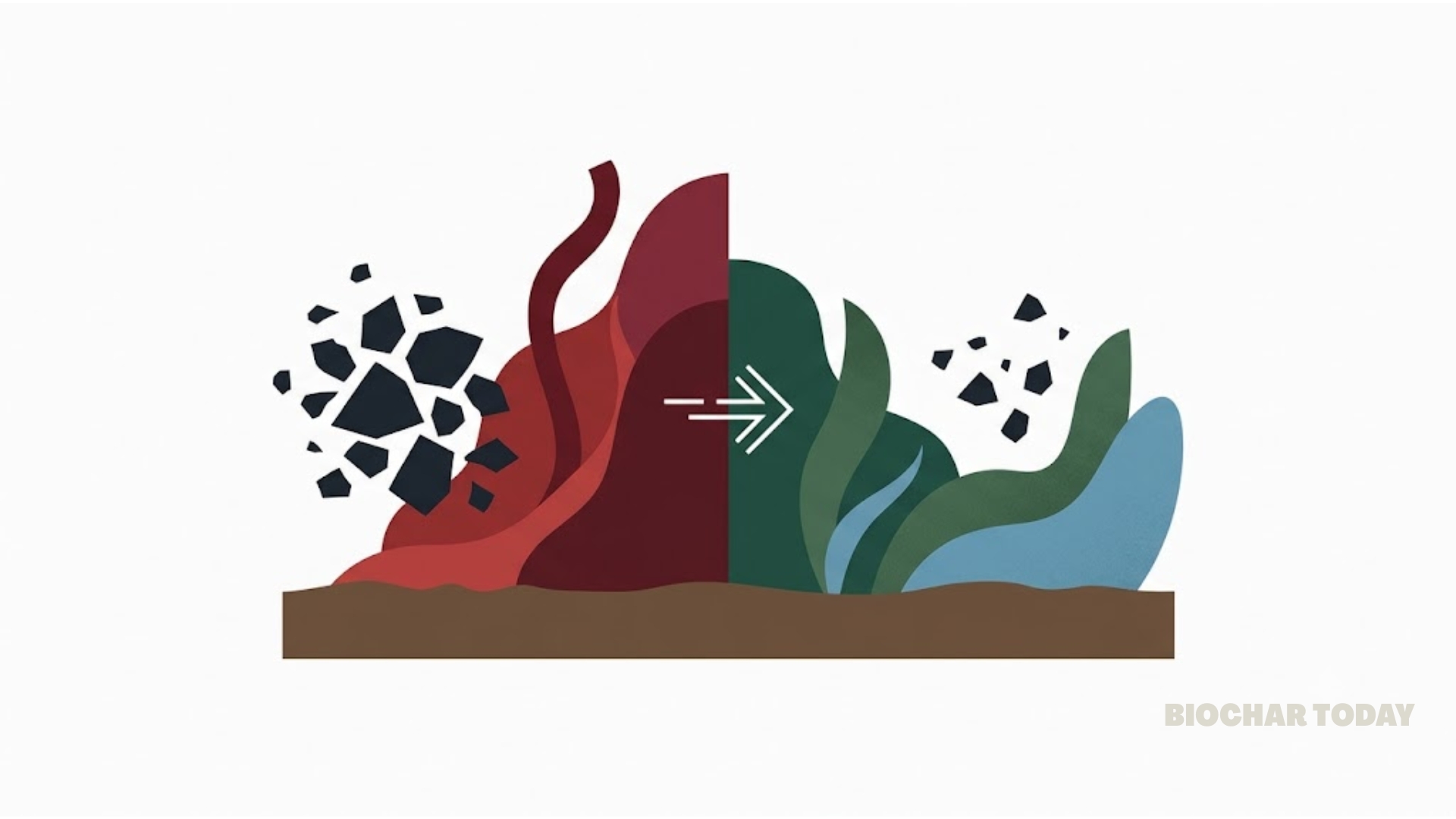
The underlying mechanism driving this carbon suppression is tied directly to soil mineralogy and acidity. In the acidic black and red soils, high concentrations of iron and aluminum oxides naturally cause microbial enzymes to stick tightly to mineral surfaces. Once bound, these enzymes become highly susceptible to targeted structural damage caused by the hydroxyl radicals emanating from the biochar. This targeted attack rapidly deactivates key enzymes responsible for breaking down complex organic polymers, effectively locking the native carbon away from microbial decomposition. When the researchers tested the modified biochar with its radicals deactivated, this enzyme suppression disappeared, causing the carbon-degrading enzymes to bounce back and drive up carbon dioxide emissions beyond normal levels. This contrast confirmed that the radical particles are the primary agents suppressing emissions in acidic environments.
However, the experiment highlighted a fascinating paradox when analyzing the neutral fluvo-aquic soil. In this neutral environment, adding untreated biochar actually increased carbon dioxide emissions, and using the radical-quenched biochar caused an even sharper spike in greenhouse gases. The authors explain that because neutral, calcareous soils lack the high levels of iron and aluminum oxides found in acidic soils, extracellular enzymes do not bind to mineral surfaces and remain largely protected from radical damage. Instead, the natural alkaline properties of this soil make the labile organic compounds within the biochar much more accessible to native microorganisms. This easily accessible carbon source triggers a biological priming effect, stimulating microbial activity and accelerating overall respiration despite the presence of any ambient radicals.
Ultimately, this research clarifies that biochar cannot be treated as a one-size-fits-all solution for climate mitigation. Its capacity to lock carbon in the ground depends heavily on the chemical personality of the receiving soil. While it acts as an effective stabilizer in iron-rich acidic landscapes, it can stimulate short-term carbon losses in neutral or alkaline fields. Moving forward, the scientific team suggests that engineering biochar production methods to better manage free radical formation could maximize global carbon storage potential.
Source: Wu, P., Fu, Y., Wang, H., & Qin, S. (2026). Soil-specific protection of organic carbon by biochar-derived hydroxyl radicals associated with enzyme suppression. Biochar, 8(126), 1-8.




Leave a Reply