
Key Takeaways
- Traditional methods for testing if biocharBiochar is a carbon-rich material created from biomass decomposition in low-oxygen conditions. It has important applications in environmental remediation, soil improvement, agriculture, carbon sequestration, energy storage, and sustainable materials, promoting efficiency and reducing waste in various contexts while addressing climate change challenges. More repels water often give conflicting results, making it difficult for farmers and scientists to know how it will affect soil.
- Researchers have identified a new category called pseudo-hydrophobicity, where biochar appears to repel water at first but quickly begins to absorb it within ninety seconds.
- This new testing approach shows that most biochar added to soil eventually behaves in a way that allows water to soak in, rather than keeping the ground dry.
- Using this improved measuring technique helps predict more accurately how different types of biochar will improve water storage in dry agricultural regions.
- The study confirms that while some biochars seem to make soil water-repellent, their fundamental nature remains compatible with absorbing moisture over time.
The journal Biochar recently published a study by lead author Wei Jing and a team of researchers including Mingjie Su, Kai Yang, Qilin Kang, Yaoming Li, Wei Li, Kun Zhang, and Jiefei Mao. Their work addresses a persistent technical hurdle in the biochar industry regarding how we measure and understand water repellency. For years, professionals have relied on two primary tests: the contact angle, which looks at the shape of a water droplet on a surface, and the water droplet penetration time, which measures how long it takes for a drop to soak in. These two methods frequently contradict one another, leading to a confusing paradox where a material might be labeled as both water-repellent and water-absorbing at the same time. This uncertainty has made it difficult to predict how biochar amendments will actually perform once they are mixed into the soil of a working farm.
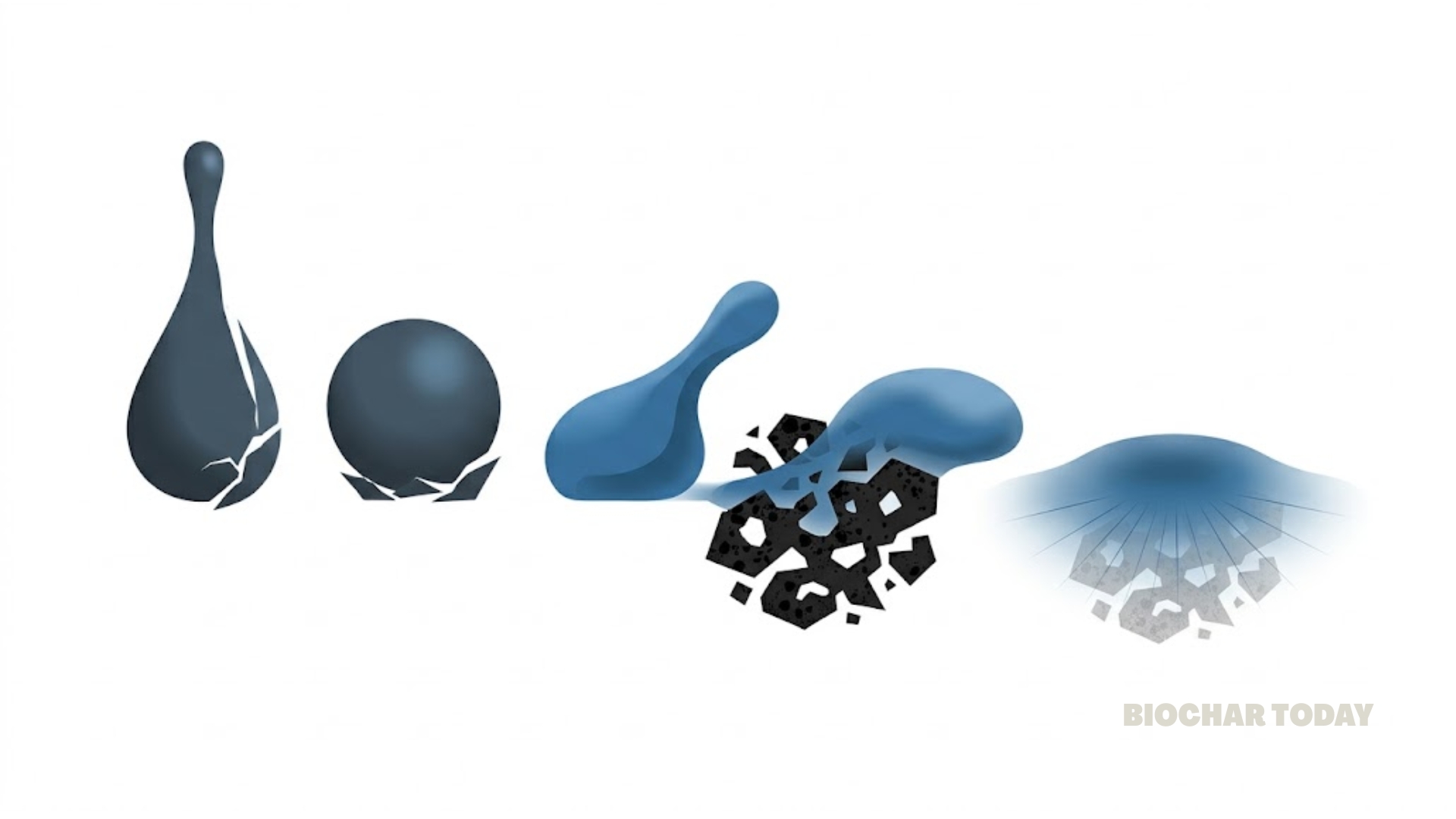
The researchers discovered that the root of this confusion lies in the instantaneous nature of traditional testing. When a water droplet first touches a biochar surface, it may bead up and appear to be repelling moisture. However, the study demonstrated that for many biochar types, this state is temporary. To capture this shift, the team proposed a dynamic contact angle method that tracks the droplet behavior over a ninety-second interval. This window of time is sufficient to see if the water begins to diffuse into the material. By observing these changes, they were able to categorize materials into four distinct groups: super-hydrophobic, strongly hydrophobic, hydrophilic, and a newly defined category called pseudo-hydrophobic. This last category is particularly important because it includes materials that look like they repel water at zero seconds but transition to a water-friendly state well before the ninety-second mark.
When applying this new standard to various biochars produced from agricultural and forestry waste, the study revealed significant insights into how production temperature affects performance. Biochars created at lower temperatures, such as three hundred degrees Celsius, generally showed much stronger and more persistent water repellency than those made at higher temperatures. This is largely because high heat breaks down the specific carbon-based chemical groups that naturally push water away. As the pyrolysisPyrolysis is a thermochemical process that converts waste biomass into bio-char, bio-oil, and pyro-gas. It offers significant advantages in waste valorization, turning low-value materials into economically valuable resources. Its versatility allows for tailored products based on operational conditions, presenting itself as a cost-effective and efficient More temperature increases to five hundred or seven hundred degrees, the biochar tends to become either pseudo-hydrophobic or entirely hydrophilic. This means that while a low-temperature biochar might be useful for creating a barrier or managing specific drainage issues, higher-temperature versions are much more likely to support the immediate water-holding goals of most farmers.
The implications for soil health are substantial, as the team also conducted a ninety-day incubation experiment where they mixed these biochars into soil at different rates. Initially, adding biochar seemed to significantly increase the water repellency of the soil, especially at a five percent addition rate. However, as the soil and biochar aged together over the three-month period, the repellency effects began to fade. The dynamic testing showed that even in cases where the soil appeared to be repelling water at first contact, it actually remained in a pseudo-hydrophobic state. This suggests that the soil retains its fundamental ability to absorb water over the long term, which is a vital finding for those using biochar to combat drought stress in arid regions.
Ultimately, this research provides a more reliable framework for the biochar industry to evaluate its products. By moving away from a single “snapshot” of water behavior and adopting a dynamic ninety-second standard, producers and researchers can offer much clearer guidance to agricultural end-users. The study suggests that the initial contact angle is not an optimal criterion on its own because it ignores the crucial process of water diffusion. Instead, by combining the initial angle with the rate of change over time, the industry can more accurately predict how a specific biochar will interact with environmental moisture. This precision will likely encourage more widespread and confident use of biochar as a tool for ecological restoration and sustainable farming.
Source: Jing, W., Su, M., Yang, K., Kang, Q., Li, Y., Li, W., Zhang, K., & Mao, J. (2026). Dynamic contact angle as a new metric for the water repellency evaluation of biochar-amended soil. Biochar, 8(38).


Leave a Reply