
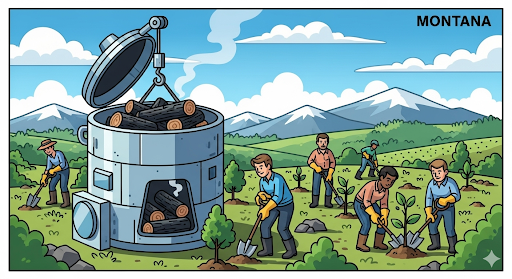
Mast Reforestation has announced the successful completion of its pioneering Mast Wood Preserve MT1 project in south-central Montana. This initiative marks the first to integrate engineered carbon removal through biomassBiomass is a complex biological organic or non-organic solid product derived from living or recently living organism and available naturally. Various types of wastes such as animal manure, waste paper, sludge and many industrial wastes are also treated as biomass because like natural biomass these More burial (BiCRS) with post-wildfire reforestation. Just four months after breaking ground, the site has been filled and capped, with continuous monitoring underway to ensure no greenhouse gas emissions occur. The project leverages Terrestrial Storage of Biomass (TSB), which captures remaining carbon in fire-killed logs that would otherwise be burned, representing a highly efficient carbon dioxide removal (CDR) pathway.
The project is registered with Puro.earth, with an anticipated issuance volume of up to 5,000 tonnes of vintage 2025 carbon removal credits by Q1 2026. The integrity and volume of these credits are verified through wood composition analysis and thorough weight records. So far, monitoring results confirm the chamber is functioning as designed, with no emissions detected. Over 10 million pounds of unmerchantable, fire-killed trees were buried—material that was slated for pile burning—effectively removing this carbon from the atmospheric cycle and placing it within a permanent chamber designed for a minimum of a century of preservation. The stability and robustness of which is still to be seen.
Mast, via its nurseries Silvaseed and Cal Forest Nurseries, is cultivating the first batch of seedlings for spring 2026 planting, grown from wild seeds collected near the MT1 site. According to Grant Canary, CEO of Mast, the MT1 project provides a viable model to fund and accelerate post-fire reforestation, which often faces funding shortfalls and a lack of available mills for burned timber. Mast’s analysis suggests there are over 2.8 million tons of fire-killed trees across Montana’s recently burned landscapes alone, highlighting the significant potential for scaling this model. According to CDR.fyi, the project is on track to be a major delivery of vintage 2025 TSB removal credits. The success of MT1 demonstrates a pathway to support local economies, improve ecological recovery, and generate credits that can be retired within a year, opening the door for broader application beyond Montana.





Leave a Reply