
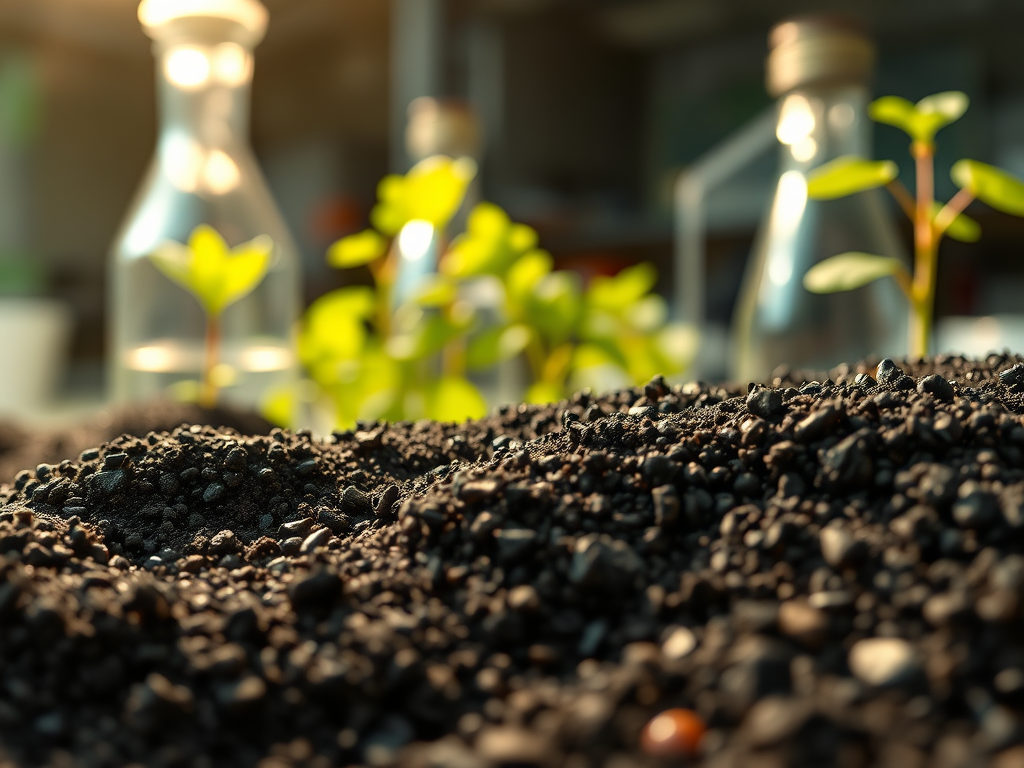
A recent review in the Journal of Water Environment and Nanotechnology by Deshraj Singh Thakur and Santosh Narayan Chadar highlights the transformative potential of nano-biochar in environmental sustainability. This advanced material, derived from agricultural waste, significantly outperforms traditional biocharBiochar is a carbon-rich material created from biomass decomposition in low-oxygen conditions. It has important applications in environmental remediation, soil improvement, agriculture, carbon sequestration, energy storage, and sustainable materials, promoting efficiency and reducing waste in various contexts while addressing climate change challenges. More due to its enhanced characteristics, including a surface area that can reach up to 1200 m2/g. The authors emphasize its crucial role in improving phytoremediationThis is a technique that uses plants to clean up contaminated soil or water. Biochar can enhance phytoremediation by improving soil conditions and promoting plant growth, allowing plants to absorb and break down pollutants more effectively. More and addressing critical environmental and agricultural challenges.
The escalating challenges of environmental contamination from industrialization and agricultural expansion necessitate innovative solutions. Traditional remediation methods are often costly and can introduce secondary pollutants, underscoring the urgent need for sustainable alternatives. Phytoremediation, a green technology that utilizes plants to remove or break down pollutants, offers a promising eco-friendly approach. However, its widespread application is limited by factors such as slow remediation rates and low pollutant bioavailability. This is where nano-biochar emerges as a game-changer.
Nano-biochar, a carbon-rich nanomaterial produced from biomassBiomass is a complex biological organic or non-organic solid product derived from living or recently living organism and available naturally. Various types of wastes such as animal manure, waste paper, sludge and many industrial wastes are also treated as biomass because like natural biomass these More pyrolysisPyrolysis is a thermochemical process that converts waste biomass into bio-char, bio-oil, and pyro-gas. It offers significant advantages in waste valorization, turning low-value materials into economically valuable resources. Its versatility allows for tailored products based on operational conditions, presenting itself as a cost-effective and efficient More, exhibits superior characteristics compared to conventional biochar. Its nanoscale size leads to a significantly larger surface area, increased porosityPorosity of biochar is a key factor in its effectiveness as a soil amendment and its ability to retain water and nutrients. Biochar’s porosity is influenced by feedstock type and pyrolysis temperature, and it plays a crucial role in microbial activity and overall soil health. Biochar More, and a higher density of functional groups, all of which enhance its ability to interact with and immobilize contaminants. This enhanced interaction makes pollutants more accessible to plant roots, thereby boosting the efficiency of phytoremediation processes. Beyond contaminant removal, nano-biochar also improves soil health by optimizing nutrient dynamics, enhancing water retention, and fostering beneficial microbial activity.
The synthesis of nano-biochar primarily involves methods like pyrolysis, hydrothermal carbonization (HTC), chemical activation, ultrasonic treatment, sol-gel method, and ball milling. Pyrolysis, a thermochemical process, converts organic materials into biochar, syngasSyngas, or synthesis gas, is a fuel gas mixture consisting primarily of hydrogen and carbon monoxide. It is produced during gasification and can be used as a fuel source or as a feedstock for producing other chemicals and fuels. More, and bio-oil at high temperatures. The properties of the resulting biochar, such as its surface area and pore structure, can be precisely customized by adjusting pyrolysis parameters like temperature and heating rate. For instance, increasing pyrolysis temperature leads to accelerated thermal decomposition and enhanced pore formation, with biochar produced at 700°C exhibiting a surface area of 249.13 m2/g and a pore volume of 0.031 cm3/g, significantly higher than biochar produced at 300°C (2.04 m2/g surface area, 0.0057 cm3/g pore volume). This dramatic increase in surface area, often ranging between 200 and 1200 m2/g, is crucial for its adsorption and catalytic potential.
Hydrothermal carbonization (HTC) offers another sustainable route, transforming biomass into carbon-rich hydrochar under moderate temperatures and elevated pressures in an aqueous environment. Chemical activation, using agents like potassium hydroxide (KOH) or phosphoric acid (H3PO4), further enhances biochar’s porosity and surface area by disrupting the biomass structure. Ultrasonic treatment and ball milling are mechanical methods that reduce biochar into nano-sized particles, increasing their reactivity and surface area for improved functionality.
Characterization techniques such as Scanning Electron Microscopy (SEM), Transmission Electron Microscopy (TEM), BET surface area analysis, X-ray Photoelectron Spectroscopy (XPS), and Fourier Transform Infrared Spectroscopy (FTIR) are crucial for understanding nano-biochar’s morphological, elemental, and structural properties. These analyses confirm its porous surface, high carbon content, and the presence of functional groups (e.g., hydroxyl, carboxyl) that are vital for pollutant adsorptionBiochar has a remarkable ability to attract and hold onto pollutants, like heavy metals and organic chemicals. This makes it a valuable tool for cleaning up contaminated soil and water. More and catalytic activity.
The applications of nano-biochar are vast and span multiple sectors, including water treatment (effective adsorption of heavy metals and organic pollutants), soil amendmentA soil amendment is any material added to the soil to enhance its physical or chemical properties, improving its suitability for plant growth. Biochar is considered a soil amendment as it can improve soil structure, water retention, nutrient availability, and microbial activity. More (improved fertility, nutrient retention, and water-holding capacity), carbon sequestration, slow-release fertilizers, and even as an additive in biodegradable plastics and construction materials. Its ability to enhance root formation and plant growth in contaminated soils is particularly significant for phytoremediation. While promising, the authors note that further systematic research is needed to address cost-effectiveness, safety, and scalability concerns for widespread adoption.
Source: Thakur, D. S., & Chadar, S. N. (2025). The Role of Nanobiochar in Enhancing Phytoremediation: A New Frontier in Environmental Sustainability. J. Water Environ. Nanotechnol., 10(2), 200–226.




Leave a Reply