
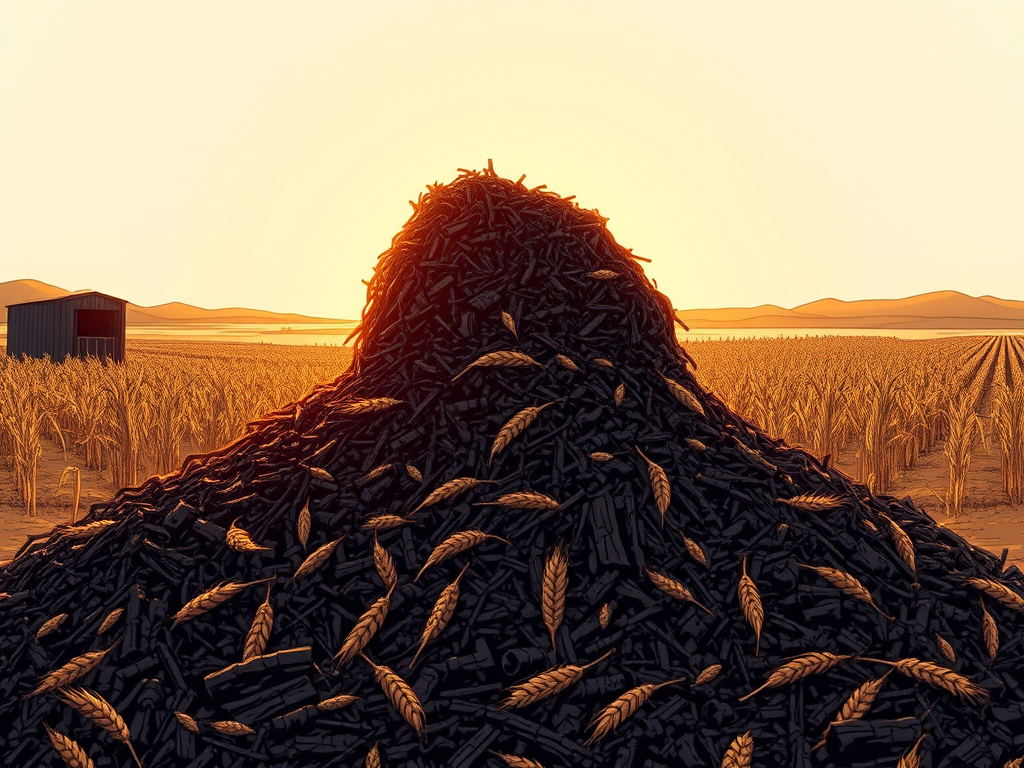
In a significant step towards sustainable waste management and agricultural enhancement, a recent study published in ACS Omega by Naeimeh Vali, Samyar Zabihi, Abas Mohsenzadeh, and Anita Pettersson explores the co-pyrolysis of municipal sewage sludge (MSS) with agricultural residues, specifically wheat straw and bakery waste husks. Their research demonstrates how this innovative approach can produce high-quality biocharBiochar is a carbon-rich material created from biomass decomposition in low-oxygen conditions. It has important applications in environmental remediation, soil improvement, agriculture, carbon sequestration, energy storage, and sustainable materials, promoting efficiency and reducing waste in various contexts while addressing climate change challenges. More, an enriched charcoal-like material, that is not only packed with plant-available nutrients but also has reduced levels of harmful heavy metals. This offers a promising alternative to traditional waste disposal and enhances soil quality.
Municipal sewage sludge, a byproduct of wastewater treatment, is rich in essential nutrients like phosphorus, carbon, and nitrogen, making it a potentially valuable resource for soil improvement and livestock feed. However, its use has been restricted in many countries due to the presence of pollutants, including heavy metals and various organic contaminants. Traditional pyrolysisPyrolysis is a thermochemical process that converts waste biomass into bio-char, bio-oil, and pyro-gas. It offers significant advantages in waste valorization, turning low-value materials into economically valuable resources. Its versatility allows for tailored products based on operational conditions, presenting itself as a cost-effective and efficient More, a thermal conversion method, can decompose most organic pollutants and immobilize heavy metals, but it often leaves phosphorus in forms that are not easily accessible to plants, such as aluminum and iron phosphates. This is where co-pyrolysis steps in as a game-changer, addressing these limitations by blending MSS with other feedstocks.
The study highlights that increasing the proportion of wheat straw and bakery waste husks, along with higher pyrolysis temperatures, leads to a decrease in biochar yield.This reduction is due to the higher volatile matterVolatile matter refers to the organic compounds that are released as gases during the pyrolysis process. These compounds can include methane, hydrogen, and carbon monoxide, which can be captured and used as fuel or further processed into other valuable products. More content in agricultural residues compared to MSS, leading to greater oil and gas production during pyrolysis. Despite the reduced yield, the quality of the biochar significantly improves.
A key finding is the enhanced formation of plant-available phosphates through co-pyrolysis, particularly at higher temperatures. The research, using thermodynamic equilibrium calculations, indicates that adding wheat straw and bakery waste promotes the formation of potassium (K) and magnesium (Mg)-bearing phosphates, instead of less available iron and aluminum-based phosphates. The study found that phosphorus concentration in biochar generally increases with temperature across all feedstockFeedstock refers to the raw organic material used to produce biochar. This can include a wide range of materials, such as wood chips, agricultural residues, and animal manure. More combinations. Notably, biochars derived from digested municipal sewage sludge (BSS) exhibited the highest phosphorus content, with a 90% BSS-10% BKW mixture yielding up to 55 g/kg of phosphorus at 900°C.
Furthermore, co-pyrolysis effectively reduces the concentration of certain heavy metals in the biochar. For example, the volatilization of cadmium was nearly undetectable in all biochars at temperatures above 500°C, suggesting its presence in flue gas, which necessitates effective cleaning systems. Similarly, the addition of wheat straw and bakery waste contributed to the removal of zinc and lead, especially at higher temperatures. This is partly attributed to the dilution effect, as agricultural residues generally contain lower levels of these metals, and to the formation of volatile chlorinated species of heavy metals due to the higher chlorine content in wheat straw. The concentration of heavy metals in biochar generally increased with higher temperatures in monopyrolysis, but co-pyrolysis mitigates this by promoting volatilization.
The physical properties of the biochar are also significantly improved by co-pyrolysis. Wheat straw, in particular, led to a more pronounced improvement in surface area and pore structure, which is crucial for the material’s adsorption capacity and its potential for heavy metal stabilization and soil remediation. For instance, a 70% LSS-30% WS mixture at 900°C showed a surface area of 150.8 m2/g, a significant increase over LSS alone at 900°C (66.90 m2/g). The morphological analysis using SEM images further confirmed that co-pyrolysis, especially with wheat straw, results in a more porous and granular structure with uniformly distributed fine particles, which directly correlates with the enhanced surface area and improved heavy metal retention.
This research underscores the potential of co-pyrolysis as a sustainable and effective method for converting municipal sewage sludge and agricultural residues into valuable biochar. By optimizing feedstock mixtures and pyrolysis temperatures, it is possible to tailor biochar properties to maximize nutrient availability and mitigate heavy metal contamination, paving the way for its broader application in agriculture and environmental remediation.
Source: Vali, N., Zabihi, S., Mohsenzadeh, A., & Pettersson, A. (2025). Copyrolysis of Municipal Sewage Sludge with Agricultural Residues: A Theoretical and Experimental Study for Tailored Biochar Production. ACS Omega.



Leave a Reply