
Key Takeaways
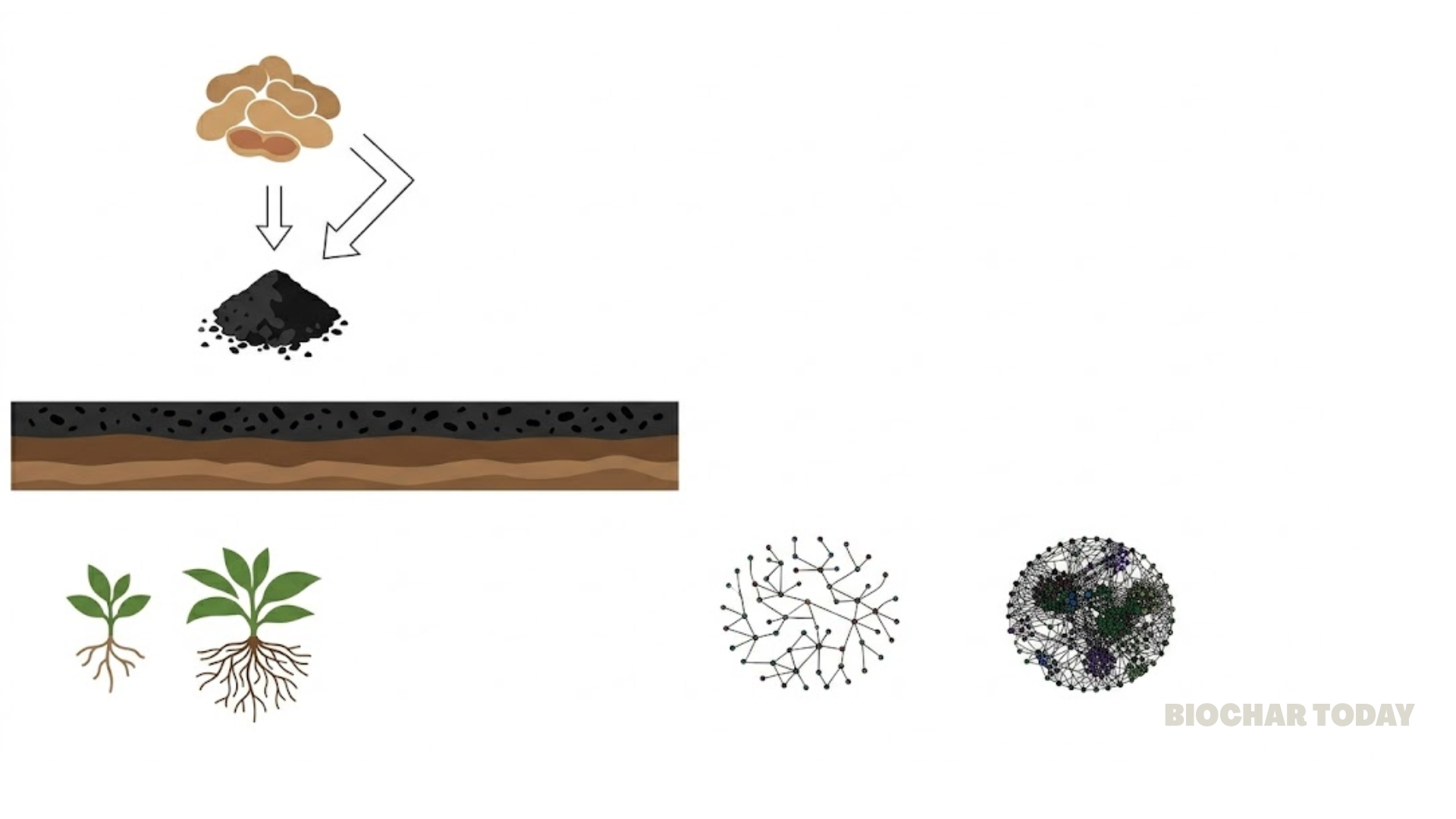
- Long-term peanut shell biocharBiochar is a carbon-rich material created from biomass decomposition in low-oxygen conditions. It has important applications in environmental remediation, soil improvement, agriculture, carbon sequestration, energy storage, and sustainable materials, promoting efficiency and reducing waste in various contexts while addressing climate change challenges. More additions boost necessary crop nutrients and natural soil enzyme functions across multiple geographic zones.
- While overall microbial diversity stays stable over time, helpful bacterial groups experiences significant population gains.
- The structural complexity and environmental stability of underground bacterial networks are enhanced by charcoalCharcoal is a black, brittle, and porous material produced by heating wood or other organic substances in a low-oxygen environment. It is primarily used as a fuel source for cooking and heating. More additions.
- Underground fungal networks become more simplified and clustered inside soil pockets after long-term charcoal treatment.
- Tobacco plant leaf quality improves indirectly through a healthier soil mix and changed bacterial relationships.
A multi-year field study published in the journal Biochar by authors Zhuzhu Liao, Peiyan Li, Xianjie Cai, Zhongke Sun, Huilin Feng, Zhihong Huang, Yaowei Wei, Quanyu Yin, Guoshun Liu, Chengwei Li, Yu Shi, and Tianbao Ren explores the long-term impacts of peanut shell biochar on rhizosphere soil ecosystems. The research team established large-scale field plots running over six consecutive growing seasons across five distinct tobacco-producing regions in China, spanning both temperate and subtropical climate zones. By investigating the Successive adaptations of underground microbial populations under realistic agricultural conditions, the study addresses a critical knowledge gap regarding how persistent biochar usage alters microbial biogeography. The resulting data offers a practical blueprint for using agricultural byproduct biochar to structurally stabilize soil microecology, protect beneficial rhizosphere communities, and indirectly elevate high-value crop characteristics.
The primary findings of the multi-year project demonstrate that prolonged charcoal application fundamentally optimizes soil fertility profiles, though the specific outcomes are heavily dictated by native regional soil chemistry. Across four of the experimental field sites, which included Mudanjiang, Shangluo, Yichun, and Yanshan Town, adding nine hundred kilograms per hectare of peanut shell biochar significantly improved key chemical indicators. The treatment recorded substantial average increases in baseline soil pHpH is a measure of how acidic or alkaline a substance is. A pH of 7 is neutral, while lower pH values indicate acidity and higher values indicate alkalinity. Biochars are normally alkaline and can influence soil pH, often increasing it, which can be beneficial More, available potassium, available phosphorus, organic matter, carbon-to-nitrogen ratios, and alkaline hydrolyzable nitrogen. Concurrently, biological activity within the rhizosphere intensified, as evidenced by a marked stimulation of vital soil enzymes, including sucrase, catalase, and urease. Conversely, at the Xuchang site, which possessed an initially high native soil pH, the charcoal treatment caused a unique reduction in available phosphorus and catalase activity, highlighting that biochar performance remains highly context-dependent.
Crucially, the biological tracking revealed that while the long-term addition of peanut shell biochar did not significantly alter global microbial richness or overall diversity indices, it induced a profound functional restructuring of the soil microbiome. The persistent presence of the porous charcoal matrix exerted a selective environmental pressure that enriched specific, structurally adapted microbial groups. Within the bacterial domain, the relative abundance of Firmicutes increased by over thirty percent, with specialized members of the class Bacilli comprising seventy percent of the significantly enriched bacterial taxa. Saprophytic fungal groups like Blastocladiomycota also experienced vast population gains, multiplying by more than nineteenfold due to the availability of carbon compounds held on the charcoal surfaces. These shifts are highly beneficial for sustainable farming, as Bacilli function as multi-purpose biological agents that actively stimulate crop growth, produce vital plant hormones, and strengthen overall disease resistance.
The study also utilized advanced co-occurrence network analysis to map how these shifting microbial populations interact, exposing an intriguing divergence between bacterial and fungal community behaviors. The long-term introduction of peanut shell biochar increased the total number of node connections, interaction edges, and linkage densities within the rhizosphere bacterial network. This structural elaboration significantly enhanced the complexity and overall stability of the bacterial community, while multiplying the number of crucial keystone microorganisms from a single entity up to five distinct groups. In sharp contrast, the charcoal amendment reduced the complexity indices of the neighboring fungal symbiotic networks, driving up their internal modularity. The researchers attribute this divergence to physical spacing, as the tiny internal pores of the biochar accommodate and foster tight bacterial cooperation while physically partitioning and disrupting the expansive mycelial networks required by larger fungal communities.
Ultimately, the structural equation modeling constructed by the research team successfully linked these microecological transformations directly to marketable crop improvements. The long-term field data confirmed that the application of peanut shell biochar indirectly dictates the accumulation of desirable soluble sugars within tobacco leaves. This quality enhancement is achieved through coordinated pathways where the biochar elevates soil organic matter levels, stabilizes beneficial bacterial interaction networks, and selectively expands the populations of specialized Bacilli strains. Although the inherent alkalinity of the biochar pushed some soil pH values slightly beyond the ideal local range for tobacco cultivation, the strong promotive effect of the increased organic matter and stabilized bacterial communities completely overwhelmed this localized negative feedback. The study concludes that using peanut shell biochar represents an ecologically sound, economically viable management strategy for securing soil health and improving agricultural productivity.
Source: Liao, Z., Li, P., Cai, X., Sun, Z., Feng, H., Huang, Z., Wei, Y., Yin, Q., Liu, G., Li, C., Shi, Y., & Ren, T. (2026). Long-term peanut shell biochar application improves soil fertility and bacterial network stability across tobacco-growing regions in China. Biochar, 8(1), 63.




Leave a Reply