
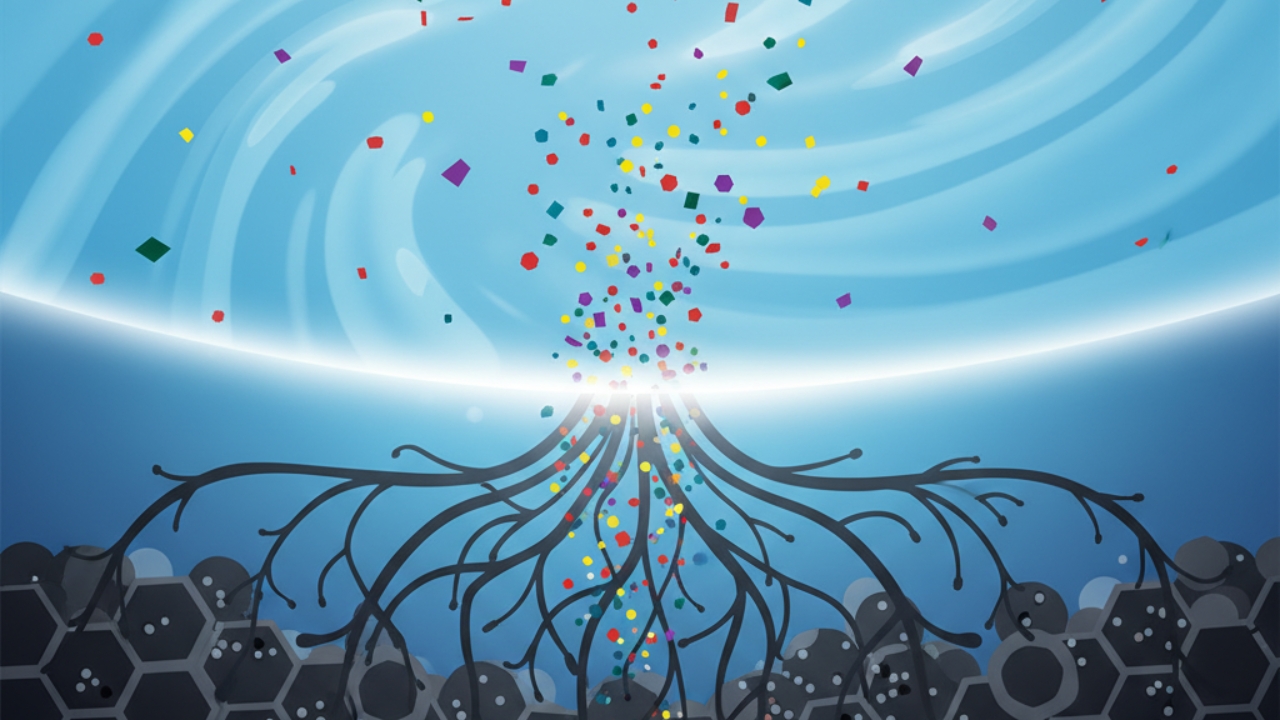
Key Takeaways
- The Problem: Microplastics (MPs) are a serious human health risk, infiltrating our water and food and linking to endocrine disruption, reproductive issues, and even cardiovascular diseases.
- The Solution: BiocharBiochar is a carbon-rich material created from biomass decomposition in low-oxygen conditions. It has important applications in environmental remediation, soil improvement, agriculture, carbon sequestration, energy storage, and sustainable materials, promoting efficiency and reducing waste in various contexts while addressing climate change challenges. More,can be created by heating organic waste (like coffee grounds, wood chips, or sewage sludge) without oxygen.
- The Result: In lab studies, specially modified biochar acts as a super-filter, removing over 99% of certain microplastics from water.
- How it Works: Biochar doesn’t just sieve particles; it uses chemical forces like electrostatic attraction, hydrogen bonding, and π−π interactions to grab and hold plastics on its surface.
- The Big Picture: This process is a “circular economy” win. It takes everyday waste—a source of pollution—and turns it into a high-value tool to clean up another major pollutant, all while locking away carbon.
Plastic is one of the most useful materials ever invented, and it has become an inescapable part of modern life. But our reliance on it has created a staggering pollution crisis. Since the 1950s, humanity has produced 9.2 billion tons of plastic; 7 billion of those tons are now waste, clogging landfills and flooding our oceans. This plastic waste breaks down into microplastics (MPs) and nanoplastics (NPs), tiny particles that are now found in our drinking water, our food, and even our bodies. This isn’t just litter. These particles are linked to severe health problems, including hormonal disruption, infertility, and cardiovascular diseases. A new review by Rubaiyana Taskin, Martins O. Omorogie, and their colleagues, published in Bioresource Technology Reports, comprehensively examines a powerful and sustainable solution: biochar.
The process of biochar production transforms low-value waste into a highly effective adsorbent. The resulting biochar has an incredibly high surface area and a porous structure, making it a perfect trap for pollutants. Instead of just physically filtering water, biochar uses a process called adsorption, where pollutant molecules chemically stick to its surface.
The review shows that while standard biochar is good, modified biochar is exceptional. Scientists can “activate” or “engineer” the biochar using various physical or chemical treatments (such as with acids, alkalies, or magnetic nanoparticles) to supercharge its pollutant-grabbing abilities. The results from various studies are striking. Biochar derived from sugarcane bagasse, for example, removed over 99% of nanoplastics from water. In another study, magnetic biochar made from rice husks achieved a 99.96% removal rate for polystyrene (PS) microplastics. Other experiments using biochar from spent coffee grounds or activated hardwood also showed removal efficiencies well over 95-100% for various plastic types.
This high efficiency isn’t just about particles getting stuck in pores. The review explains that the adsorption is driven by a combination of powerful molecular forces. For polystyrene, a common plastic pollutant, an attraction called π−π interaction plays a key role, where the plastic’s aromatic rings are drawn to the biochar’s carbon structure. Other key mechanisms include hydrogen bonding (the same force that holds water molecules together) , electrostatic interactions (where the engineered surface charge of the biochar attracts the plastics) , and hydrophobic interactions (the tendency of plastics, which repel water, to stick to the biochar surface to “hide” from the water).
Perhaps the most compelling part of this research is how it fits into a “circular economy”. This isn’t just about creating a new filter; it’s about fundamentally rethinking waste. This approach takes two major pollution streams—organic waste from farms or cities and plastic waste in our water—and uses one to solve the other. The pyrolysisPyrolysis is a thermochemical process that converts waste biomass into bio-char, bio-oil, and pyro-gas. It offers significant advantages in waste valorization, turning low-value materials into economically valuable resources. Its versatility allows for tailored products based on operational conditions, presenting itself as a cost-effective and efficient More process also has a major climate benefit: it sequesters carbon. Instead of organic waste decomposing and releasing carbon dioxide (CO2) or methane (CH4) into the atmosphere, that carbon is locked into the stable biochar for the long term, effectively becoming a “carbon sink”. Furthermore, the byproducts of pyrolysis, bio-oil and syngasSyngas, or synthesis gas, is a fuel gas mixture consisting primarily of hydrogen and carbon monoxide. It is produced during gasification and can be used as a fuel source or as a feedstock for producing other chemicals and fuels. More, can be captured and used as renewable energy sources, making the entire process even more sustainable.
This solution is not without its challenges. The review notes that more research is needed to find efficient ways to regenerate the “spent” biochar once it’s full of plastics. Scientists must also ensure that the chemical modification processes are safe and don’t cause secondary pollution. In a real-world river or wastewater plant, other contaminants like pesticides or heavy metals might compete with microplastics for space on the biochar’s surface, which could reduce its effectiveness. Future research will focus on solving these problems and even using artificial intelligence to model and design new biochars specifically tailored to capture different types of plastics.
Source: Taskin, R., Neelancherry, R., Helmreich, B., & Omorogie, M. O. (2025). Trends in the applications of biochar for the abatement of microplastics in water. Bioresource Technology Reports, 30, 102395.


Leave a Reply