
Key Takeaways
- A new, specially designed biocharBiochar is a carbon-rich material created from biomass decomposition in low-oxygen conditions. It has important applications in environmental remediation, soil improvement, agriculture, carbon sequestration, energy storage, and sustainable materials, promoting efficiency and reducing waste in various contexts while addressing climate change challenges. More can remove over 97% of the common pesticide Imidacloprid (IMI) from water.
- The biochar is made by heating white melon seed shells with chitosan, a natural polymer, which adds key nitrogen atoms.
- The material has a massive adsorption capacity, meaning a small amount can trap a large amount of the pesticide.
- The biochar is extremely durable, maintaining 94.4% of its effectiveness even after three cycles of use and regeneration by heating.
Nitrogen-containing pollutants, from agricultural pesticides to pharmaceuticals, are a growing source of water contamination worldwide. One of the most common is Imidacloprid (IMI), a persistent pesticide found in global surface waters that conventional treatment plants struggle to remove. Finding a way to efficiently and sustainably pull these molecules out of our water is a critical environmental challenge. A new study by Fuxiang Zhang, Jialin Lv, and colleagues, published in the journal Environmental Chemistry and Ecotoxicology, provides a powerful new solution: a “designer” biochar with an exceptional ability to capture these specific pollutants.
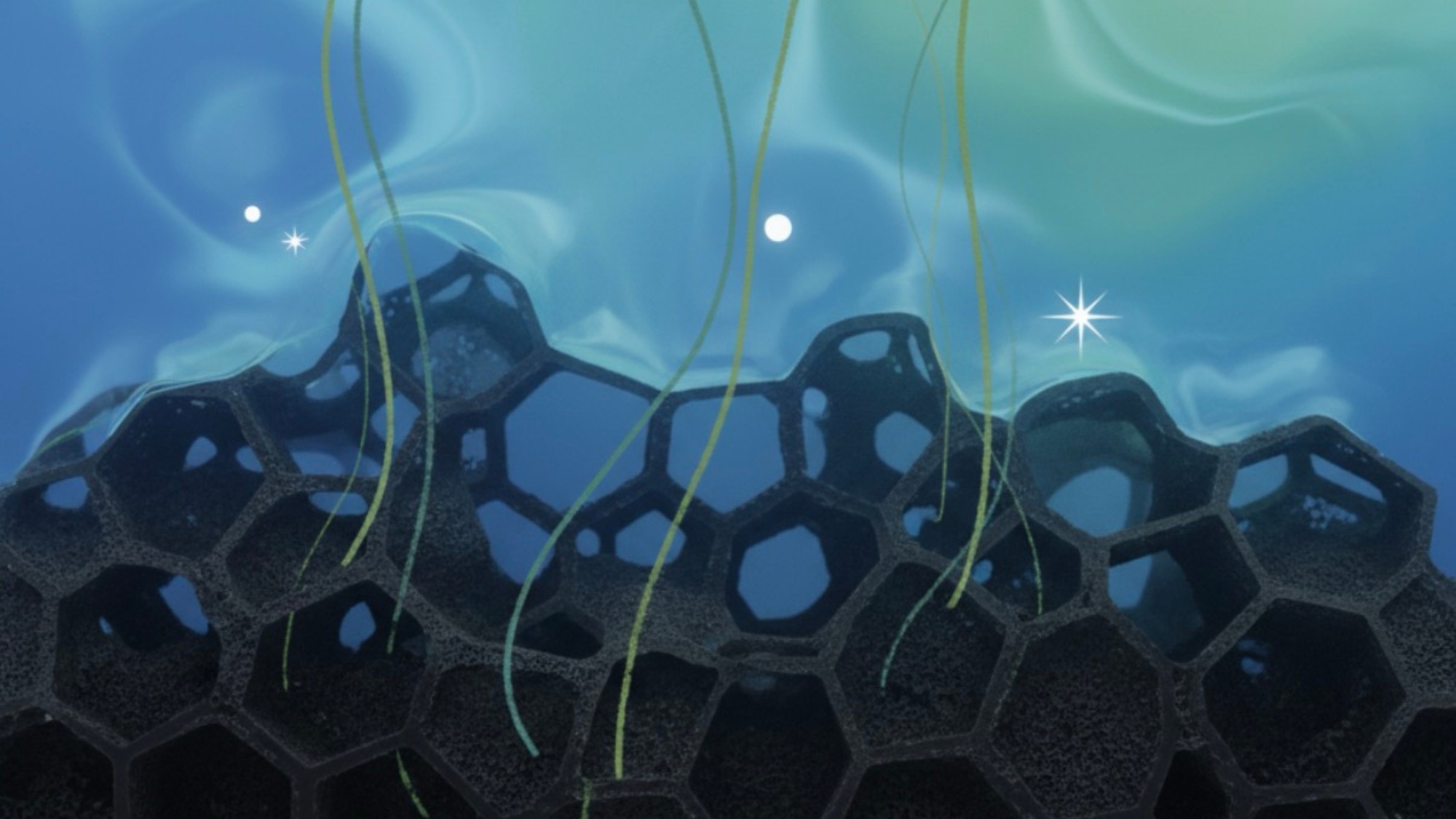
The researchers developed a hierarchically structured, nitrogen-doped graphitic biochar, dubbed NBC900. This advanced material was synthesized by taking a carbon-rich base (white melon seed shells) and modifying it with chitosan, a natural polymer derived from shellfish. This mixture was then pyrolyzed (heated without oxygen). This process not only created a porous, stable biochar but also “doped” it with nitrogen atoms from the chitosan, which proved to be the secret to its success. The result was a material with an exceptional adsorption capacity, able to capture 140.1mg of the IMI pesticide per gram of biochar. In batch experiments, it successfully removed 97.2% of the pesticide from the water.
What makes this material a practical solution, and not just a lab curiosity, is its resilience. The researchers found the NBC900 biochar works effectively across a massive pHpH is a measure of how acidic or alkaline a substance is. A pH of 7 is neutral, while lower pH values indicate acidity and higher values indicate alkalinity. Biochars are normally alkaline and can influence soil pH, often increasing it, which can be beneficial More range, from highly acidic (pH 2) to highly alkaline (pH 11), and is not significantly affected by changes in ionic strength (saltiness). This means it could be deployed in a wide variety of real-world water conditions. Furthermore, its reusability is remarkable. After being fully saturated with the pesticide, the team regenerated the biochar simply by heating it again. After three complete regeneration cycles, the biochar retained 94.4% of its original removal efficiency. This high durability makes it a sustainable and cost-effective option for water treatment.
The most significant part of the study is its deep dive into the “why.” The team used comprehensive material characterizations to figure out how the biochar was so good at grabbing this specific pesticide. The primary mechanism was found to be chemisorption—the pesticide wasn’t just passively soaking into pores, it was forming strong chemical bonds with the biochar’s surface. The high pyrolysisPyrolysis is a thermochemical process that converts waste biomass into bio-char, bio-oil, and pyro-gas. It offers significant advantages in waste valorization, turning low-value materials into economically valuable resources. Its versatility allows for tailored products based on operational conditions, presenting itself as a cost-effective and efficient More temperature created a highly graphitized surface, which facilitated powerful $\pi$-$\pi$ interactions, a force where the electron-rich pesticide molecule is strongly attracted to the electron-rich biochar surface.
The “magic,” however, came from the nitrogen-doping. The study provided novel insight into a specific chemical hook: a Lewis acid-base interaction. The nitrogen-doped biochar was rich in pyridine-N and carbonyl (C=O) groups, which act as Lewis bases (electron donors). These groups sought out and formed strong chemical bonds with the Lewis acid (electron-accepting) parts of the IMI pesticide, specifically its nitro and pyridine groups. This targeted chemical attraction between the nitrogen in the biochar and the nitrogen in the pollutant is what gives the material its high capacity and selectivity.
This research moves beyond just creating a new filter. It provides a molecular-level blueprint for how to design adsorbents for specific pollutants. By understanding that a biochar’s nitrogen groups can be tailored to lock onto the nitrogen groups of a contaminant, scientists can now work on developing a new generation of high-performance filters to target a wide range of persistent pollutants, from pesticides to pharmaceuticals.
Source: Zhang, F., Lv, J., Pan, F., Fu, Q., Jia, H., Li, Y.-F., Hough, R., Zhang, Z., Cui, S., & Liu, G. (2025). Unveiling the role of nitrogen-related functional groups in Imidacloprid adsorption by chitosan-modified graphitic biochar: A mechanistic insight into N-containing pollutant removal. Environmental Chemistry and Ecotoxicology, 7, 1671–1683.

Leave a Reply