
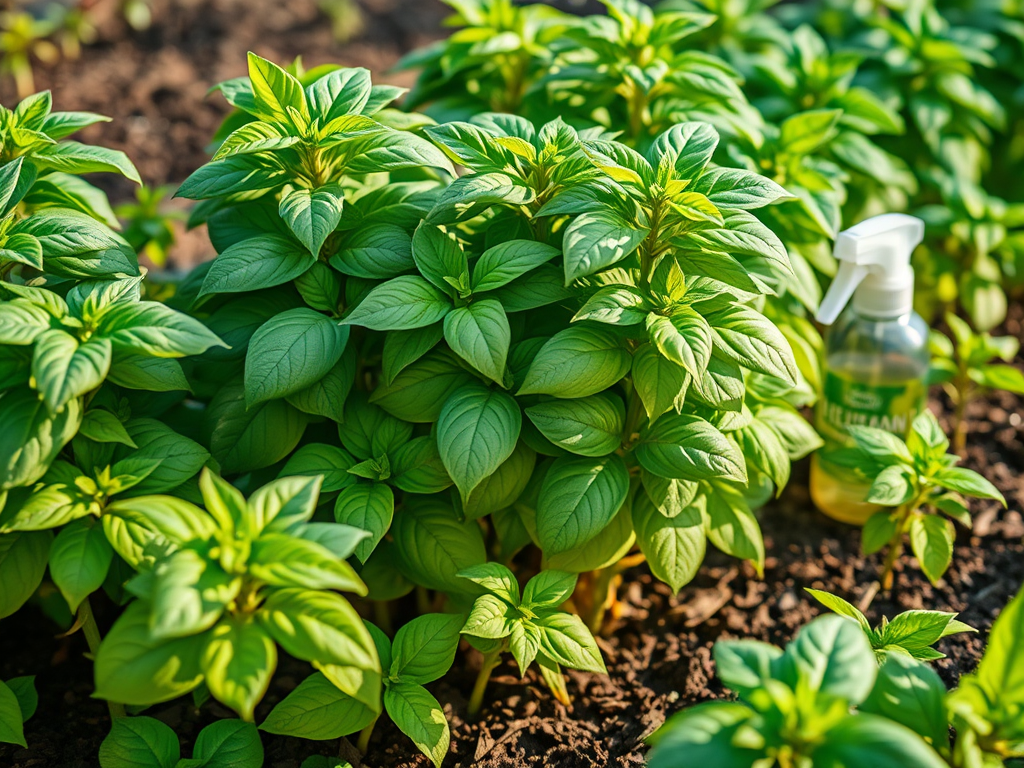
In a recent study published in IOP Conference Series: Earth and Environmental Science, H.E. Alfahdawi, H.G. Khaleefa, and A.F. Almehemdi investigated the combined effects of melatonin and biocharBiochar is a carbon-rich material created from biomass decomposition in low-oxygen conditions. It has important applications in environmental remediation, soil improvement, agriculture, carbon sequestration, energy storage, and sustainable materials, promoting efficiency and reducing waste in various contexts while addressing climate change challenges. More on the growth characteristics of Ocimum Basilicum L. CV. Cinnamon, commonly known as aromatic basil. This research addresses the need for sustainable methods to enhance agricultural productivity, especially for medicinal crops like basil, which are valued for their volatile oils and antioxidant properties. Traditional reliance on chemical fertilizers has led to soil degradation, highlighting the importance of eco-friendly alternatives like biochar.
The experiment, conducted in 2022, explored four levels of melatonin (0, 25, 50, and 75 mmol) as a foliar spray and four levels of biochar (0, 250, 500, and 750 gm pot⁻¹) added to the soil. Melatonin, a powerful endogenous molecule, is known to improve carbon metabolism, increase antioxidant production, and influence various plant processes such as root growth, flowering, fruit ripening, and leaf senescence. Biochar is recognized for its ability to improve soil fertility, nutrient holding capacity, moisture retention, and overall soil physical and chemical properties.
The results showed significant improvements in several growth characteristics of basil plants with the application of melatonin and biochar. For plant height, the highest value of 48.03 cm was achieved with 75 mmol melatonin (M3), significantly outperforming the control (M0) at 44.217 cm. Biochar at 750 gm pot⁻¹ (B3) also showed superiority with a height of 49.067 cm compared to the control (B0) at 42.883 cm. The most striking outcome was the interaction between M3 and B3, which resulted in a plant height of 51.533 cm, marking a 24.9% increase over the untreated control (M0B0) at 41.200 cm. Stem diameter also saw considerable improvement, with the M3 melatonin treatment yielding the highest value of 5.038 mm, compared to M0 at 4.372 mm. Similarly, B3 biochar addition led to the largest stem diameter of 5.304 mm, against B0’s 4.121 mm. The number of branches increased significantly with M3 melatonin (5.25 branches plant⁻¹) and B3 biochar (5.10 branches plant⁻¹), compared to their respective controls (4.57 and 4.43 branches plant⁻¹).
Leaf area was maximized with M3 melatonin at 10.56 cm² leaf⁻¹, contrasting with M0 at 9.72 cm² leaf⁻¹. B3 biochar also led to the largest leaf area of 10.72 cm² leaf⁻¹, while B0 recorded the lowest at 9.37 cm² leaf⁻¹. The interaction of M3B2 resulted in the largest leaf area of 10.91 cm² leaf⁻¹. The number of leaves was highest at 129.70 leaf plant⁻¹ with M3 melatonin and 129.00 leaf plant⁻¹ with B3 biochar, compared to controls of 108.467 and 105.517 leaf plant⁻¹ respectively. Fresh leaves weight was significantly affected by both treatments. M3 melatonin resulted in 160.563 gm, and B3 biochar in 159.682 gm, both notably higher than their respective controls (M2 at 135.972 gm for melatonin, and B0 at 127.585 gm for biochar). Leaf dry weight followed a similar trend, with M3 melatonin yielding 17.128 gm (compared to M0 at 14.564 gm) and B3 biochar yielding 17.116 gm (compared to B0 at 13.109 gm). This translates to a 30.6% increase in leaf dry weight for the optimal melatonin treatment. Finally, the dry matter percentage was highest at 10.654% for M3 melatonin and 10.736% for B3 biochar, outperforming M1 at 10.412% and B0 at 10.267% respectively.
These findings collectively demonstrate that melatonin activates enzymes for biochemical processes, stimulates growth regulators, enhances cell division and elongation, and maintains the antioxidant system, contributing to increased plant height, branch number, leaf number, leaf area, and both fresh and dry weights. Biochar complements this by improving soil aeration, composition, water-holding capacity, and nutrient availability, which directly stimulates crop growth and yields. In conclusion, the study recommends the use of 75 mmol melatonin as a spray and 750 gm pot⁻¹ biochar addition to significantly stimulate the growth of aromatic basil. These natural materials improve the growth environment sustainably and cleanly, suggesting their potential for use in other vegetable and medicinal crops to maximize efficiency and yield.
Source: Alfahdawi, H. E., Khaleefa, H. G., & Almehemdi, A. F. (2023). Effect of adding Melatonin and Biochar on some Growth Characteristics of Ocimum Basilicum L. CV. Cinnamon. IOP Conference Series: Earth and Environmental Science, 1252(1), 012080.





Leave a Reply