
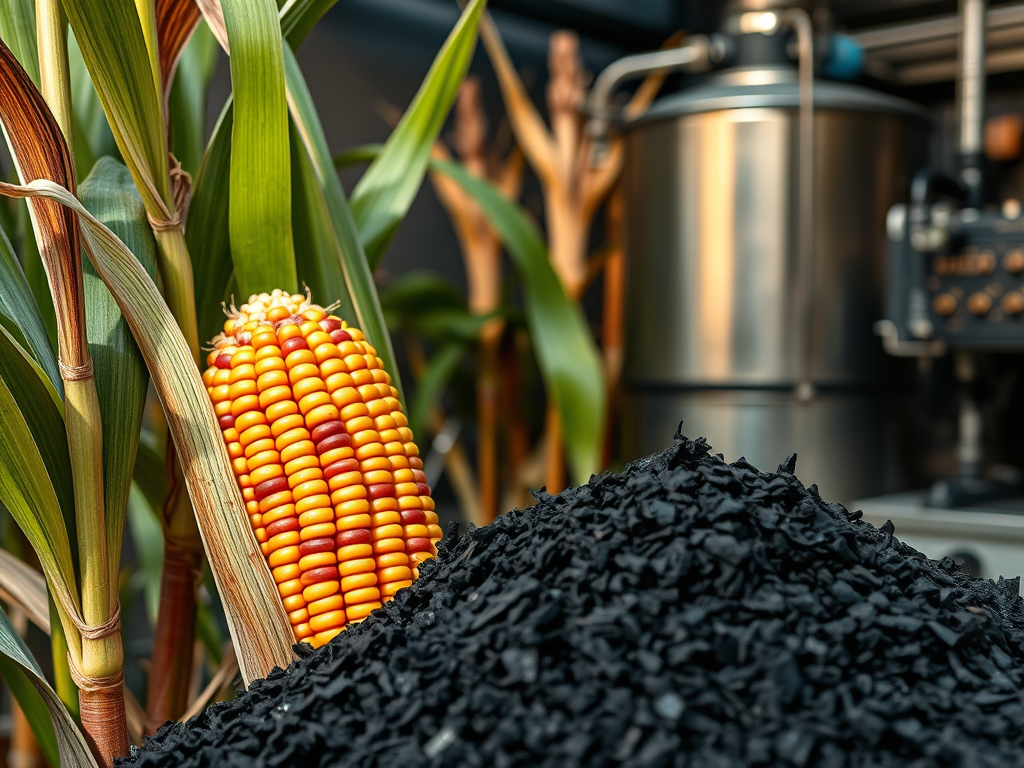
Tequila production, while culturally and economically significant, generates a large volume of polluting wastewater called vinasses. In a study published in Sustainable Chemistry and Pharmacy, Juan Daniel Castanier-Rivas et al. explore a sustainable solution by investigating the use of maize stover, an abundant agricultural byproduct, to produce biocharBiochar is a carbon-rich material created from biomass decomposition in low-oxygen conditions. It has important applications in environmental remediation, soil improvement, agriculture, carbon sequestration, energy storage, and sustainable materials, promoting efficiency and reducing waste in various contexts while addressing climate change challenges. More for vinasse filtration.
Maize, a crucial global crop, leaves behind a substantial amount of residual biomassBiomass is a complex biological organic or non-organic solid product derived from living or recently living organism and available naturally. Various types of wastes such as animal manure, waste paper, sludge and many industrial wastes are also treated as biomass because like natural biomass these More after harvest, primarily maize stover. This stover, composed of the plant’s stems and leaves, can contribute to environmental problems if not managed properly. The researchers explore an alternative: converting maize stover into biochar, a charcoal-like material, through pyrolysisPyrolysis is a thermochemical process that converts waste biomass into bio-char, bio-oil, and pyro-gas. It offers significant advantages in waste valorization, turning low-value materials into economically valuable resources. Its versatility allows for tailored products based on operational conditions, presenting itself as a cost-effective and efficient More (heating in the absence of oxygen). They propose using this biochar as a filter to treat tequila vinasses, a wastewater known for its high organic and mineral content and potential to cause environmental damage.
The study compares maize-stover-derived biochar (MS-BC) with commercially available granular activated carbonActivated carbon is a form of carbon that has been processed to create a vast network of tiny pores, increasing its surface area significantly. This extensive surface area makes activated carbon exceptionally effective at trapping and holding impurities, like a molecular sponge. It is commonly More (CN-GAC), a standard filtration material. Researchers evaluated the effectiveness of each material in reducing key pollutants in the wastewater, specifically chemical oxygen demand (COD), total phosphorus (TP), and total nitrogen (TN).
The economic feasibility of biochar production from maize stover was also assessed using process simulation software. Furthermore, a life cycle assessment (LCA) was conducted to evaluate the environmental impacts associated with biochar production and its use in wastewater treatment.
Results showed that maize stover biochar and activated carbon both reduced nitrogen levels in the wastewater. However, maize stover biochar increased phosphate levels, indicating a need for pretreatment to avoid this leachingLeaching is the process where nutrients are dissolved and carried away from the soil by water. This can lead to nutrient depletion and environmental pollution. Biochar can help reduce leaching by improving nutrient retention in the soil. More. The economic analysis revealed that maize stover biochar can be produced at a significantly lower cost than activated carbon, presenting a potential economic advantage. The life cycle assessment suggested that maize stover biochar has the potential for a lower environmental footprint.
SOURCE: Castanier-Rivas, J. D., Larrea-Cedeño, A. S., Sukumara, S., García de Alba-Verduzco, J., González-López, M. E., & Gradilla-Hernández, M. S. (2025). Towards Circularity: Integrating biochar production from maize stover into the tequila industry. Sustainable Chemistry and Pharmacy, 45, 102027



Leave a Reply