
Key Takeaways
- High removal rates for both metals are achieved when utilizing agricultural waste combined biocharBiochar is a carbon-rich material created from biomass decomposition in low-oxygen conditions. It has important applications in environmental remediation, soil improvement, agriculture, carbon sequestration, energy storage, and sustainable materials, promoting efficiency and reducing waste in various contexts while addressing climate change challenges. More.
- The combined biochar demonstrates a synergistic enhancement effect for eliminating contaminants in a dual metal environment.
- Optimal heavy metal capture occurs under acidic conditions without requiring multi-step chemical treatments.
- The material demonstrates excellent structural stability and performance across five regeneration cycles.
- The process offers a safe and indigenuous alternative for treating toxic tannery effluents.
In a recent publication in Scientific Reports, researchers Tayyaba Kanwal, Rashid Iftikhar, Mathias Ernst, Kang Hoon Lee, and Muhammad Ali Inam investigated sustainable water treatment alternatives to mitigate heavy metal contamination from industrial discharges, such as tannery effluents. Industrial wastewater in developing regions often contains levels of hexavalent chromium and divalent lead that exceed international safe environmental discharge limits by up to a thousand times. Traditional treatment methodologies, including chemical coagulation, electrochemical separation, and membrane filtration systems, suffer from steep operational costs, complex maintenance protocols, and excessive toxic sludge generation. To provide a scalable and economically viable remedy, the authors fabricated an engineered composite using a single-step co-pyrolysis method to incorporate magnesium oxide nanoparticles directly into an indigenous biomassBiomass is a complex biological organic or non-organic solid product derived from living or recently living organism and available naturally. Various types of wastes such as animal manure, waste paper, sludge and many industrial wastes are also treated as biomass because like natural biomass these More framework comprising a one-to-one mass ratio of rice husk and banana peel.
The engineered agricultural composite exhibited remarkable physiochemical transformations, including a significant increase in crystallinity and surface area due to the magnesium-assisted activation process during thermal degradation. In single-solute synthetic test trials, the magnesium oxide-impregnated combined biochar achieved an exceptional absolute decontamination rate, successfully removing ninety-four percent of hexavalent chromium at a highly acidic level of two, and one hundred percent of divalent lead at a fluid level of four. These evaluations were achieved within a rapid equilibrium contact time of two hours using a standard adsorbent dose of two grams per liter in a solution with an initial metal loading of twenty milligrams per liter. The physical structure of the porous matrix provided an abundance of active surface binding sites, which prevented the typical particle agglomeration seen in conventional nanomaterial applications.
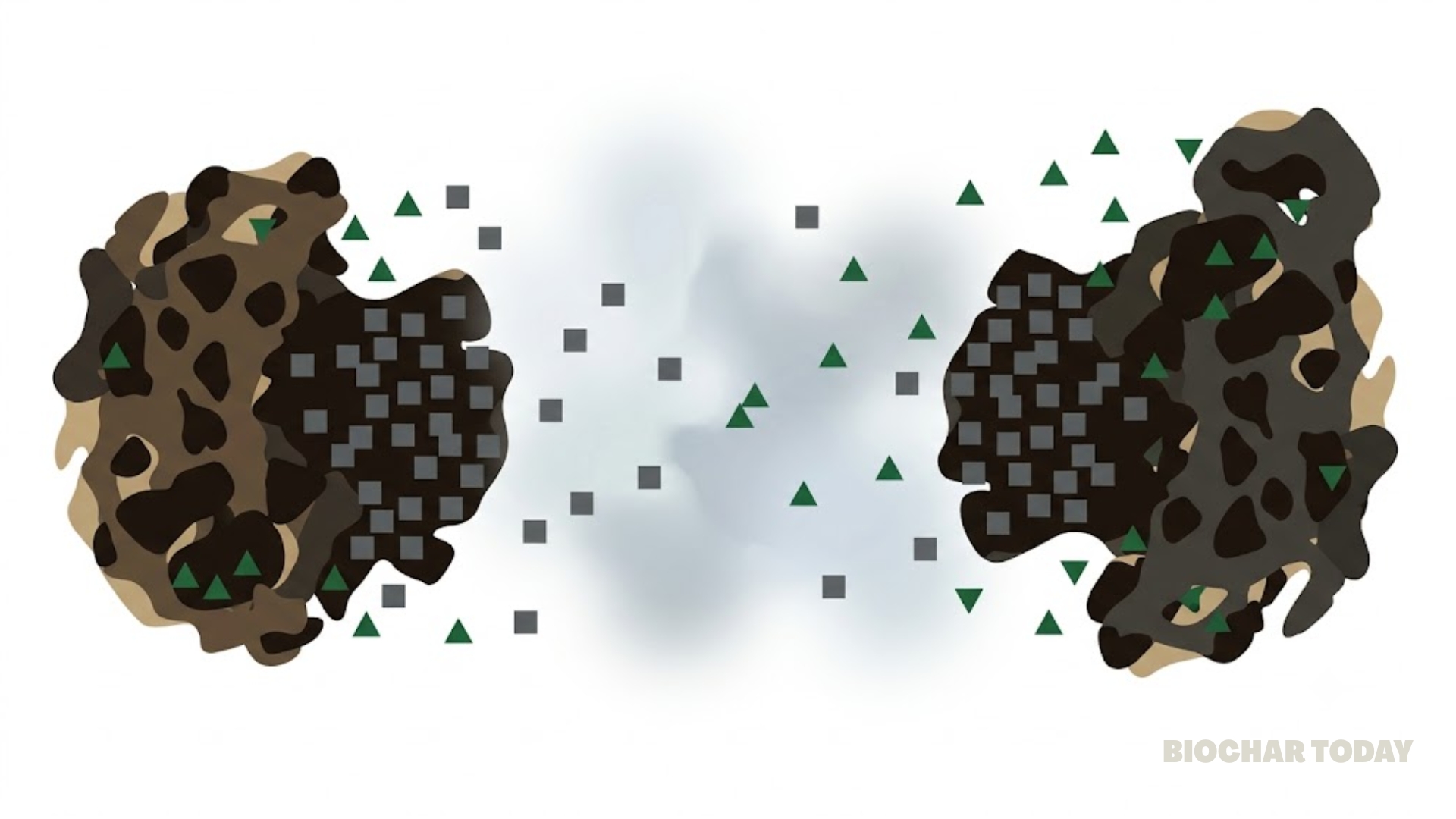
When the composite material was introduced into a competitive binary solute system containing both heavy metals simultaneously, it revealed unexpected cooperative adsorption dynamics. At a fluid level of two, the system maintained a high lead removal efficiency of ninety-nine percent, while experiencing only a minor decrease in hexavalent chromium removal, which settled at eighty-eight and a half percent. Interestingly, the data indicated that as the overall concentrations of the metal pollutants were increased, the presence of lead ions actively facilitated the continuous capture of chromium onto the carbon framework. This synergistic effect is primarily attributed to the co-attachment of dissolved metal complexes and the formation of unique bimetallic bonds on the porous matrix.
Spectroscopic evaluations confirmed that the underlying mechanistic pathway for heavy metal reduction consists of multiple simultaneous chemical interactions. For hexavalent chromium, the primary extraction routes are electrostatic attraction to the positively charged protonated surfaces, coupled with chemical reduction and surface complexation. For divalent lead, the removal is primarily governed by direct ligand exchange followed by stable surface complexation with oxygen-containing functional groups, rather than simple hydroxide precipitation. In the dual-metal competitive landscape, the simultaneous presence of both species encourages a highly organized, cooperative multilayer adsorption behavior across the heterogeneous surface of the modified combined biochar. Furthermore, the composite material displayed high industrial durability, retaining its structural integrity and heavy metal separation efficiency over five consecutive adsorption and desorption cycles using a sodium hydroxide regenerating solution.
Source: Kanwal, T., Iftikhar, R., Ernst, M., Lee, K. H., & Inam, M. A. (2026). Adsorption behavior of lead and chromium onto MgO impregnated biochar derived from banana peels and rice husk in binary environment. Scientific Reports.


![Eucalyptus Wood Waste-Derived Biochar Achieves a Ninety-Eight Percent Removal Efficiency for Benzo[ghi]perylene in Vehicle-Wash Wastewater](https://biochartoday.com/wp-content/uploads/2026/10/SCIENCE-BLOGS-2026-2026-10-19T160523.703.jpg)


Leave a Reply