
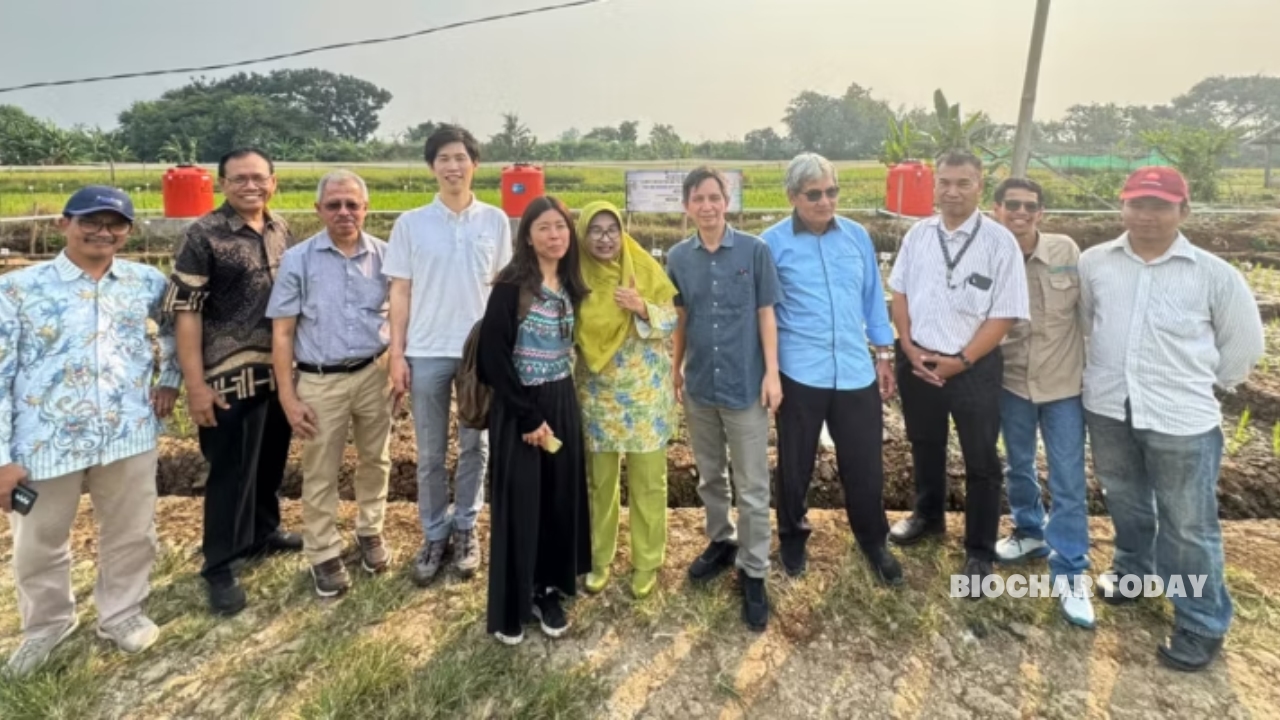
IPB University, in collaboration with Faeger Co Ltd and PT Yanmar Diesel Indonesia, has launched a one-year research project to evaluate the joint effectiveness of Alternate Wetting and Drying (AWD) and rice husk biocharBiochar is a carbon-rich material created from biomass decomposition in low-oxygen conditions. It has important applications in environmental remediation, soil improvement, agriculture, carbon sequestration, energy storage, and sustainable materials, promoting efficiency and reducing waste in various contexts while addressing climate change challenges. More in Indonesian rice cultivation. Initiated in April 2026, the study operates as a controlled experiment on the university’s research fields to determine how this combined approach influences greenhouse gas emissions and crop productivity. The project aims to establish a rigorous scientific foundation to support agricultural climate change mitigation, resource efficiency, and carbon accounting frameworks, including the Joint Crediting Mechanism.
Irrigated rice farming serves as a cornerstone of food security in Indonesia, yet the sector presents substantial environmental challenges that complicate long-term sustainability. The continuous flooding of rice paddies generates high volumes of anaerobic methane emissions, positioning the industry as a primary agricultural contributor to climate change. Furthermore, the intensive cultivation process generates vast quantities of agricultural waste, particularly rice husks. Local management often relies on open-field burning or leaves the biomassBiomass is a complex biological organic or non-organic solid product derived from living or recently living organism and available naturally. Various types of wastes such as animal manure, waste paper, sludge and many industrial wastes are also treated as biomass because like natural biomass these More underutilized, which wastes a potential resource and exacerbates regional air pollution and environmental degradation.
To address these compounding problems, the collaborative project introduces an integrated system that unites smart water management with organic waste recycling. The field trials deploy AWD, a controlled irrigation methodology designed to interrupt prolonged soil saturation, thereby suppressing methane production and reducing total water consumption. Concurrently, the system incorporates rice husk biochar to redirect the underutilized agricultural byproduct into an amendment capable of sequestering carbon for centuries. The highly porous structure of the biochar enhances soil fertility, nutrient retention, and moisture storage capacity, mitigating the risks that an unpredictable climate poses to crop yields.
The research team conducts comprehensive monitoring across diverse water regimes and biochar applications to quantify changes in methane, nitrous oxide, soil carbon, and harvest yields. Early stages of the study focus on building empirical datasets to validate low-emission production models and inform emerging international carbon crediting frameworks. Beyond controlled testing, the partners are identifying pilot locations with organized farmer groups and nearby processing mills to facilitate rapid scaling. This strategic evaluation ensures that the combined AWD and biochar methodology aligns directly with national climate goals while remaining economically viable for smallholder family farms.




Leave a Reply