
Key Takeaways
- BiocharBiochar is a carbon-rich material created from biomass decomposition in low-oxygen conditions. It has important applications in environmental remediation, soil improvement, agriculture, carbon sequestration, energy storage, and sustainable materials, promoting efficiency and reducing waste in various contexts while addressing climate change challenges. More contains natural chemical groups that allow it to easily trade electrons with surrounding pollutants and bacteria to speed up cleanup processes.
- This built-in ability to transfer electrons lets standard biochar perform better at breaking down contaminants than more expensive materials like graphite.
- Standard testing methods often give vastly different measurements of biochar performance because they cannot reach all the hidden active sites inside the material’s tiny pores.
- When left outdoors, environmental factors like rain and weather can split biochar into tiny pieces, exposing new active spots while sometimes clogging old ones.
- Processing different types of organic waste together during production offers a clean and affordable way to design high-performance biochar without using harsh chemicals.
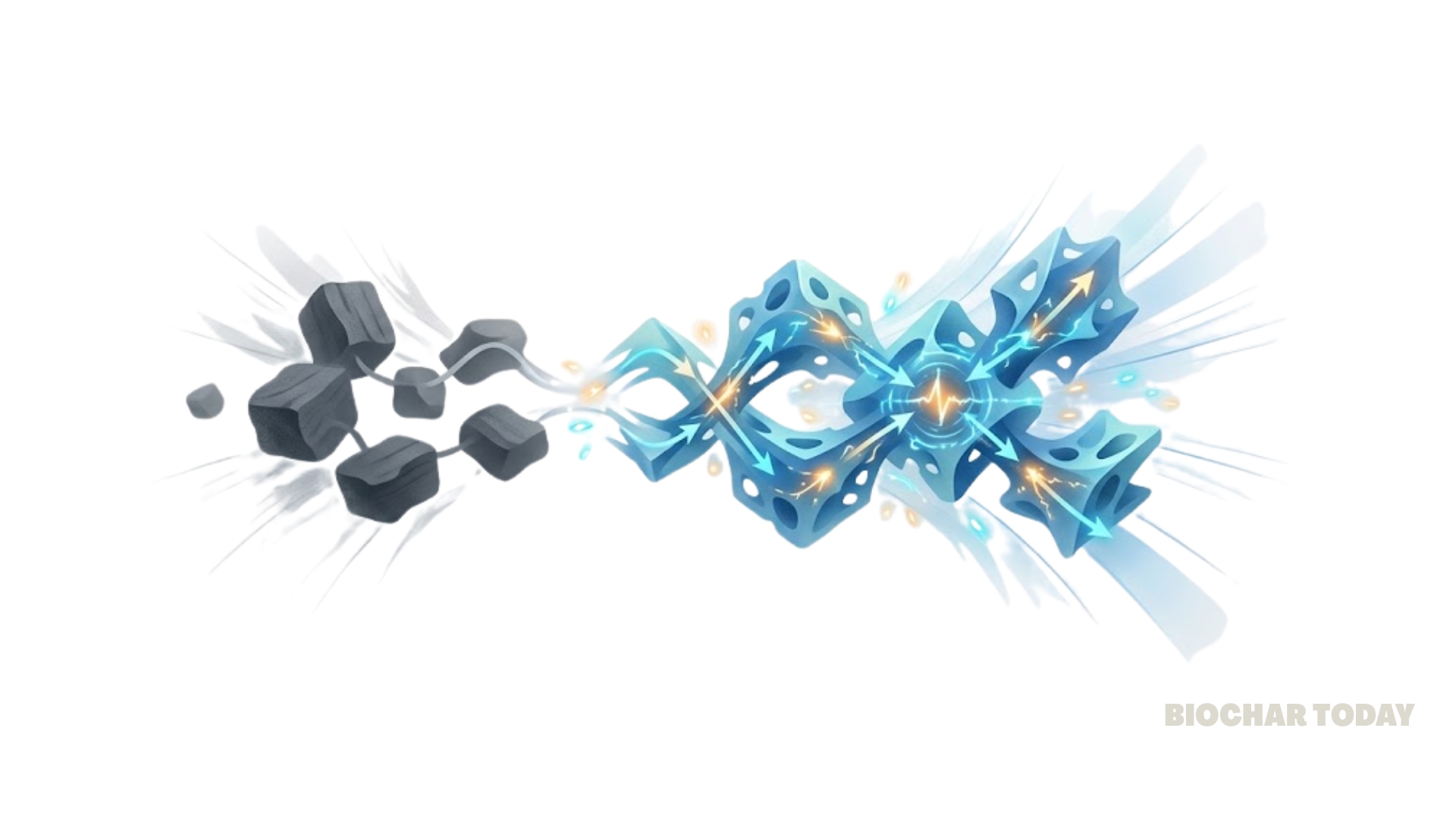
A recent review published in the journal Biochar by authors Shasha Li, Zimeng Zhang, Yanling Ren, Fan Lü, Xiaoying Hu, Zhenhan Duan, Lili Yang, Jianwei Du, Pinjing He, Mingyang Zhang, and Yong Wen establishes that the inherent redox properties of pristine biochar provide a distinct commercial and ecological advantage. While the large-scale practical utilization of biochar has historically been restricted by its lower specific surface area and structural conductivity when compared to commercial activated carbonActivated carbon is a form of carbon that has been processed to create a vast network of tiny pores, increasing its surface area significantly. This extensive surface area makes activated carbon exceptionally effective at trapping and holding impurities, like a molecular sponge. It is commonly More or graphene, its internal chemical composition offers a compelling alternative. The publication notes that post-modification strategies designed to improve these physical traits frequently cause severe structural instability, high secondary pollution, and excessive energy costs that undermine sustainability. By exploring the fundamental mechanisms that govern electron transfer, the authors demonstrate that pristine biochar can achieve superior performance in breaking down environmental contaminants and assisting microbial energy recovery simply by exploiting its built-in chemical groups.
The synthesis of existing literature demonstrates that biochar successfully eliminates kinetic hindrance and accelerates abiotic and extracellular electron transfer across diverse environmental scenarios. Statistically, the biological degradation efficiency of biochar correlates directly with its electron exchange capacities rather than its physical electrical conductivity. This enables pristine biochar to easily outperform highly conductive graphitic materials that entirely lack built-in chemical redox activity. For example, the material’s specific oxygenated groups decrease the activation energies of greenhouse gas molecules, facilitating an output rate that is more than ten times higher than that achieved by advanced carbon alternatives like graphene. This outstanding capability proves that upgrading the intrinsic chemical reactivity of biochar offers a highly sustainable pathway for global environmental management and industrial carbon storage without the need for expensive post-treatments.
However, accurately assessing and standardizing these properties presents a significant industrial challenge due to the immense complexity of biochar structure. Chemical, electrochemical, and microbiological testing methods often yield highly conflicting measurements of electron exchange capacities. This wide divergence occurs because individual testing probes rely on distinct chemical reagents and microorganisms that operate across vastly different electrical potential ranges. Furthermore, the physical shape and internal porosityPorosity of biochar is a key factor in its effectiveness as a soil amendment and its ability to retain water and nutrients. Biochar’s porosity is influenced by feedstock type and pyrolysis temperature, and it plays a crucial role in microbial activity and overall soil health. Biochar More of biochar restrict the spatial accessibility of its active sites, as many crucial groups remain trapped inside pores that are physically too small for testing probes or microbes to enter. Consequently, a large portion of the material’s true electron capacity is heavily underestimated during standard laboratory evaluations, complicating direct performance comparisons.
The long-term performance of biochar is further altered by natural weathering processes once it is deployed into real environmental systems. Environmental aging causes mechanical disintegration and structural fracturing from rainfall and freeze-thaw cycles, which breaks the bulk material down into highly mobile colloidal and nanoscale particles. This physical breakdown exposes deep internal surfaces and unleashes dissolved black carbon that acts as an active electron shuttle to accelerate local toxic metal transformations. Simultaneously, ongoing abiotic oxidation introduces more oxygen-rich functional groups onto the material’s surface, while organic, mineral, and microbial coatings form external layers that block existing pores. Because these natural factors exert directly opposing effects on active site exposure and pore availability, the final net change in electron transfer capacity remains highly unpredictable over time.
To overcome these structural complexities and achieve cost-effective manufacturing, the authors highlight advanced data-driven design strategies as the future of the industry. Co-pyrolysis, which involves processing multiple types of organic waste streams together in a low-oxygen atmosphere, allows manufacturers to naturally tailor the internal elements and active sites of biochar without generating secondary chemical waste. By utilizing machine learning algorithms and multi-objective optimization models, engineers can accurately predict how specific combinations of waste feedstocks and heating temperatures will behave. This advanced mathematical approach allows producers to finely balance material performance against environmental risks and financial costs. Ultimately, prioritizing and targeting the inherent redox superiority of biochar provides a clear, sustainable blueprint for maximizing its utility in global green engineering.
Source: Li, S., Zhang, Z., Ren, L., Lü, F., Hu, X., Duan, Z., Yang, L., Du, J., He, P., Zhang, M., & Wen, Y. (2026). Driving biochar applications via intrinsic redox superiority: electron transfer mechanisms, quantification, aging effects, and design strategies. Biochar, 8(87).





Leave a Reply