
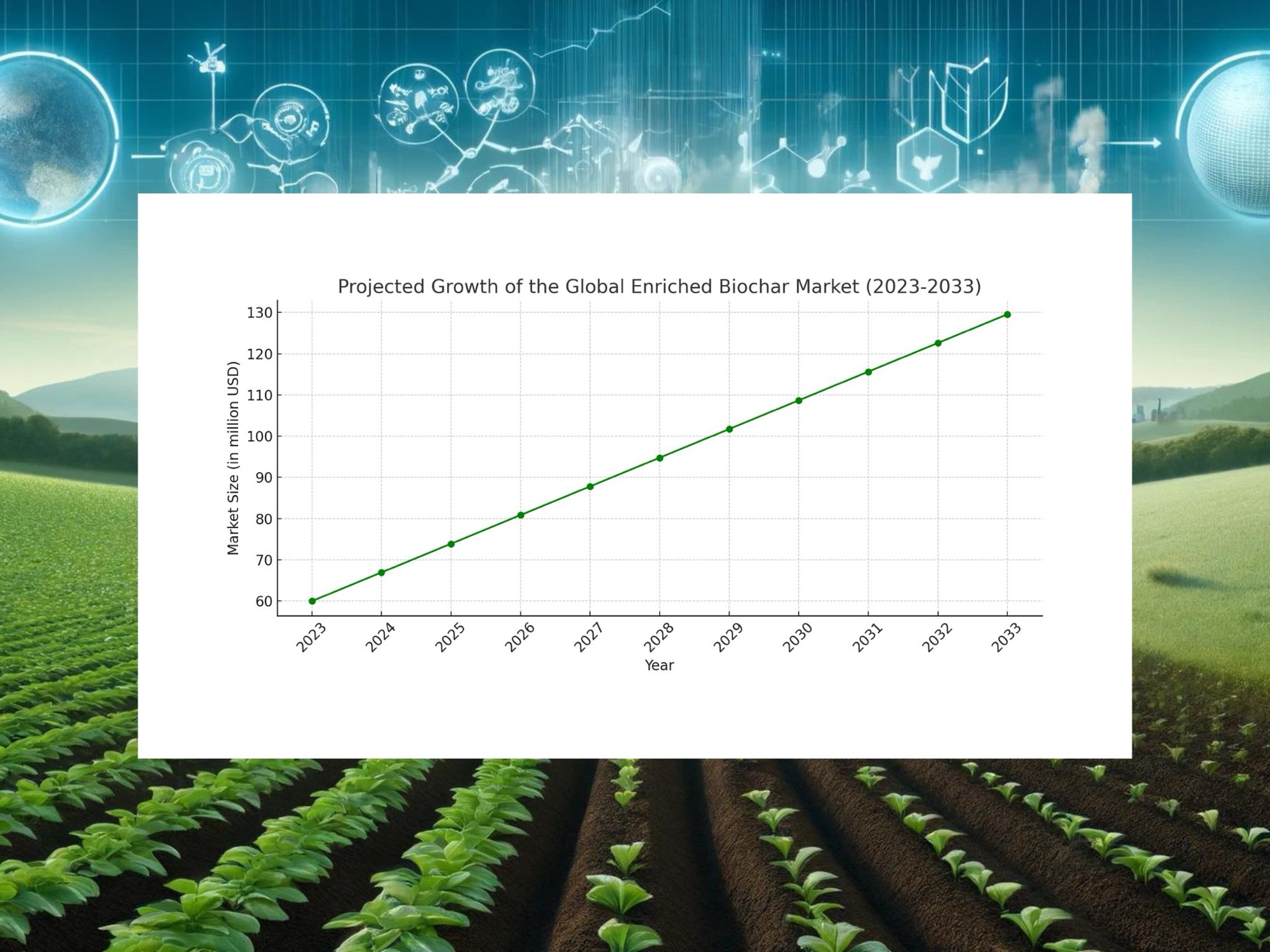
The global enriched biocharBiochar is a carbon-rich material created from biomass decomposition in low-oxygen conditions. It has important applications in environmental remediation, soil improvement, agriculture, carbon sequestration, energy storage, and sustainable materials, promoting efficiency and reducing waste in various contexts while addressing climate change challenges. More market, valued at USD 60 million in 2023, is expected to reach USD 129.53 million by 2033, according to The Brainy Insights. This forecast underscores the market’s rapid expansion over the next decade, attributed primarily to advances in production technology and an increased emphasis on sustainable agricultural practices.
Enriched biochar is produced through the pyrolysisPyrolysis is a thermochemical process that converts waste biomass into bio-char, bio-oil, and pyro-gas. It offers significant advantages in waste valorization, turning low-value materials into economically valuable resources. Its versatility allows for tailored products based on operational conditions, presenting itself as a cost-effective and efficient More of organic biomassBiomass is a complex biological organic or non-organic solid product derived from living or recently living organism and available naturally. Various types of wastes such as animal manure, waste paper, sludge and many industrial wastes are also treated as biomass because like natural biomass these More. Its robust and porous nature makes it an ideal soil amendmentA soil amendment is any material added to the soil to enhance its physical or chemical properties, improving its suitability for plant growth. Biochar is considered a soil amendment as it can improve soil structure, water retention, nutrient availability, and microbial activity. More, enhancing soil fertility, structure, and moisture retention. In agriculture, which accounted for 51% of the market share and revenue of USD 30.60 million in 2023, enriched biochar is pivotal for promoting soil health and sustainable farming practices. The substance not only provides a habitat for beneficial microorganisms, thereby enriching soil ecology but also facilitates nutrient transport to plants and reduces nitrogen leaching—a significant pollutant in agricultural runoff.
The product’s ability to sequester carbon aids in mitigating climate change by capturing and storing carbon dioxide in a stable form. This carbon sequestration capability, combined with biochar’s efficacy in water filtration by removing impurities and enhancing water quality, marks it as a critical component in both environmental sustainability and agricultural productivity.
Europe is poised to dominate this market through the forecast period due to its commitment to environmental sustainability and robust support for biochar research and applications. The European Union’s financial support for sustainable agriculture further propels the use of enriched biochar, highlighting a region-wide shift towards innovative, environmentally friendly farming techniques.
However, the enriched biochar market faces challenges, including the substantial initial investment required for production facilities and the general lack of awareness about biochar’s benefits. These obstacles may hinder market growth, especially among small-scale farmers and businesses who find the upfront costs prohibitive.
Overall, while the initial costs and limited market awareness pose challenges, the ongoing research, governmental incentives, and increasing demand for sustainable agricultural products are expected to drive significant growth in the enriched biochar market over the next decade. This growth indicates a promising shift towards more sustainable and efficient agricultural practices globally.





Leave a Reply