
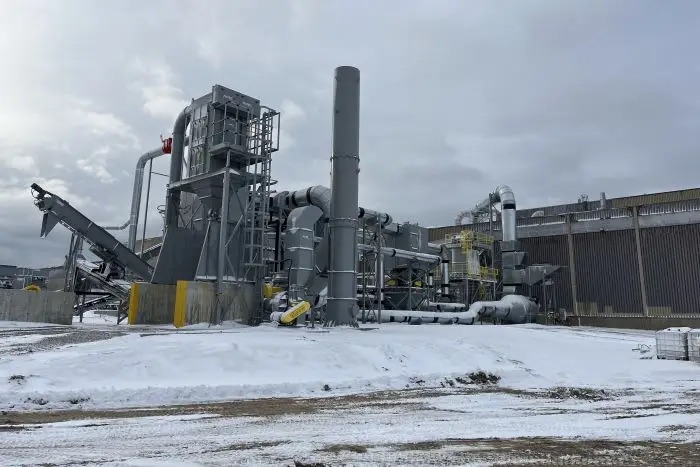
Canada’s biocharBiochar is a carbon-rich material created from biomass decomposition in low-oxygen conditions. It has important applications in environmental remediation, soil improvement, agriculture, carbon sequestration, energy storage, and sustainable materials, promoting efficiency and reducing waste in various contexts while addressing climate change challenges. More industry has reached a new level of maturity with the launch of Carbonité’s large-scale production facility in Port-Cartier, Quebec. Operational since February 2025, the plant is on track to produce 10,000 tonnes of biochar this year, sourced entirely from residual biomassBiomass is a complex biological organic or non-organic solid product derived from living or recently living organism and available naturally. Various types of wastes such as animal manure, waste paper, sludge and many industrial wastes are also treated as biomass because like natural biomass these More supplied by the nearby forestry sector.
Located in a former pulp and paper mill, the facility uses an automated pyrolysisPyrolysis is a thermochemical process that converts waste biomass into bio-char, bio-oil, and pyro-gas. It offers significant advantages in waste valorization, turning low-value materials into economically valuable resources. Its versatility allows for tailored products based on operational conditions, presenting itself as a cost-effective and efficient More process to convert forest residues like bark into biochar. The operation also recovers and reuses syngasSyngas, or synthesis gas, is a fuel gas mixture consisting primarily of hydrogen and carbon monoxide. It is produced during gasification and can be used as a fuel source or as a feedstock for producing other chemicals and fuels. More generated during pyrolysis, which is condensed into bio-oil, making the process more energy efficient and economically viable.
Most of the current production is exported to Europe, where demand remains strong. However, Carbonité’s broader strategy includes domestic applications and replication of its model in other regions. Plans are in place to add two more production lines by 2027, tripling capacity to 30,000 tonnes annually.
Biochar from this facility offers known benefits: long-term carbon storage, improved soil structure, and enhanced nutrient retention. Despite its promise, cost remains a challenge, especially for large-scale agricultural use. At up to $1,200 per tonne, it is currently most suitable for targeted or high-value applications.
Transportation logistics also present hurdles. With no container terminal at the Port-Cartier dock, all shipments are trucked to Montreal. Local stakeholders are advocating for infrastructure upgrades to support future export capacity.
Carbonité’s operation marks a significant step in building a forest-based circular economy, offering a scalable model for climate-resilient industrial development.




Leave a Reply