
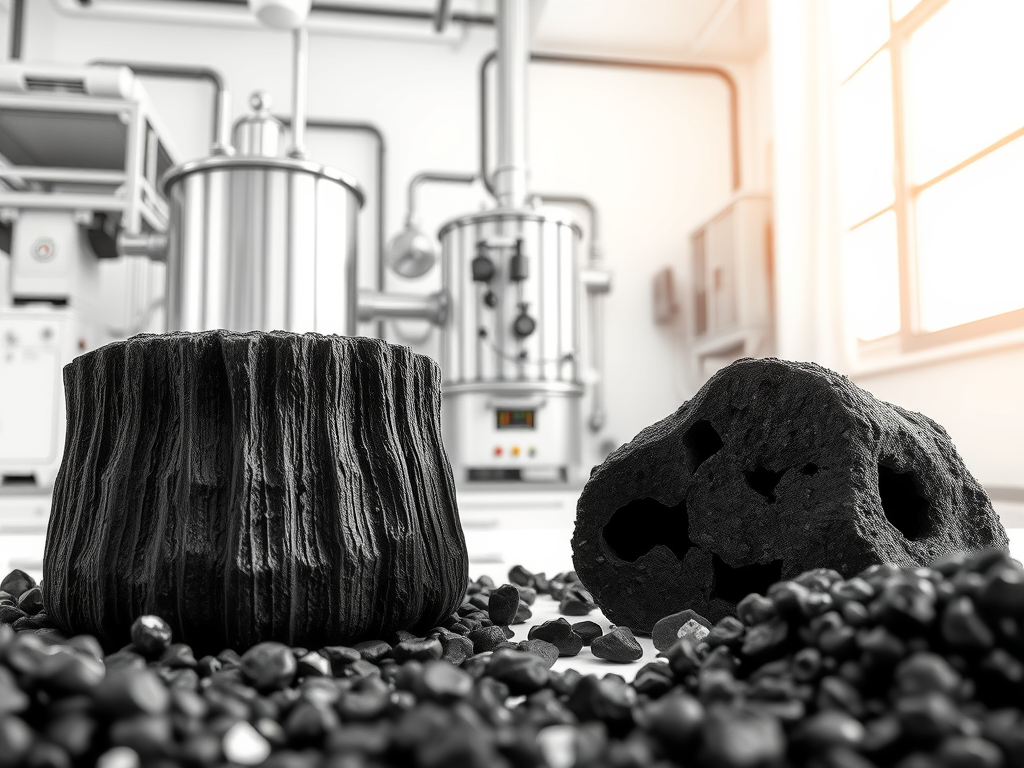
From an in-house reactor, biocharBiochar is a carbon-rich material created from biomass decomposition in low-oxygen conditions. It has important applications in environmental remediation, soil improvement, agriculture, carbon sequestration, energy storage, and sustainable materials, promoting efficiency and reducing waste in various contexts while addressing climate change challenges. More with superior properties for waste valorization was made, challenging expensive commercial reactors. In an article published in RSC Advances, Mashrafi Bin Mobarak, Fariha Chowdhury, and others examined the properties of biochar made from rubber seed shells (RSS) in both an in-house built reactor and a commercial pyrolytic reactor. Their work revealed that despite being produced under identical conditions—600 °C for three hours at a heating rate of 10 °C per minute—the resulting biochars had distinct characteristics, with the in-house version showing superior properties. This study highlights how the choice of reactor can significantly affect the final product, offering a cost-effective path for creating high-quality biochar.
Biochar produced through pyrolysisPyrolysis is a thermochemical process that converts waste biomass into bio-char, bio-oil, and pyro-gas. It offers significant advantages in waste valorization, turning low-value materials into economically valuable resources. Its versatility allows for tailored products based on operational conditions, presenting itself as a cost-effective and efficient More, creates a material that resists breaking down, which makes it good for long-term carbon storage. The kind of raw material used, along with the preparation method, influences the final product’s properties like its surface area, pHpH is a measure of how acidic or alkaline a substance is. A pH of 7 is neutral, while lower pH values indicate acidity and higher values indicate alkalinity. Biochars are normally alkaline and can influence soil pH, often increasing it, which can be beneficial More, and nutrient content. The research compared two biochar samples: RSSBC-1, from the in-house reactor, and RSSBC-2, from a commercial one.
Elemental analysis revealed a higher carbon and nitrogen content in RSSBC-1, while RSSBC-2 had more hydrogen and oxygen. The in-house biochar also had a lower O/C ratio, which is a key measure of biochar stability and suggests a reduced risk of carbon dioxide emissions. A very low O/C ratio, specifically below 0.2, suggests a biochar half-life that could be over 1000 years. Both biochar samples in this study had O/C ratios well below this threshold, at 0.08 for RSSBC-1 and 0.14 for RSSBC-2, indicating they are very stable. The H/C ratio, an indicator of aromaticity, was the same for both at 0.02.
The physical structures of the biochars also showed notable differences. Scanning Electron Microscopy (SEM) images showed that RSSBC-1 had a corrugated and rough surface with elliptical pores. In contrast, RSSBC-2 had a denser and more rigid surface with crack-like pores. A more quantitative analysis using nitrogen adsorption-desorption isotherms found that RSSBC-1 had a higher specific surface area of 336.02 m2g−1 compared to 299.09 m2g−1 for RSSBC-2. The average pore diameter was also smaller for the in-house biochar at 2.67 nm compared to 2.79 nm for the commercial one. A smaller particle size was also observed for RSSBC-1, with an average hydrodynamic diameter of 115.23 nm, while RSSBC-2 measured 248.68 nm.
The electrical properties of the biochars were also distinct. The point of zero charge (PZC), which is the pH at which the biochar’s surface has no net charge, was 7.65 for RSSBC-1 and 6.14 for RSSBC-2. This suggests that RSSBC-1’s surface would be positively charged over a wider pH range. Zeta potential measurements showed that RSSBC-1 had a heterogeneous surface charge distribution with two distinct peaks at -16.72 mV and +37.61 mV, while RSSBC-2 had a uniform negative charge of -14.91 mV. This varied charge on RSSBC-1 might make it better for environmental remediation because it could interact with a wider range of contaminants.
Overall, the findings confirmed that the reactor type significantly influences the properties of the biochar produced. The in-house built reactor, despite its lower cost, yielded biochar with superior qualities for certain applications, such as a higher specific surface area and heterogeneous surface charge. This research supports the use of more accessible, in-house reactors as a viable alternative to expensive commercial ones for producing high-quality biochar from agricultural waste, thereby promoting waste valorization and long-term carbon sequestration..
Source: Mobarak, M. B., Chowdhury, F., Quddus, M. S., Pinky, N. S., Mustafi, S., Nahar, A., Akhtar, U. S., Yasmin, S., & Alam, M. A. (2024). Unveiling the reactor effect: a comprehensive characterization of biochar derived from rubber seed shell via pyrolysis and in-house reactor. RSC Advances, 14(52), 29848–29859.





Leave a Reply