
Key Takeaways
- Wood shrinks unevenly when heated to make biocharBiochar is a carbon-rich material created from biomass decomposition in low-oxygen conditions. It has important applications in environmental remediation, soil improvement, agriculture, carbon sequestration, energy storage, and sustainable materials, promoting efficiency and reducing waste in various contexts while addressing climate change challenges. More because its two main structural carbohydrates break down at different temperatures.
- Sideways shrinkage starts first as softer hemicellulose breaks down, while lengthwise shrinkage occurs later when tougher cellulose fibers decompose.
- Naturally occurring minerals in wood, especially sodium and potassium, lower the temperature at which wood starts shrinking by about thirty degrees Celsius.
- Hardwoods generally shrink more across their width than softwoods because of differences in how their internal nutrient-transporting cells are shaped and arranged.
- Choosing specific tree species and adjusting mineral levels before heating allows producers to predictably shape the final pore structure of biochar.
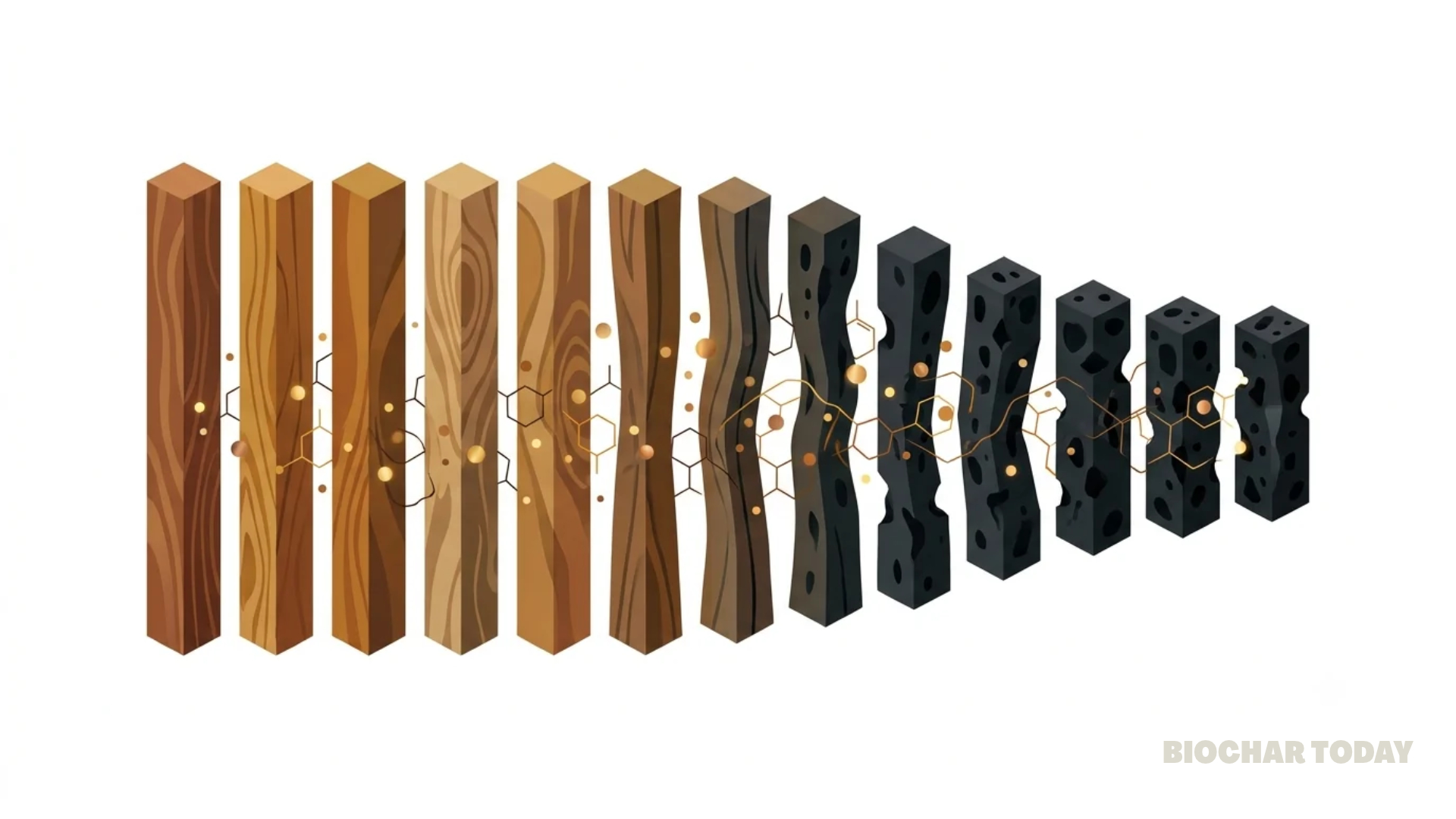
A recent study in the journal Biochar by Yu Wang, Ramadan Eljamal, Misao Yokoyama, Takashi Nomura, Eiji Minami, and Haruo Kawamoto of Kyoto University reveals how wood chemistry and mineral content dictate directional shrinkage during biochar production. Examining five softwood and five hardwood species alongside variants treated with specific mineral ions, the researchers demonstrated that uneven shrinkage during heating is driven by the sequential breakdown of cell-wall carbohydrates. These findings clarify how producers can control the final physical architecture of wood-derived biochar.
When wood is heated in the absence of oxygen to produce biochar, it shrinks unevenly—a phenomenon known as anisotropic shrinkage. This uneven contraction directly shapes the internal pore network and mechanical stability of the resulting carbon material. While dimensional stability is advantageous for filtration and catalysis, controlled shrinkage can generate beneficial micropores for agricultural soil amendments. Until now, however, the exact chemical and structural mechanisms governing how wood contracts along its length versus across its width remained poorly understood.
s42773-026-00661-5 (1).pdf+ 4
The researchers discovered that directional shrinkage follows a distinct two-stage chemical sequence. Across the ten species tested—including Japanese cedar, Douglas fir, Japanese beech, and paulownia—radial shrinkage across the width of the wood began first, triggered primarily by the thermal breakdown of hemicellulose. At this early stage, most cellulose remained intact, with 40 to 90 percent of glucomannan and 30 to 90 percent of xylan still present. Conversely, longitudinal shrinkage along the grain began much later, after hemicellulose levels fell below 20 percent and cellulose microfibrils started to degrade. Longitudinal contraction peaked at temperatures 10 to 20 degrees Celsius above the point of maximum weight loss, when cellulose recovery dropped to between 2 and 36 percent in softwoods and 1 to 25 percent in hardwoods. Once heating exceeded 400 degrees Celsius and cellulose fully decomposed, directional differences disappeared.
Natural minerals bound to the cell wall also strongly altered this thermal behavior. Substituting native minerals with monovalent alkali metals—specifically sodium and potassium—lowered cellulose degradation and shrinkage onset temperatures by approximately 30 degrees Celsius across most species. In contrast, treating hardwoods with hydrogen or magnesium ions delayed the peak radial shrinkage rate by roughly 10 degrees Celsius while increasing overall sideways contraction. Calcium ions generally suppressed radial shrinkage, a pattern exemplified by Japanese zelkova, which naturally contains high levels of calcium oxalate. Wood anatomy further amplified these chemical effects: hardwoods shrank more across their width than softwoods because their radial ray parenchyma cells are arranged in short, wide clusters rather than single, reinforced rows.
By mapping how specific tree species and mineral ions interact during pyrolysisPyrolysis is a thermochemical process that converts waste biomass into bio-char, bio-oil, and pyro-gas. It offers significant advantages in waste valorization, turning low-value materials into economically valuable resources. Its versatility allows for tailored products based on operational conditions, presenting itself as a cost-effective and efficient More, this research establishes a practical framework for engineering biochar properties. Rather than treating wood shrinkage as an unpredictable byproduct of heating, manufacturers can select specific feedstocks and adjust mineral concentrations prior to carbonization to tune pore development and structural integrity for targeted environmental, agricultural, and industrial uses.
Source: Wang, Y., Eljamal, R., Yokoyama, M., Nomura, T., Minami, E., & Kawamoto, H. (2026). Cell-wall chemistry governs anisotropic shrinkage during wood carbonization: roles of polysaccharide degradation and exchangeable cations. Biochar, 8, 144.




Leave a Reply