
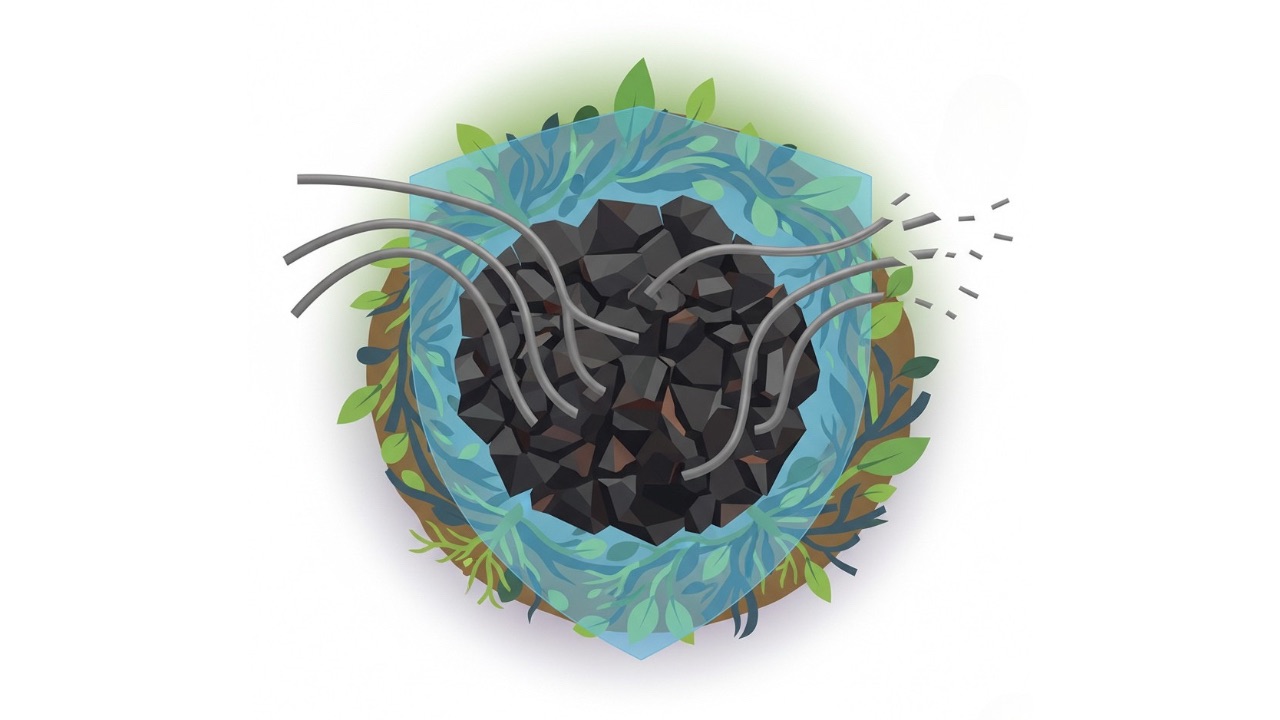
Key Takeaways
- Using plants to clean up lead (Pb)-polluted soil creates large amounts of toxic plant waste (Pb-enriched biomassBiomass is a complex biological organic or non-organic solid product derived from living or recently living organism and available naturally. Various types of wastes such as animal manure, waste paper, sludge and many industrial wastes are also treated as biomass because like natural biomass these More) that can cause secondary pollution.
- Heating this plant waste in a low-oxygen environment (pyrolysisPyrolysis is a thermochemical process that converts waste biomass into bio-char, bio-oil, and pyro-gas. It offers significant advantages in waste valorization, turning low-value materials into economically valuable resources. Its versatility allows for tailored products based on operational conditions, presenting itself as a cost-effective and efficient More) turns it into a stable biocharBiochar is a carbon-rich material created from biomass decomposition in low-oxygen conditions. It has important applications in environmental remediation, soil improvement, agriculture, carbon sequestration, energy storage, and sustainable materials, promoting efficiency and reducing waste in various contexts while addressing climate change challenges. More, significantly reducing the waste volume by over 90%.
- Pyrolysis at elevated temperatures, particularly ≥500∘C , is necessary to convert the most toxic, bioavailable forms of Pb into highly stable mineral compounds.
- High-temperature biochar (700∘C) dramatically increases the stable Pb fraction from 28% in the raw plant waste to 83% in the final material , drastically reducing the ecological risk.
- The treated biochar is safe for disposal under most natural conditions, as Pb release remains below regulatory limits (e.g., in water or mild acid rain, pH>4). However, disposal in extremely acidic sites (like acid mine drainage, pH=2) still poses a serious risk.
The challenge of managing large volumes of hazardous, metal-enriched biomass residues is a critical bottleneck for the broader implementation of phytoremediationThis is a technique that uses plants to clean up contaminated soil or water. Biochar can enhance phytoremediation by improving soil conditions and promoting plant growth, allowing plants to absorb and break down pollutants more effectively. More technology. While using plants to clean up lead (Pb)-polluted soil is ecologically friendly and cost-effective, the resulting plant waste, or Pb-enriched biomass (BMPb), can lead to secondary pollution if improperly disposed of. A study by Liu et al. in Frontiers in Chemistry provides a detailed solution: pyrolyzing this waste at various temperatures (300°C to 700°C) to produce Pb-enriched biochar (BCPb). The researchers focused on elucidating the mechanisms underlying stabilization and evaluating the environmental safety of the resulting material.
Pyrolysis effectively reduced the volume of the BMPb by more than 90% and concentrated the Pb within the biochar matrix. The core finding reveals that the effectiveness of Pb stabilization is strongly dependent on the pyrolysis temperature. At lower temperatures, minerals like lead phosphate and lead carbonate dominate Pb immobilization. At higher temperatures, especially ≥500°C, more stable, complex phases become predominant, including lead hydroxy carbonate and sodium aluminosilicate. This chemical shift is driven by the increasing alkalinity of the biochar at elevated temperatures, which promotes the formation of these stable lead precipitates. For instance, the pHpH is a measure of how acidic or alkaline a substance is. A pH of 7 is neutral, while lower pH values indicate acidity and higher values indicate alkalinity. Biochars are normally alkaline and can influence soil pH, often increasing it, which can be beneficial More of the biochar significantly increased with temperature, reaching a maximum of 10.49 at 700°C.
This chemical transformation successfully converts the highly mobile, bioavailable portions of Pb into stable fractions. In the raw plant waste, the exchangeable (F1) and reducible (F2) fractions—which directly determine ecological risk—were the main species. With increasing pyrolysis temperature, these labile fractions drastically declined, while the stable fractions (oxidizable, F3, and residual, F4) rose significantly. Critically, the combined labile fraction (F1+F2) decreased substantially to 17% in the 700°C biochar, corresponding to a significant increase in the stable fraction (F3+F4) to 83%.
LeachingLeaching is the process where nutrients are dissolved and carried away from the soil by water. This can lead to nutrient depletion and environmental pollution. Biochar can help reduce leaching by improving nutrient retention in the soil. More tests confirmed the enhanced safety profile. In deionized water, the Pb leaching rate progressively diminished as the pyrolysis temperature increased. All BCPb samples, including those created at 700°C, remained below the relevant regulatory thresholds for landfills (less than 10.0 mg⋅g−1) when the pH was higher than 2. The inherent alkalinity of the biochar effectively buffered solutions mimicking acid rain (pH=4.0), stabilizing the Pb. However, under highly acidic conditions (pH=2.0), the leaching was exceptionally high (up to 46.06 mg⋅g−1), indicating the material is not suitable for disposal in environments prone to extreme acidification, such as acid mine drainage sites. Furthermore, a 45-day soil simulation experiment confirmed that the bioavailable Pb in the biochar was converted toward more stable forms upon exposure to natural soil conditions.
Overall, the findings suggest that pyrolysis of Pb-enriched biomass at temperatures above 500°C offers an effective and safe method for residue treatment. While the process dramatically reduces direct ecological risk (lowering the Risk Assessment Code and Potential Ecological Risk Index), the resultant material still contains a high total concentration of Pb, leading to an elevated geological accumulation index. This underscores the need for secure disposal or further treatment of the stabilized biochar to mitigate long-term geological accumulation hazards.
Source: Liu, J., Wang, Y., Pang, J., Wang, J., Li, T., & Wang, L. (2025). Mechanistic insights into pyrolysis temperature-dependent lead (Pb) stabilization in phytoremediation residue-derived biochar. Frontiers in Chemistry, 13:1705662.


Leave a Reply