
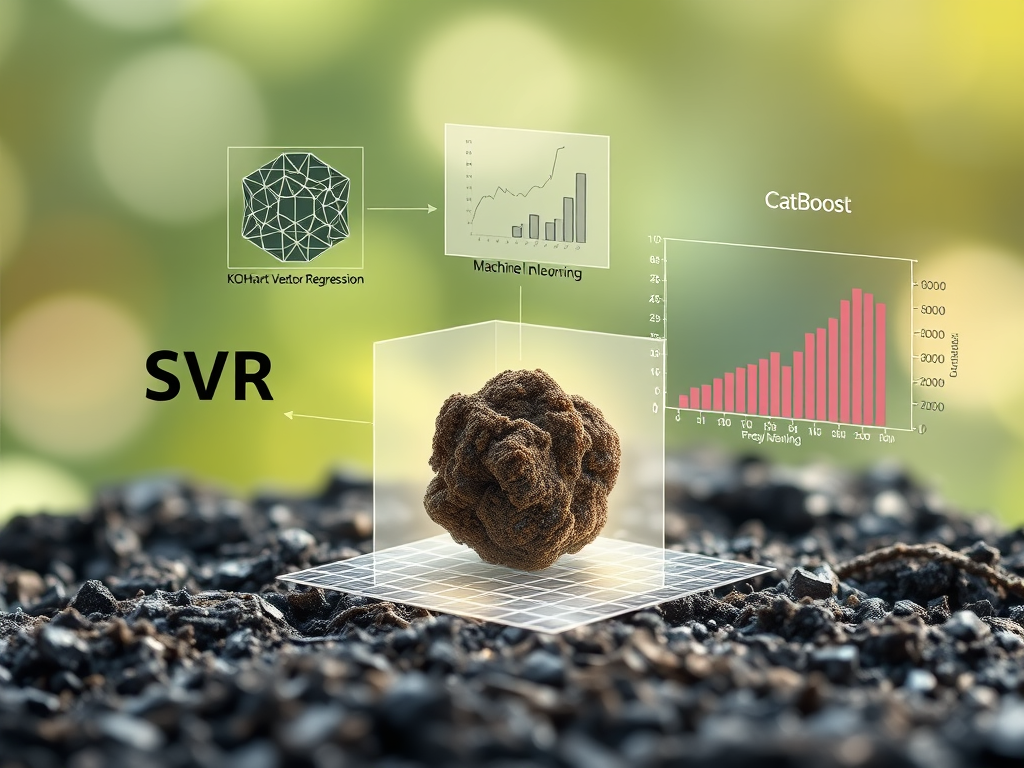
In a groundbreaking study published in Scientific Reports, Raouf Hassan and Alireza Baghban have unveiled advanced machine learning models that promise to significantly enhance our ability to predict carbon dioxide (CO2) adsorption in KOH-activated biocharBiochar is a carbon-rich material created from biomass decomposition in low-oxygen conditions. It has important applications in environmental remediation, soil improvement, agriculture, carbon sequestration, energy storage, and sustainable materials, promoting efficiency and reducing waste in various contexts while addressing climate change challenges. More. This is a crucial development for geoenergy engineering and environmental technology, particularly in the quest for efficient carbon capture and storage (CCS) solutions. The research, which trained and validated models on a dataset of 329 data points, focuses on capturing the intricate relationships between variables like pressure, temperature, and the physical and chemical properties of biochar, and their influence on CO2 adsorption.
Biochar, derived from organic biomassBiomass is a complex biological organic or non-organic solid product derived from living or recently living organism and available naturally. Various types of wastes such as animal manure, waste paper, sludge and many industrial wastes are also treated as biomass because like natural biomass these More and chemically activated by potassium hydroxide (KOH), is especially appealing because of its sustainable nature, renewable origins, and ease of customization. However, the effectiveness of pristine biochar in CO2 adsorption is often limited by its underdeveloped pore structure. KOH activation is a highly efficient method to improve this structure by promoting the formation of micropores and small mesopores, which are essential for boosting CO2 adsorption capacity. Accurate modeling of CO2 adsorption in KOH-activated biochar is vital for optimizing its application in carbon capture technologies, especially in industries like petroleum where reducing CO2 emissions is increasingly critical. The complexity arises from the interplay of factors such as pressure, temperature, biochar composition, and the degree of KOH activation, all of which directly influence adsorption capacity.
To navigate this complexity, the researchers employed a comprehensive suite of fifteen machine learning methods, including convolutional neural networks (CNNs), random forests (RFs), artificial neural networks (ANNs), linear regression, ridge and lasso regressions, elastic net, support vector machines (SVMs), decision trees (DTs), gradient boosting machines (GBMs), k-nearest neighbors (KNN), light gradient boosting machines (LightGBM), extreme gradient boosting (XGBoost), CatBoost, and Gaussian process models. This extensive comparison allowed for a thorough evaluation of their predictive power.
The rigorous analysis, which included Monte Carlo outlier detection to ensure data suitability, revealed that the Support Vector Regression (SVR) and CatBoost models significantly outperformed the others. These models achieved the highest accuracy in predicting CO2 adsorption, with impressive R2 values of 0.9235 for SVR and 0.9327 for CatBoost. Coupled with low mean squared error (MSE) values of 0.2207 for SVR and 0.1942 for CatBoost, these results demonstrate their superior ability to capture the intricate relationships within the data.
Further insights were gained through sensitivity and SHAP (SHapley Additive exPlanations) analyses. The sensitivity analysis indicated a correlation between all input parameters and CO2 adsorption. Crucially, the SHAP analysis identified pressure and temperature as the most critical factors influencing CO2 adsorption levels in KOH-activated biochar. This highlights their paramount importance in controlling adsorption efficiency and provides fundamental understanding for future material design and process optimization.
The findings of this study are a significant step forward in developing cognitive carbon capture tools. By providing highly accurate predictive models, particularly SVR and CatBoost, this research can accelerate the design, screening, and optimization of KOH-activated biochar for industrial CO2 capture applications, thereby reducing the reliance on costly and time-consuming experimental work. The robust performance and interpretability of these models offer valuable insights for enhancing adsorption efficiency in real-world scenarios.
Source: Hassan, R., & Baghban, A. (2025). Predicting CO2 adsorption in KOH-activated biochar using advanced machine learning techniques. Scientific Reports, 15(24410).





Leave a Reply