
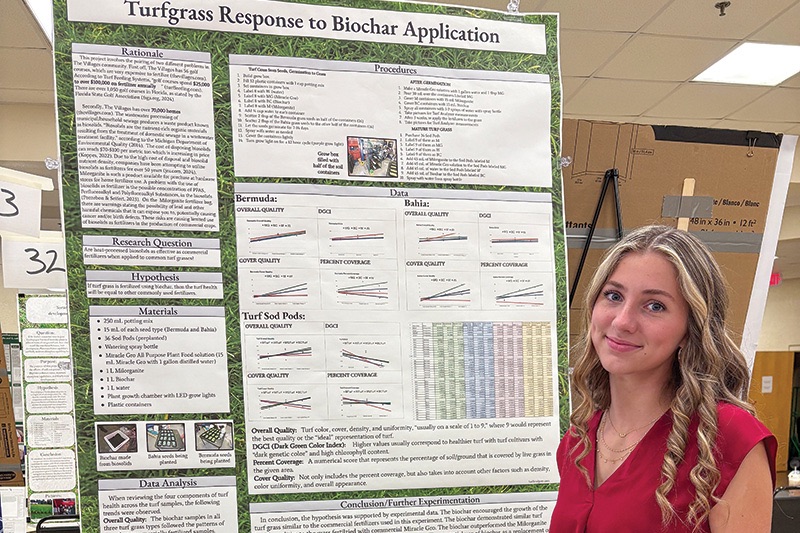
A Florida high school student’s science project offers a promising path toward more sustainable golf course maintenance. Sarah Colley, a sophomore at The Villages High School, investigated whether biocharBiochar is a carbon-rich material created from biomass decomposition in low-oxygen conditions. It has important applications in environmental remediation, soil improvement, agriculture, carbon sequestration, energy storage, and sustainable materials, promoting efficiency and reducing waste in various contexts while addressing climate change challenges. More, a product derived from recycled sewage, could serve as an effective and environmentally friendly alternative to traditional fertilizers. Her research aimed to reduce both golf courses’ reliance on chemical fertilizers and the costly, often environmentally taxing, disposal of human biosolids.
In her garage laboratory, Colley compared biochar to Miracle-Gro fertilizer on bermudagrass and bahiagrass. Her initial findings indicated that biochar yielded comparable results to the commercial fertilizer. This innovative project, titled “Turfgrass Response to Biochar Application,” earned Colley a spot at the Regeneron International Science and Engineering Fair.
Colley was inspired by the dual challenges of fertilizer expenses for golf courses and the significant costs associated with managing wastewater treatment byproducts. The biochar used in her experiment, supplied by Jacobs Engineering, is unique because it’s processed to eliminate PFAS chemicals, harmful substances often found in similar commercial products. These “forever chemicals” pose environmental and health risks, accumulating in organisms and potentially causing serious health issues in humans. Colley’s project demonstrated biochar’s potential as an equally effective and PFAS-free fertilizer.
Using the TurfAnalyzer app to evaluate her data, Colley confirmed that turf treated with biochar responded similarly to that treated with Miracle-Gro across several quality metrics, including overall quality, percent coverage, and dark green color index. This summer, she plans to expand her research to an actual golf course plot, further testing her findings in a real-world setting. Her work highlights a significant step towards greener golf course management.




Leave a Reply