
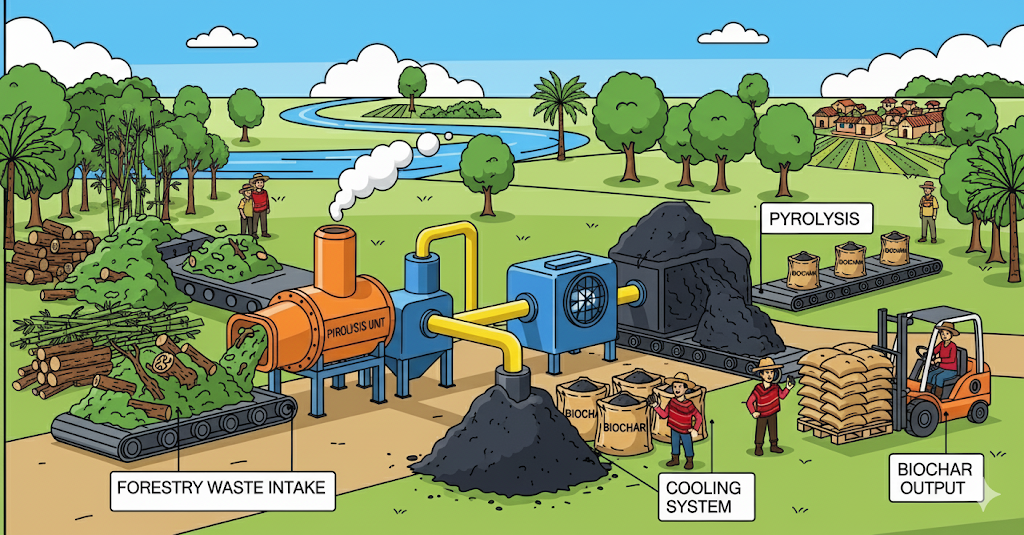
Construction has begun on a new biocharBiochar is a carbon-rich material created from biomass decomposition in low-oxygen conditions. It has important applications in environmental remediation, soil improvement, agriculture, carbon sequestration, energy storage, and sustainable materials, promoting efficiency and reducing waste in various contexts while addressing climate change challenges. More production facility in Guarayos, Bolivia, a project led by the biochar company Exomad Green. The plant represents a significant expansion of the company’s operations, which currently produce biochar at two sites in the Santa Cruz department. The new facility, a collaboration with Japanese firm Itochu, is projected to have an annual production capacity of 100,000 tonnes of biochar.
The project is situated on a 15-hectare site and involves an investment of $50 million. Operations are scheduled to commence in the second quarter of 2026. This new plant is designed to use forestry waste as its primary raw material. By converting this waste into biochar, the facility aims to address both environmental challenges and economic opportunities within the forestry sector.
Exomad Green, which was founded in 2013, has a long-standing presence in Bolivia, operating across 12 forestry concessions and supplying biochar to various global markets. The company’s current production volume is approximately 25,000 tonnes annually. This new Guarayos plant will substantially increase their output. The expansion is part of a broader strategy to meet growing global demand for biochar, particularly for its applications in agriculture for soil enhancement and as a carbon sequestration tool. The partnership with Itochu, a company with a strong focus on sustainable investments, reflects the increasing interest from international partners in large-scale biochar projects.
SOURCE: Exomad Green, líder mundial en producción de biochar, inicia megaobra en Guarayos


![Eucalyptus Wood Waste-Derived Biochar Achieves a Ninety-Eight Percent Removal Efficiency for Benzo[ghi]perylene in Vehicle-Wash Wastewater](https://biochartoday.com/wp-content/uploads/2026/10/SCIENCE-BLOGS-2026-2026-10-19T160523.703.jpg)

Leave a Reply