
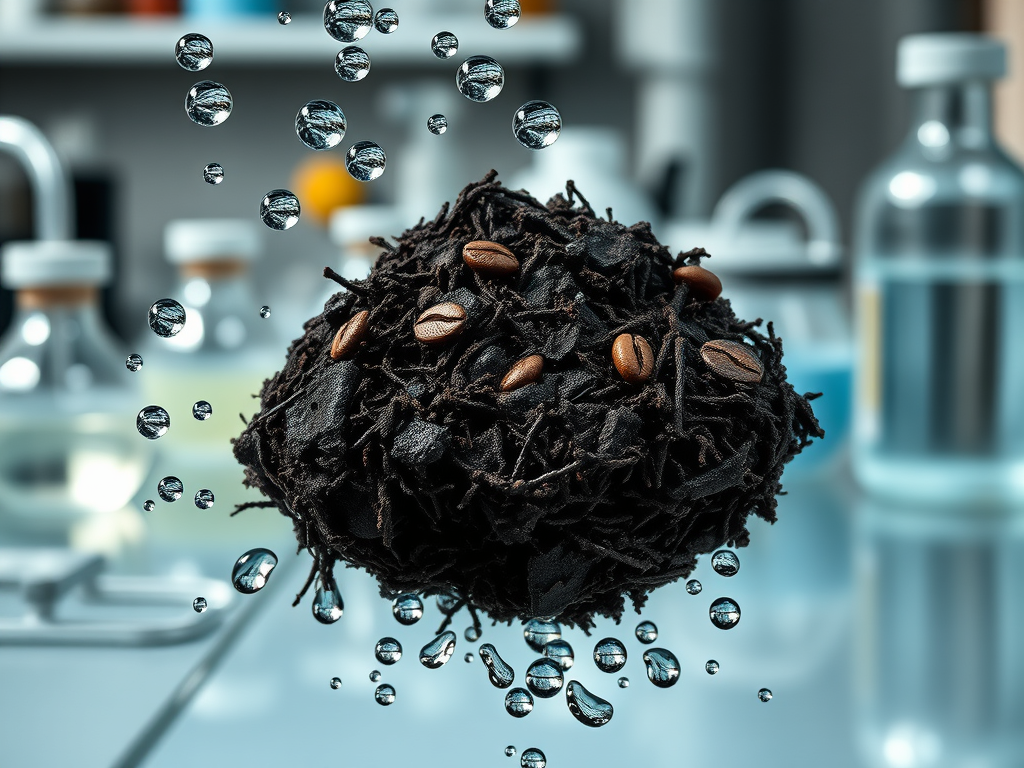
Inga Block and colleagues, in their recent study published in ACS Omega , explore an innovative approach to wastewater treatment by enhancing biocharBiochar is a carbon-rich material created from biomass decomposition in low-oxygen conditions. It has important applications in environmental remediation, soil improvement, agriculture, carbon sequestration, energy storage, and sustainable materials, promoting efficiency and reducing waste in various contexts while addressing climate change challenges. More derived from spent coffee grounds (SCG). The study investigates how chemical activation with magnesium carbonate (MgCO₃) improves the biochar’s surface area and adsorption efficiency for removing organic contaminants from aqueous solutions.
The researchers developed a biochar material with a significantly increased surface area (~600 m²/g), optimizing its ability to adsorb a variety of pollutants. Their experiments demonstrated that the enhanced biochar effectively removed up to 100% of dyes such as methylene blue and methyl orange, as well as pharmaceuticals like diclofenac and tetracycline, along with bisphenol A (BPA), an endocrine disruptor. Adsorption efficiency was influenced by pHpH is a measure of how acidic or alkaline a substance is. A pH of 7 is neutral, while lower pH values indicate acidity and higher values indicate alkalinity. Biochars are normally alkaline and can influence soil pH, often increasing it, which can be beneficial More, with some contaminants showing better removal rates in acidic or basic conditions.
Structural analysis using FTIR, SEM, and XRD confirmed that the improved biochar exhibited high porosityPorosity of biochar is a key factor in its effectiveness as a soil amendment and its ability to retain water and nutrients. Biochar’s porosity is influenced by feedstock type and pyrolysis temperature, and it plays a crucial role in microbial activity and overall soil health. Biochar More and stability. Adsorption followed a pseudo-first-order kinetic model, suggesting strong pollutant affinity. Additionally, the material maintained high efficiency across multiple reuse cycles, making it a cost-effective and sustainable alternative to traditional activated carbonActivated carbon is a form of carbon that has been processed to create a vast network of tiny pores, increasing its surface area significantly. This extensive surface area makes activated carbon exceptionally effective at trapping and holding impurities, like a molecular sponge. It is commonly More.
This research highlights the potential of spent coffee biochar as an eco-friendly solution for water purification. Future studies should focus on scaling up production and evaluating its performance in real-world wastewater treatment applications.
SOURCE: Block, I., Rawel, H. M., Klamroth, T., Günter, C., Kim, J., Loepthien, F., Gahlaut, S. K., Bald, I., & Taubert, A. (2025). Improving spent coffee biochar for effective organic contaminant removal from aqueous media. ACS Omega.https://doi.org/10.1021/acsomega.4c09171



Leave a Reply