
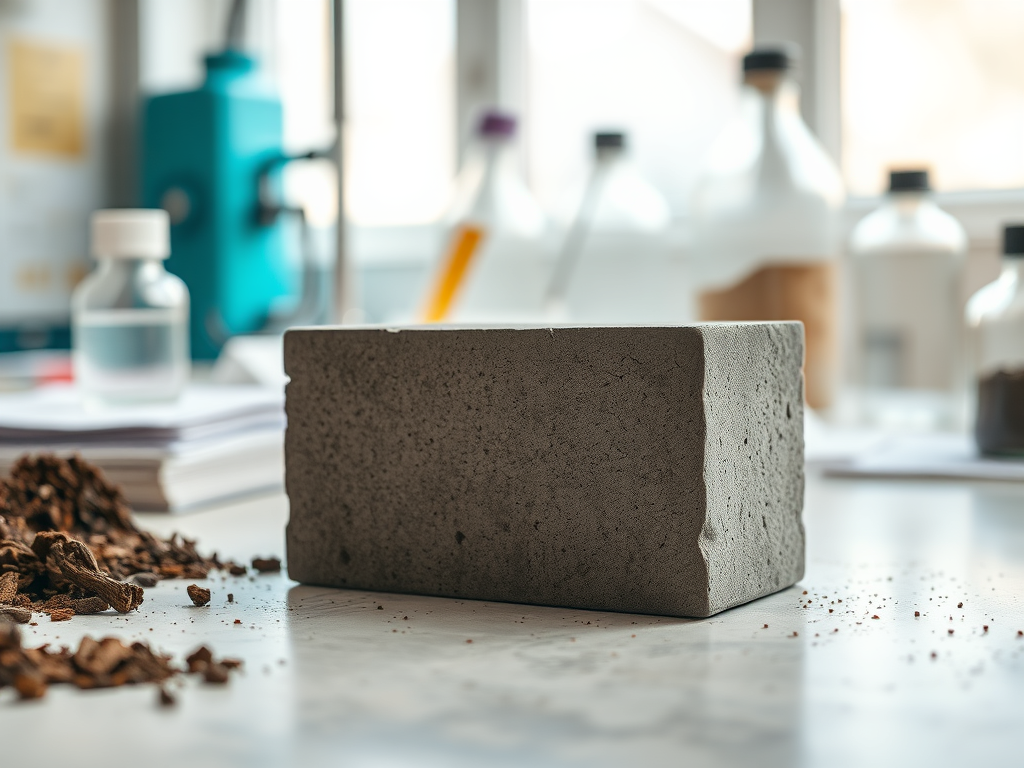
In a significant stride towards sustainable construction, recent research published in Scientific Reports by F. Wu et al., highlights the potential of agricultural biocharBiochar is a carbon-rich material created from biomass decomposition in low-oxygen conditions. It has important applications in environmental remediation, soil improvement, agriculture, carbon sequestration, energy storage, and sustainable materials, promoting efficiency and reducing waste in various contexts while addressing climate change challenges. More as a partial replacement for cement in ultra-high-performance concrete (UHPC). This innovative approach not only offers a sustainable way to repurpose agricultural waste but also enhances the mechanical and durability properties of UHPC mortar, with a key finding showing a 2.65% increase in compressive strength at a 1% biochar addition.
UHPC is highly valued in the construction industry for its exceptional strength, durability, and workability, largely due to its dense microstructure, which contributes to a longer service life and reduced maintenance compared to traditional cement-based materials. However, its widespread adoption has been hampered by high production costs, significant carbon emissions, and substantial energy demands. This has spurred interest in biochar, a carbon-rich material created from agricultural waste through pyrolysisPyrolysis is a thermochemical process that converts waste biomass into bio-char, bio-oil, and pyro-gas. It offers significant advantages in waste valorization, turning low-value materials into economically valuable resources. Its versatility allows for tailored products based on operational conditions, presenting itself as a cost-effective and efficient More, as a potential partial substitute for cement. While the benefits of biochar have been explored in regular concrete, its specific impact on UHPC’s microstructure and long-term performance had remained largely unexplored until now. The study, led by F. Wu and detailed in their 2025 Scientific Reports paper, aimed to address this gap by evaluating how biochar derived from apricot, date, palm, and peach shells influences the mechanical and durability characteristics of UHPC mortar across various proportions.
Researchers prepared fourteen different mortar formulations, including a control mix without biochar, all maintaining a water-cement ratio of 0.24 and consistent quantities of sand, water, silica fume, and superplasticizer. Samples were tested after 3 and 28 days of curing for several properties, including slump (workability), density, compressive strength, drying shrinkage, water permeability, chloride resistance, surface morphology (using SEM), and pore structure (using mercury intrusion porosimetry). The findings revealed compelling insights into the performance of biochar-enhanced UHPC. Workability, measured by slump, consistently decreased as the biochar content increased. For instance, at a 24% replacement level, slump dropped by 5.38% compared to the control, a reduction attributed to biochar’s rough shape and high carbon content, which absorbs water and reduces flow. Density also saw slight decreases in all biochar mixes at 3 days. Interestingly, at 28 days, mixes with 0.75-2% biochar showed a slight recovery in density, possibly due to retained water within the biochar promoting further hydration. However, at the 24% level, density dropped more significantly, likely due to increased porosityPorosity of biochar is a key factor in its effectiveness as a soil amendment and its ability to retain water and nutrients. Biochar’s porosity is influenced by feedstock type and pyrolysis temperature, and it plays a crucial role in microbial activity and overall soil health. Biochar More around the biochar particles. A standout result was the impact on compressive strength. A 1% addition of biochar led to a 2.65% increase in compressive strength over the control mix. Researchers theorized that moisture stored within the biochar acts as nucleation points, facilitating more efficient hydration. However, beyond this 1% threshold, the structural advantages diminished, as the porous nature of biochar began to compromise the matrix’s integrity.
Furthermore, the study observed a reduction in shrinkage across all biochar mixes, particularly at lower dosages. Biochar’s stable, porous structure appears to regulate internal moisture during curing, effectively acting as an internal curing agent. Microstructure analysis, confirmed by SEM images, showed that the 1% biochar mix exhibited denser hydration products and lower porosity, while the 24% mix displayed more voids. Similarly, low-percentage biochar mixes demonstrated improved resistance to chloride penetration, indicated by reduced electrical flux, whereas higher biochar contents led to increased electrical flux due to the growth of capillary pores.
In conclusion, this research provides strong evidence that even small additions of agricultural biochar, specifically around 1%, can significantly improve the mechanical performance and durability of UHPC mortar. These improvements encompass enhanced compressive strength, reduced shrinkage, and increased resistance to moisture and chloride ingress. By effectively repurposing agricultural waste, this method offers a sustainable and high-performing alternative for UHPC production, marking a promising step towards more environmentally friendly construction practices.
Source: Wu, F., et al. (2025). Biochar modification enhances mechanical and durability properties of cement-based materials. Scientific Reports, 15(1).



Leave a Reply