
Key Takeaways
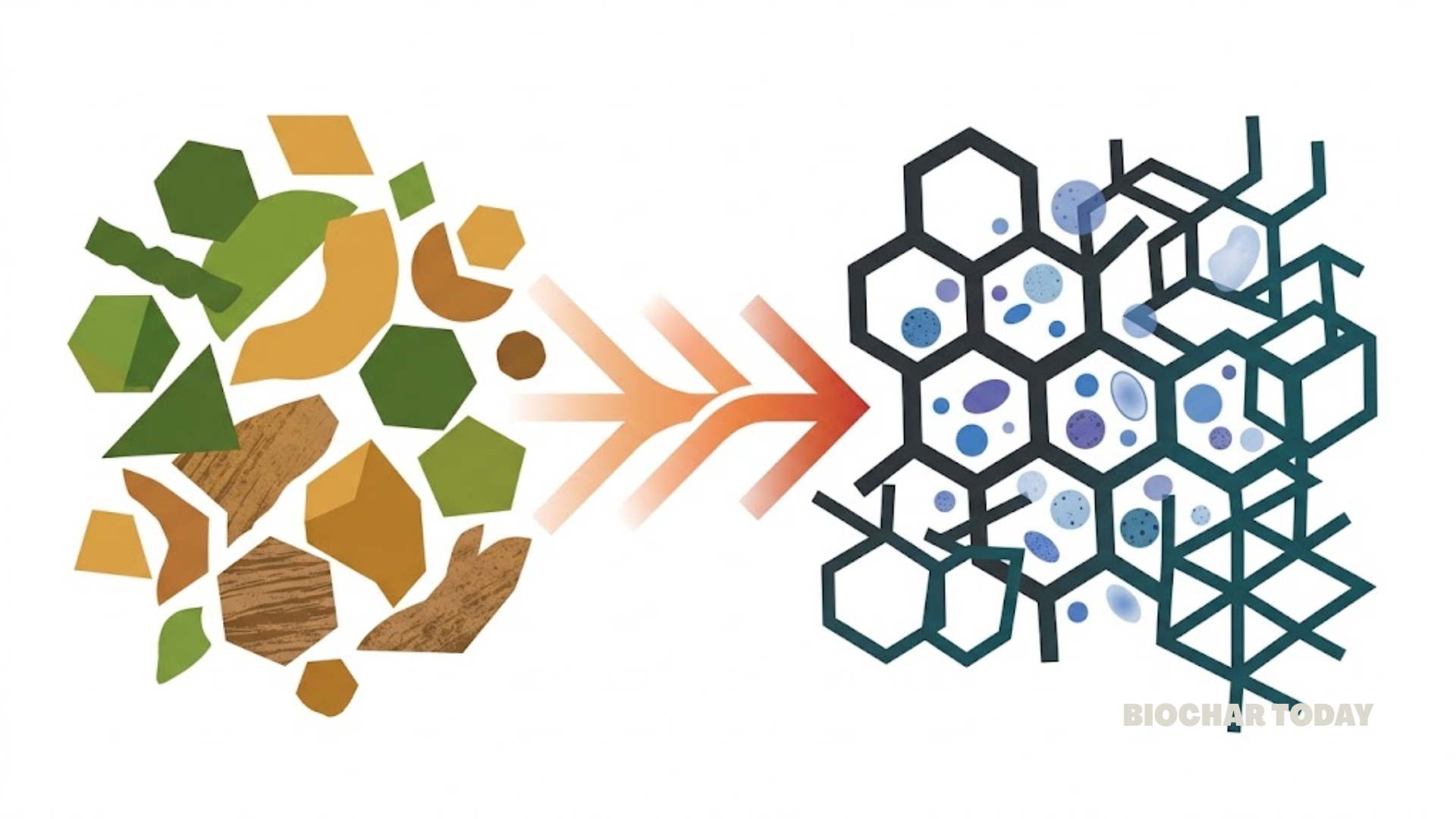
- Converting common farming leftovers into charcoalCharcoal is a black, brittle, and porous material produced by heating wood or other organic substances in a low-oxygen environment. It is primarily used as a fuel source for cooking and heating. More filters provides a highly efficient and cost-effective method to cleanse polluted water supplies.
- Higher processing temperatures create a more stable and porous material structure that significantly boosts filtration performance.
- These specialized filters successfully trap microscopic plastic fragments while simultaneously catching dissolved chemical hazards.
- Safety evaluations confirm that the treatment material is completely secure and does not release toxic compounds back into clean water.
- The filters can be treated by heat and repeatedly reused across several cleaning cycles with only minor drops in their overall efficiency.
In a recent study published in the peer-reviewed scientific journal BiocharBiochar is a carbon-rich material created from biomass decomposition in low-oxygen conditions. It has important applications in environmental remediation, soil improvement, agriculture, carbon sequestration, energy storage, and sustainable materials, promoting efficiency and reducing waste in various contexts while addressing climate change challenges. More, authors Ruogu Tang, Siyu Qiu, Changqing Wu, and Juzhong Tan evaluated the dual-functional filtration performance of various agricultural waste byproducts. The research systematically screened sustainable carbon materials derived from corn cobs, cocoa husks, walnut shells, and bamboo stalks processed under diverse pyrolysisPyrolysis is a thermochemical process that converts waste biomass into bio-char, bio-oil, and pyro-gas. It offers significant advantages in waste valorization, turning low-value materials into economically valuable resources. Its versatility allows for tailored products based on operational conditions, presenting itself as a cost-effective and efficient More temperatures and residence times to target distinct water contaminants. By executing detailed physical and chemical characterizations, the investigation links structural parameter choices with final remediation capacities. The findings highlight a scalable, low-cost engineering framework that transforms raw residue into highly efficient adsorbents tailored for decentralized wastewater treatment systems. Ultimately, this work offers crucial insights into multi-contaminant filtration dynamics, focusing on the simultaneous immobilization of dissolved ionic nutrients and emerging micro/nanoplastic particulates.
The initial phase of the investigation shows that both feedstockFeedstock refers to the raw organic material used to produce biochar. This can include a wide range of materials, such as wood chips, agricultural residues, and animal manure. More origin and thermal treatment choices deeply govern structural evolution and mineral retention. While woody precursors like bamboo and walnut shells generate the highest structural yields and largest specific surface areas, corn cob residues provide balanced properties that excel under realistic flow-through conditions. Increasing the processing severity to seven hundred degrees Celsius for two point five hours minimizes lingering volatile fractions and yields a robust carbon architecture with optimized porosityPorosity of biochar is a key factor in its effectiveness as a soil amendment and its ability to retain water and nutrients. Biochar’s porosity is influenced by feedstock type and pyrolysis temperature, and it plays a crucial role in microbial activity and overall soil health. Biochar More. When evaluating chemical performance, the high-temperature corn cob adsorbent displays superior removal capacities across all tested experimental scenarios. This optimized material effectively removes sixty-three point nine-five percent of dissolved ammonia from aqueous solutions at moderate concentrations. The removal mechanism is guided by a combination of outer-sphere complexation, hydrogen bonding, and surface attractions where positive ammonium ions bind tightly to the intrinsically negative oxygenated functional groups on the carbon matrix.
Concurrently, the high-temperature corn cob adsorbent displays exceptional proficiency when capturing particulate hazards from flowing water streams. The material achieves a ninety-seven point nine-nine percent removal rate for polystyrene micro/nanoplastics across diverse submicron size scales. Microscopic examinations show that plastic particles are captured through a combination of physical layer trapping on the external surfaces and direct pore-filling inside the internal porous architecture. This physical entrapment is further reinforced by strong electrostatic interactions within the filtration column. Because the polystyrene materials carry a positive surface charge under localized acidic preparation conditions, they adhere strongly to the negative surface structures of the filter bed, causing a measurable charge neutralization. Adsorption tests across varying solution chemistries confirm this functional relationship, as filtration efficiency peaks in acidic environments and drops under alkaline conditions due to increased electrostatic repulsion.
Beyond initial clean-up metrics, the study validates two critical operational benchmarks required for practical commercial deployment: environmental safety and multi-cycle reusability. Thorough static leachingLeaching is the process where nutrients are dissolved and carried away from the soil by water. This can lead to nutrient depletion and environmental pollution. Biochar can help reduce leaching by improving nutrient retention in the soil. More tests lasting twenty-four hours confirm that zero detectable amounts of the sixteen United States Environmental Protection Agency priority polycyclic aromatic hydrocarbons are released into clean water filtrates, proving a negligible risk of secondary pollution. Furthermore, preliminary regeneration trials show that the spent corn cob filters can be successfully re-pyrolyzed and deployed for consecutive treatment phases. The seven hundred degree material demonstrates superior thermal stability compared to low-temperature counterparts, maintaining an ammonia removal efficiency greater than fifty-five percent even after three complete usage cycles. This retention capacity demonstrates that thermal re-pyrolysis successfully clears occupied pore spaces and restores active functional sites, establishing a reusable, circular infrastructure path for eco-friendly resource recovery.
Source: Tang, R., Qiu, S., Wu, C., & Tan, J. (2025). Biochar: from agricultural waste byproducts to novel adsorbents for ammonia and micro/nanoplastics (MNPs). Biochar, 7(122), 1-22.




Leave a Reply