

Key Takeaways
- Scientists are transforming biocharBiochar is a carbon-rich material created from biomass decomposition in low-oxygen conditions. It has important applications in environmental remediation, soil improvement, agriculture, carbon sequestration, energy storage, and sustainable materials, promoting efficiency and reducing waste in various contexts while addressing climate change challenges. More into an advanced material by adding elements like nitrogen, phosphorus, or iron.
- This process, called element doping, tailors the material’s properties, opening up new uses beyond traditional soil improvement.
- Doped biochar is now a highly efficient adsorbent for pollutants, an effective catalyst for chemical reactions, and a high-performance material for energy storage devices like supercapacitors.
- The element-doped biochar also significantly improves carbon sequestration, with certain metal dopants increasing carbon retention by as much as 45%.
- Emerging uses include specialized applications in cosmetics, such as skincare products leveraging silver-doped biochar’s antimicrobial properties.
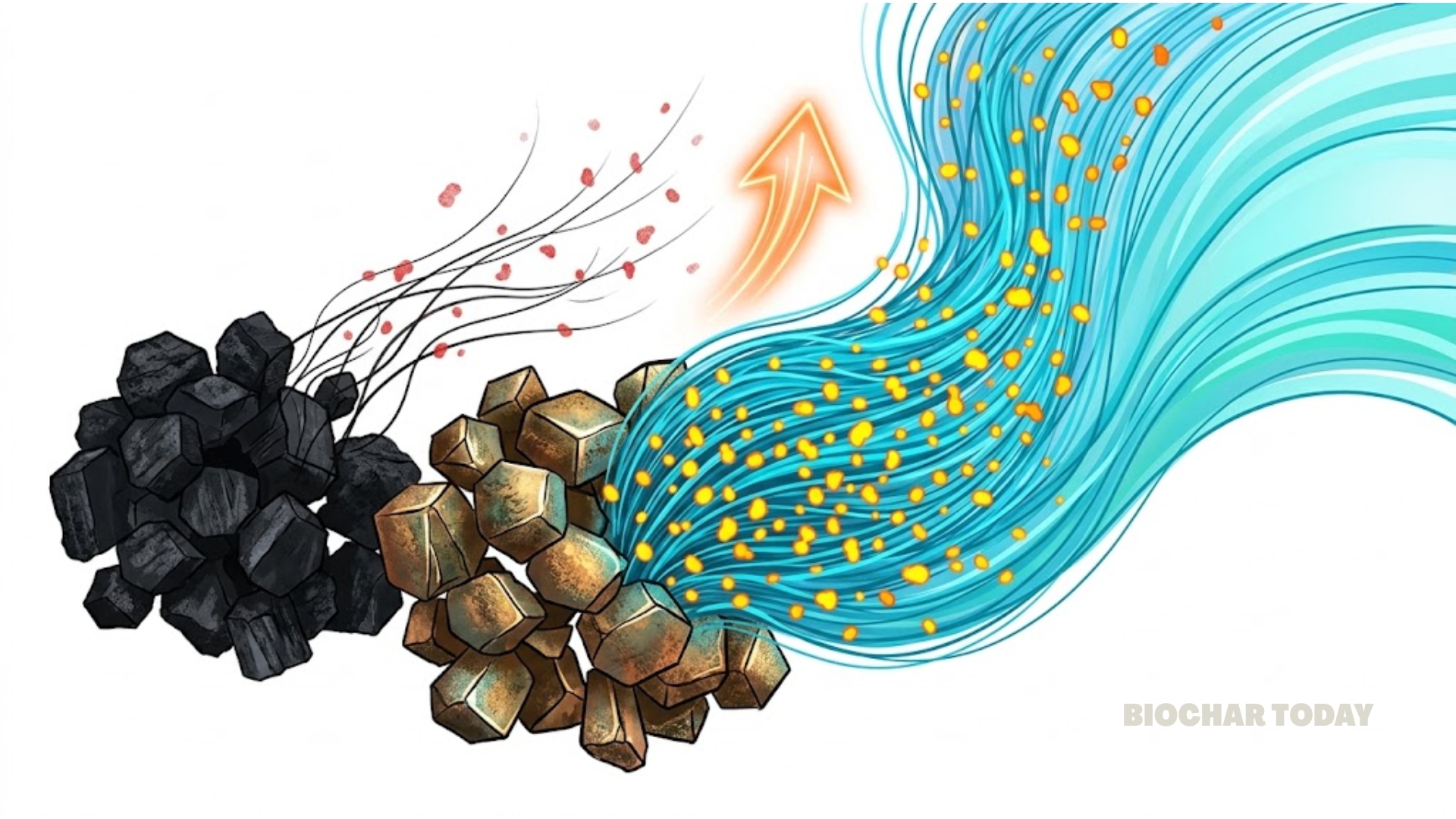
In a comprehensive review published in the journal Biochar, Zhao, Jiang, Chen, Wang, and Nan explore the groundbreaking versatility of element-doped biochar, positioning it as a key sustainable material for environmental and energy applications. Biochar has long been recognized for its role in soil enhancement and carbon sequestration. However, the strategic incorporation of various elements, such as non-metals (nitrogen, phosphorus, sulfur, oxygen) and metals (iron, copper, rare-earth elements), significantly enhances its core functionalities, improving its adsorption capacity, catalytic efficiency, and electrochemical performance. This process, called element doping, elevates biochar from a simple soil amendmentA soil amendment is any material added to the soil to enhance its physical or chemical properties, improving its suitability for plant growth. Biochar is considered a soil amendment as it can improve soil structure, water retention, nutrient availability, and microbial activity. More to a versatile material capable of performing highly specialized tasks. The review systematically details the link between the preparation method, the resulting structure, the enhanced performance, and the eventual application, offering a comprehensive framework for optimization.
The researchers highlight two primary methods for generating element-doped biochar: in-situ doping (or self-doping) and exogenous doping. In-situ doping is a straightforward process where biowaste naturally rich in a desired element, like N, P, or S, is directly carbonized. This method leads to a uniform distribution of the dopant and is cost-effective, but it is challenging to precisely control the final element content. In contrast, exogenous doping introduces external dopants like urea, metal salts, or acids to low-heteroatom biomassBiomass is a complex biological organic or non-organic solid product derived from living or recently living organism and available naturally. Various types of wastes such as animal manure, waste paper, sludge and many industrial wastes are also treated as biomass because like natural biomass these More before pyrolysisPyrolysis is a thermochemical process that converts waste biomass into bio-char, bio-oil, and pyro-gas. It offers significant advantages in waste valorization, turning low-value materials into economically valuable resources. Its versatility allows for tailored products based on operational conditions, presenting itself as a cost-effective and efficient More, offering much greater control and quantifiability over the final composition. This fine-tuning allows scientists to tailor the biochar’s properties for specific applications, often resulting in superior functionality.
Element doping profoundly impacts biochar’s physical structure and chemical properties. For instance, introducing non-metallic elements like nitrogen (N), oxygen (O), and phosphorus (P) primarily influences the surface chemistry, pore structure, and electronic properties. N-doping introduces defects and highly active functional groups (like pyridine N and pyrrole N), enhancing the material’s surface roughness, specific surface area, catalytic activity, and electrical conductivity. P-doping introduces P-O and C-P-O bonds, protecting the carbon structure and creating structural defects that optimize the electronic structure, notably increasing the specific surface area and adsorption capacity. Conversely, the incorporation of metallic elements like iron (Fe), cobalt (Co), and nickel (Ni) can promote the ordering of carbon layers, thereby increasing the degree of graphitization, which is key to improving electrical conductivity and catalytic performance. This ability to regulate the structure, from creating more micropores to increasing graphitization, is fundamental to biochar’s enhanced performance.
The utility of element-doped biochar is extensive, spanning multiple critical sectors. In environmental remediation, doped biochar serves as a powerful adsorbent and catalyst carrier. For adsorption, doping tailors the surface functional groups and pore structure, making it highly effective for removing contaminants like heavy metals and organic pollutants through various mechanisms, including electrostatic interactions and π-π stacking. As a catalyst carrier, elements like Fe, N, and O enhance electron transfer and provide abundant active sites, making them highly efficient for advanced oxidation processes used to degrade complex organic pollutants, such as pyrene (PYR), into simpler molecules like CO2 and H2O.
In the fight against climate change, element doping substantially boosts carbon sequestration. While traditional biochar stabilizes only about 50% of the original biomass carbon, alkali metals (K, Na, Ca, Mg) and Si-doping significantly increase carbon retention and stability. This enhancement is achieved through three primary mechanisms: the formation of stable chemical bonds (e.g., C-P bonds), physical protection by surface metal oxides that block carbon volatilization, and the chemical absorption of small carbon molecules during pyrolysis.
Beyond environmental uses, doped biochar is crucial for energy storage, where it offers a sustainable alternative to conventional materials like graphene. N, S, and P dopants improve specific capacitance and electrical conductivity by altering the electron cloud distribution, enhancing charge transfer, and creating more active sites. For example, a multi-element N, P co-doped biochar was found to significantly reduce mechanical stress and inhibit volume expansion in sodium- and potassium-ion batteries, which have larger ions than traditional lithium-ion batteries, leading to enhanced cycling stability.
Finally, emerging applications include its use in cosmetics and bio-composites. Zinc-doped biochar is being explored for its ability to adsorb oils and inhibit tyrosinase activity (reducing melanin production) for skincare products. Silver-doped biochar, leveraging its antimicrobial properties, is integrated into bio-composites for medical devices and food packaging, while conductive-element-doped biochar is used in functional coatings to reduce surface resistance, providing anti-static properties. These applications demonstrate the vast, often untapped potential of elemental doping to customize biochar for high-value industries.
Source: Zhao, J., Jiang, Y., Chen, X., Wang, C., & Nan, H. (2025). Unlocking the potential of element-doped biochar: from tailored synthesis to multifunctional applications in environment and energy. Biochar, 7(1), 77.



Leave a Reply