
Key Takeaways
- Agricultural waste from teff crop harvesting can be converted into a valuable material that improves soil quality instead of being burned or thrown away.
- Heating the crop waste at an intermediate temperature of 500 degrees Celsius produces the best balance of surface structure and material yield.
- The resulting biocharBiochar is a carbon-rich material created from biomass decomposition in low-oxygen conditions. It has important applications in environmental remediation, soil improvement, agriculture, carbon sequestration, energy storage, and sustainable materials, promoting efficiency and reducing waste in various contexts while addressing climate change challenges. More material features a porous internal network that holds water and essential plant nutrients effectively in farming applications.
- The material helps make acidic agricultural soils more alkaline, creating a safer environment for crop roots to absorb nutrients.
- Using crop residues for carbon-rich soil amendments reduces farm pollution and supports environmentally friendly farming practices.
Agricultural residues represent a massive opportunity for waste recycling across developing regions. In East Africa, cereal crop production yields millions of tons of teff straw annually, which is typically burned in fields or discarded as agricultural waste. Converting this underutilized biomassBiomass is a complex biological organic or non-organic solid product derived from living or recently living organism and available naturally. Various types of wastes such as animal manure, waste paper, sludge and many industrial wastes are also treated as biomass because like natural biomass these More into biochar through controlled thermal heating offers a dual benefit by reducing field pollution and restoring degraded soils. The suitability of biochar as a soil conditioner depends heavily on its physical structure, internal pore space, surface chemistry, and mineral retention. These characteristics change dramatically based on the temperature used during thermal processing.
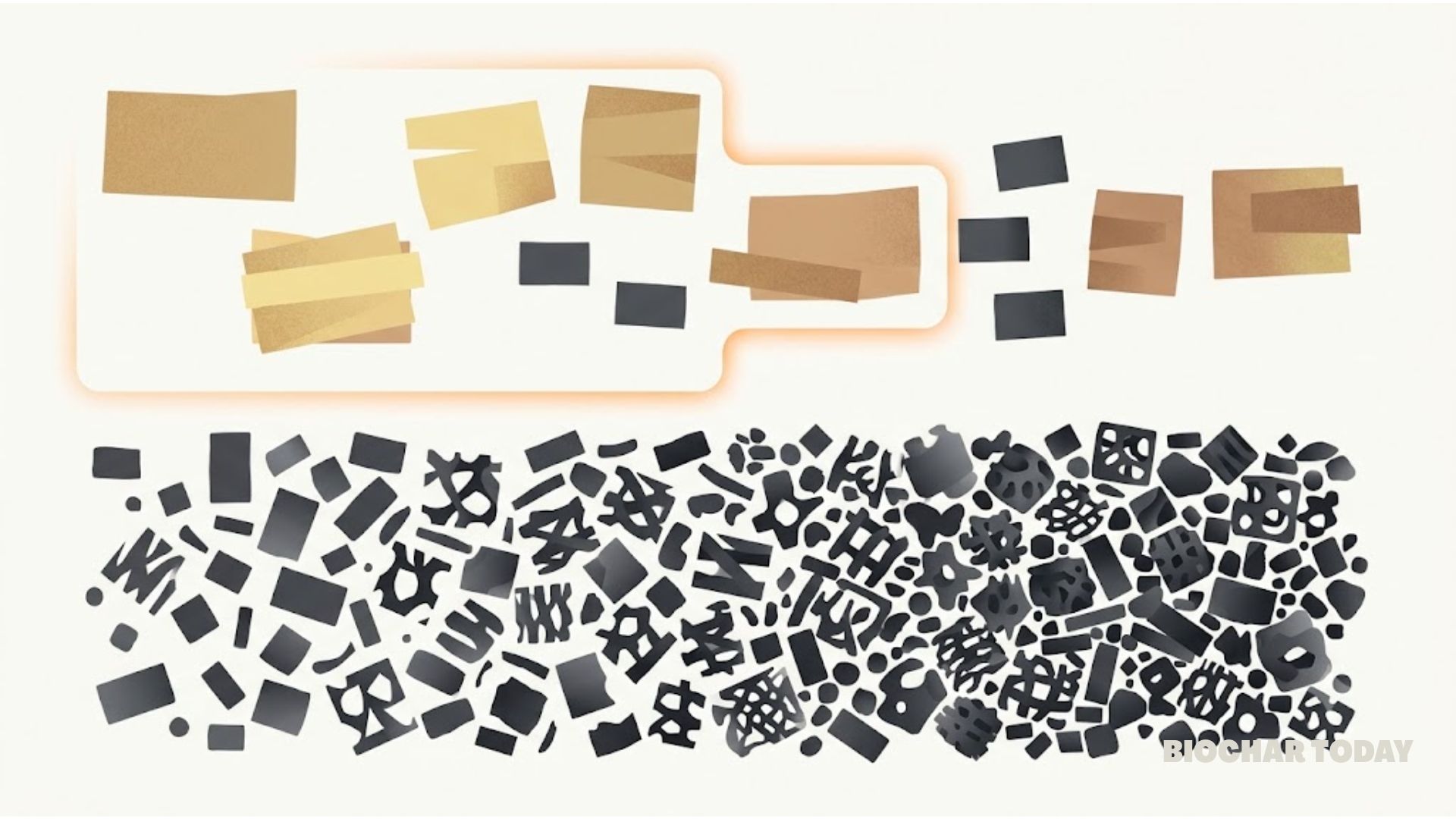
A systematic analysis of teff straw processing reveals how thermal decomposition shifts the physical and chemical properties of the material. Raw teff straw exhibits a dense, fibrous surface with low porosityPorosity of biochar is a key factor in its effectiveness as a soil amendment and its ability to retain water and nutrients. Biochar’s porosity is influenced by feedstock type and pyrolysis temperature, and it plays a crucial role in microbial activity and overall soil health. Biochar More and limited functional surface area. As heating increases, volatile organic components evaporate, leaving behind a highly porous carbon framework. Volatile content drops from over 75 percent in raw biomass down to under 19 percent after heating. Meanwhile, fixed carbon levels increase from under 17 percent in raw straw to over 68 percent in the processed char, proving that thermal treatment locks stable carbon into the material matrix.
Evaluating processing performance across different temperature points highlights clear trade-offs between yield, surface expansion, and mineral composition. Processing biomass at 400 degrees Celsius yields a higher mass of final material at over 31 percent, but leaves behind higher levels of unreacted organic matter and a smaller surface area of 11.1 square meters per gram. Conversely, pushing temperatures up to 600 degrees Celsius drives deeper carbonization but reduces total material yield down to 24.2 percent while increasing total ashAsh is the non-combustible inorganic residue that remains after organic matter, like wood or biomass, is completely burned. It consists mainly of minerals and is different from biochar, which is produced through incomplete combustion. Ash Ash is the residue that remains after the complete More content to 13 percent. Operating at 500 degrees Celsius yields the optimal balance by maximizing surface area while preserving mass yield and avoiding excessive ash buildup.
Structural examination shows that material processed at 500 degrees Celsius forms extensive micro and mesoporous channels throughout its matrix. Surface area expands from 2.6 square meters per gram in raw straw to 18.4 square meters per gram in the finished biochar. X-ray analysis reveals that the thermal treatment breaks down the organized crystalline structures of cellulose and hemicellulose, leaving behind an amorphous carbon arrangement that favors fluid retention and molecular adsorption. Thermogravimetric testing confirms that the resulting char resists further thermal breakdown up to 300 degrees Celsius, ensuring long-term persistence when applied to natural environments.
Chemical analysis indicates that essential plant nutrients concentrate within the solid matrix during heating. Essential elements including silicon, potassium, calcium, magnesium, and phosphorus show marked increases in relative concentration as light volatile gases escape. Potassium content increases from 0.79 percent in raw straw to 3.14 percent in the finished char, while calcium levels more than double. Additionally, the processed biochar demonstrates a strongly alkaline pHpH is a measure of how acidic or alkaline a substance is. A pH of 7 is neutral, while lower pH values indicate acidity and higher values indicate alkalinity. Biochars are normally alkaline and can influence soil pH, often increasing it, which can be beneficial More of 9.3. Applying alkaline material to acidic agricultural soils neutralizes excess acidity, reduces toxic aluminum mobility, and improves overall nutrient uptake for growing plants.
The overall findings confirm that converting teff straw into biochar at 500 degrees Celsius yields a valuable, carbon-rich soil amendmentA soil amendment is any material added to the soil to enhance its physical or chemical properties, improving its suitability for plant growth. Biochar is considered a soil amendment as it can improve soil structure, water retention, nutrient availability, and microbial activity. More. The process balances energy input, material yield, structural porosity, and nutrient concentration. Utilizing regionally available agricultural byproducts as functional land amendments provides a practical pathway for circular economy initiatives, helping farmers enhance soil fertility, improve water retention, and sequester carbon in sustainable agricultural systems.
Source: Bayu, A. B., Zielińska-Jurek, A., Okoczuk, P., & Kulbat, E. (2026). Evaluation of change in biochar properties derived from Eragrostis tef straw and pyrolysisPyrolysis is a thermochemical process that converts waste biomass into bio-char, bio-oil, and pyro-gas. It offers significant advantages in waste valorization, turning low-value materials into economically valuable resources. Its versatility allows for tailored products based on operational conditions, presenting itself as a cost-effective and efficient More temperature for agricultural application. Scientific Reports, 16, Article 68324.



Leave a Reply