
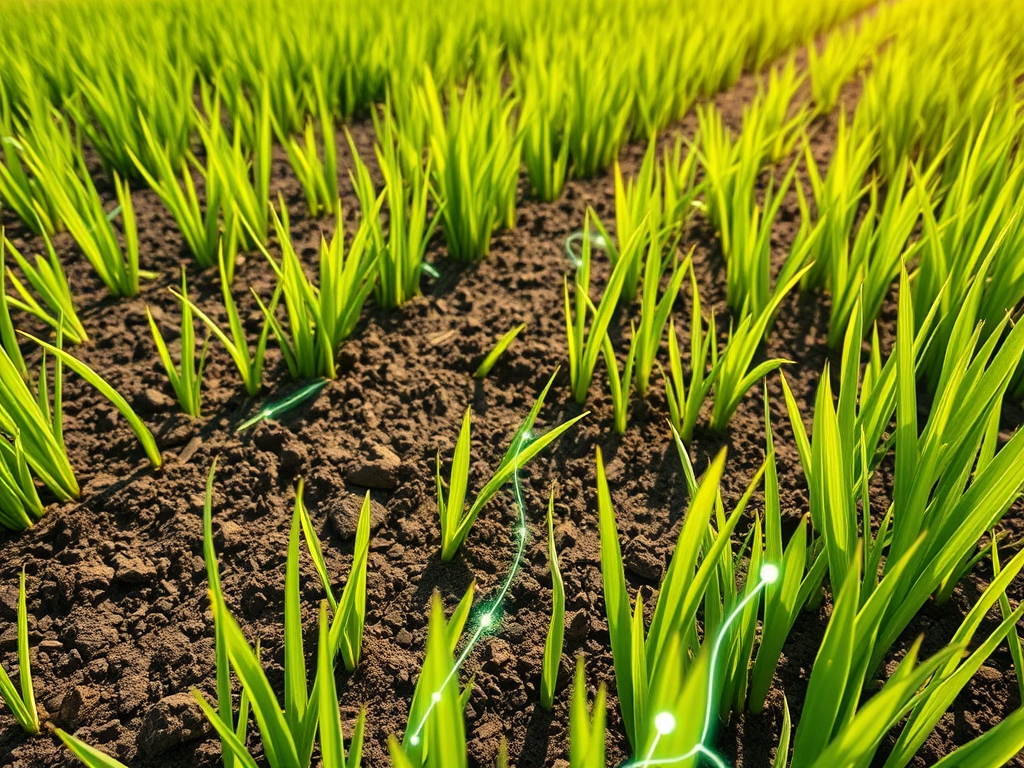
Rice paddies, while crucial for global food security, are a major source of methane (CH4), a potent greenhouse gas. Methane emissions from these soils account for 30% of annual agricultural methane emissions. BiocharBiochar is a carbon-rich material created from biomass decomposition in low-oxygen conditions. It has important applications in environmental remediation, soil improvement, agriculture, carbon sequestration, energy storage, and sustainable materials, promoting efficiency and reducing waste in various contexts while addressing climate change challenges. More, a carbon-rich material produced from biomassBiomass is a complex biological organic or non-organic solid product derived from living or recently living organism and available naturally. Various types of wastes such as animal manure, waste paper, sludge and many industrial wastes are also treated as biomass because like natural biomass these More, has been proposed as a way to regulate these emissions, but previous studies have shown conflicting results. A new study in the journal Biochar by Yufei Wu, Ting He, and a team of researchers sheds light on this by demonstrating how the electrical conductivity of biochar can dramatically increase methane production.
The researchers prepared biochar with varying conductivity levels by incorporating different amounts of graphene. They then added these biochar samples to paddy soil systems for an anaerobic incubation experiment. The biochar’s dissolved organic matter (DOM) was removed before the experiment to isolate the effects of conductivity. They found that adding biochar significantly increased methane accumulation in all systems compared to the control group without biochar. The most conductive biochar, Mb-G40, increased methane accumulation by 69% compared to the control. Other biochar samples increased methane accumulation by 18% to 26%.
The team then investigated the mechanism behind this increase. They found a strong positive correlation between methane production and the electron transfer rate (ETR). The ETR increased as the conductivity of the biochar samples increased, with the most conductive sample (Mb-G40) showing an ETR three times greater than the control. This finding suggests that biochar’s conductivity facilitates electron transfer in the soil, acting like a “high-way” for electrons and thereby accelerating methanogenesis.
To confirm the role of biochar, the researchers conducted electrochemical experiments after removing all dissolved organic matter from the paddy soil. The results showed that the redox peaks, which indicate electron transfer, were primarily due to the redox process of the dissolved organic matter, confirming its crucial role in mediating these reactions. Biochar, due to its conductivity, actively participates in this DOM-mediated electron transfer.
To further validate this, the researchers used a model compound for DOM, anthraquinone-2,6-disulfonate (AQDS). The experiment with biochar and AQDS confirmed that biochar enhanced the ETR of AQDS, supporting the hypothesis that biochar facilitates electron transfer mediated by DOM. The increased ETR was a direct result of the biochar’s conductivity, which accelerated electron transfer through both the biochar and the DOM.
The study also looked at the impact of biochar on microbial communities. While the addition of biochar altered the abundance of bacterial and archaeal communities, there were no significant changes in the relative abundance of methanogenic archaea across the different biochar treatments from Mb-G0 to Mb-G40. This suggests that the increase in methane production was due to the accelerated electron transfer rate and not a fundamental shift in the methanogenic archaeal community composition.
In conclusion, this research provides a clear mechanism for how biochar influences methane production in paddy soils. Its electrical conductivity facilitates electron transfer, which in turn enhances methanogenesis. The study offers valuable insights for optimizing biochar use, suggesting that highly conductive biochar may not be ideal for mitigating methane emissions in paddy soil systems.
Source: Wu, Y., He, T., Cheng, C., Liu, B., Chang, Z., Du, W., Li, H., Zhang, P., & Pan, B. (2025). Biochar conductivity enhances methane generation in paddy soil by facilitating electron transfer mediated by dissolved organic matter. Biochar, 7(85).



Leave a Reply