
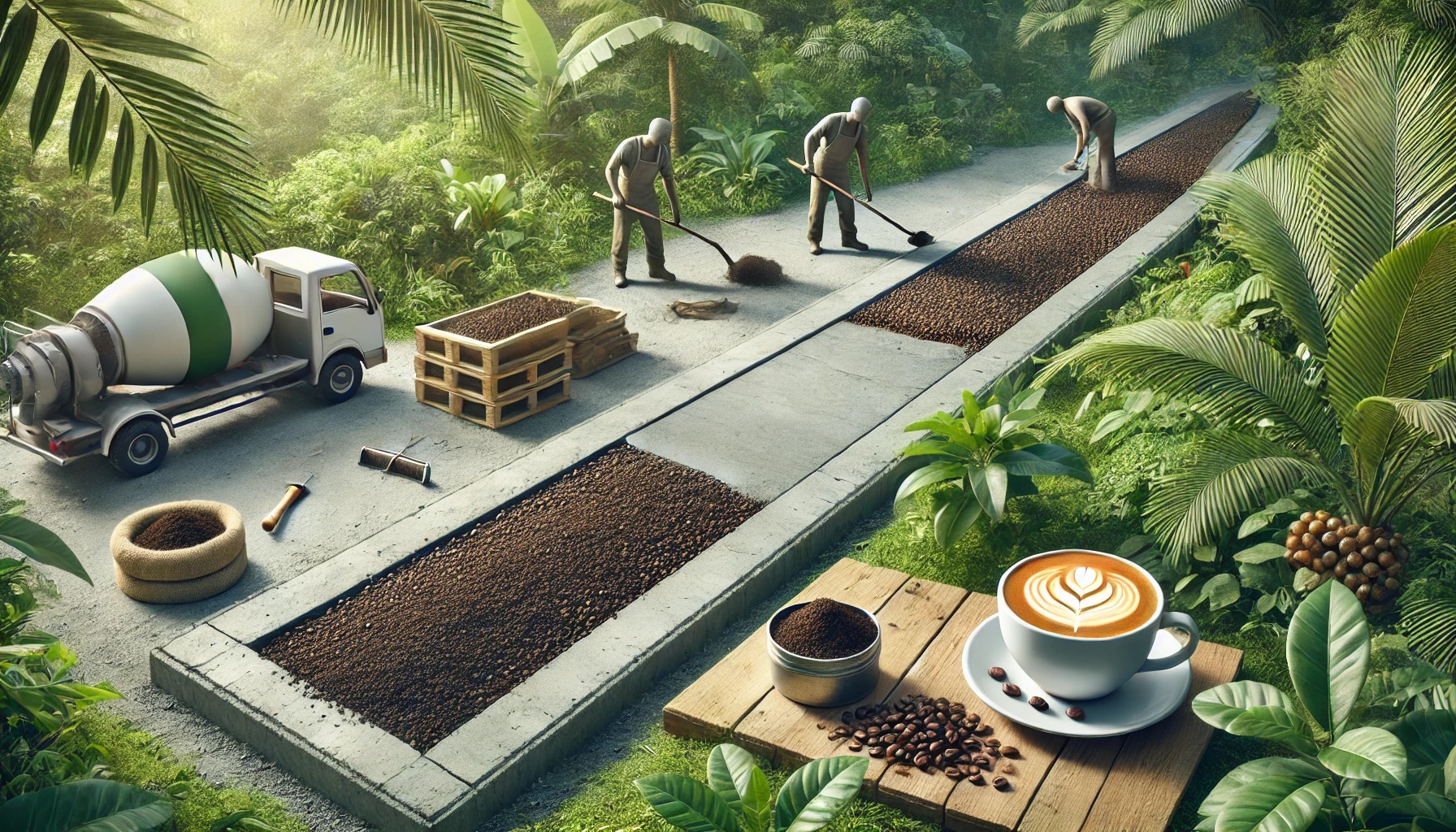
Recent research has explored the use of biocharBiochar is a carbon-rich material created from biomass decomposition in low-oxygen conditions. It has important applications in environmental remediation, soil improvement, agriculture, carbon sequestration, energy storage, and sustainable materials, promoting efficiency and reducing waste in various contexts while addressing climate change challenges. More, derived from spent coffee grounds, as a sustainable additive in concrete. Laboratory tests had previously shown that coffee biochar produced at 350°C could improve concrete compressive strength by up to 30%. To validate these findings in real-world conditions, researchers conducted a field trial using biochar-modified concrete for a footpath in Gisborne, Victoria, Australia.
The biochar for this trial was produced at 450°C, slightly above the laboratory-optimal 350°C, due to equipment limitations. Despite this adjustment, the field trial yielded valuable insights. The biochar-modified concrete demonstrated higher workability, with a 15% increase in slump compared to the control mix. This was attributed to water saturation in the biochar, which acted as an internal curing agent and improved the material’s fresh-state properties.
In terms of compressive strength, the field-trial concrete showed slight reductions of 6% at seven days and 9.3% at 28 days compared to the control mix. These results were not as strong as the optimal 350°C lab-based biochar but were better than those obtained from 500°C biochar in earlier studies. Interestingly, concrete cores taken from the footpath at 54 days exhibited improved strength, underscoring the benefits of long-term hydration facilitated by biochar’s water-retention properties.
Flexural strength saw notable improvement, with an 18.9% increase compared to the control. This enhancement was likely due to biochar’s porous structure, which modifies the pore network and promotes better stress distribution. Similarly, the concrete showed reduced shrinkage, enhancing dimensional stability. These effects stem from biochar’s ability to regulate moisture and refine the pore structure, which mitigates internal stresses during drying.
The study highlights both the potential and challenges of integrating coffee biochar into construction materials. While the field trial demonstrated promising mechanical and durability benefits, optimal production conditions for biochar remain a constraint. Addressing supply chain limitations, such as achieving precise pyrolysisPyrolysis is a thermochemical process that converts waste biomass into bio-char, bio-oil, and pyro-gas. It offers significant advantages in waste valorization, turning low-value materials into economically valuable resources. Its versatility allows for tailored products based on operational conditions, presenting itself as a cost-effective and efficient More temperatures, is essential for scaling up this sustainable innovation.
Incorporating coffee biochar into concrete represents a step forward in sustainable construction. By recycling waste materials into high-value applications, this approach aligns with circular economy principles and reduces reliance on traditional, resource-intensive aggregates. With further refinement, biochar-enhanced concrete could become a mainstream material, improving performance and environmental outcomes simultaneously.
SOURCE: Roychand, et al (2025) Translating lab success to the field: Evaluating coffee biochar-enhanced concrete in real-world construction. Case Studies in Construction Materials. https://doi.org/10.1016/j.cscm.2025.e04233





Leave a Reply