
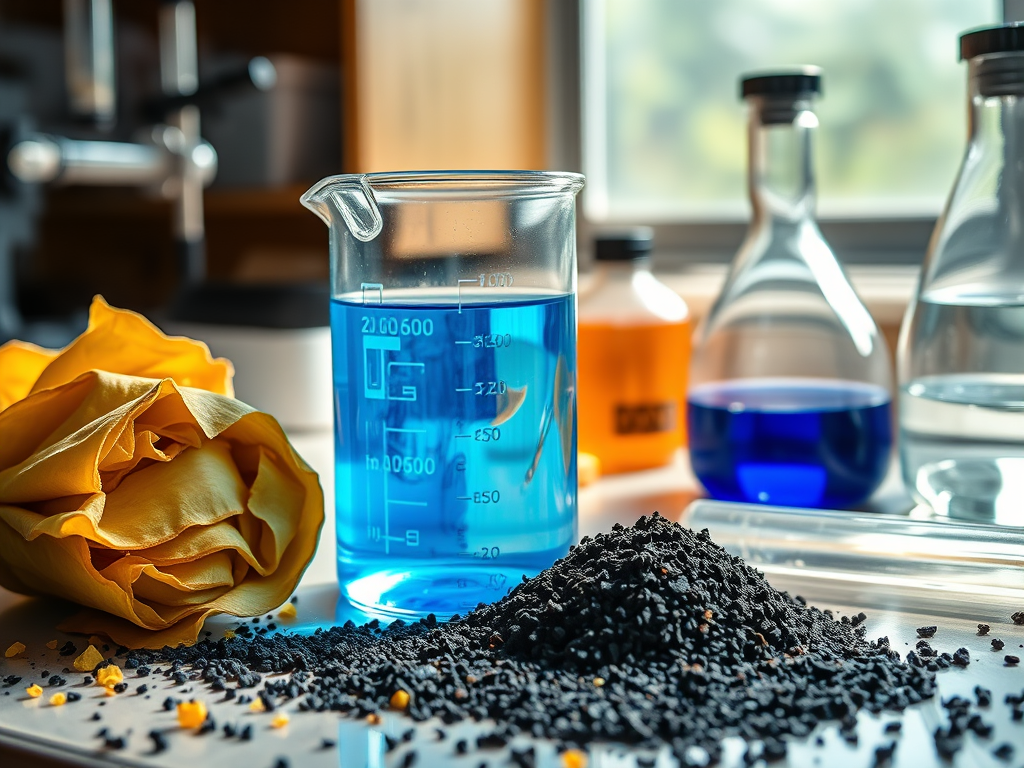
In a recent investigation published in Rasayan Journal of Chemistry, researchers M. Napitupulu, P. Ningsih, T. Santoso, and D.K. Walanda explored the efficacy of biocharBiochar is a carbon-rich material created from biomass decomposition in low-oxygen conditions. It has important applications in environmental remediation, soil improvement, agriculture, carbon sequestration, energy storage, and sustainable materials, promoting efficiency and reducing waste in various contexts while addressing climate change challenges. More derived from cassava peel (BCP) as a sustainable adsorbent for removing Indigosol Blue 04-B dye from batik wastewater. This study addresses the critical environmental issue of industrial effluent, particularly from textile manufacturing, which often contains synthetic dyes harmful to aquatic ecosystems and human health. By valorizing cassava peel, a readily available agricultural waste product in Indonesia, into an efficient adsorbent, the research provides an environmentally friendly and cost-effective solution that aligns with the United Nations Sustainable Development Goal (SDG) 6: Clean Water and Sanitation.
The research team produced cassava peel biochar through a pyrolysisPyrolysis is a thermochemical process that converts waste biomass into bio-char, bio-oil, and pyro-gas. It offers significant advantages in waste valorization, turning low-value materials into economically valuable resources. Its versatility allows for tailored products based on operational conditions, presenting itself as a cost-effective and efficient More process at temperatures of 300°C, 350°C, and 400°C. Characterization of the biochar included assessing its water and ashAsh is the non-combustible inorganic residue that remains after organic matter, like wood or biomass, is completely burned. It consists mainly of minerals and is different from biochar, which is produced through incomplete combustion. Ash Ash is the residue that remains after the complete More content, pore morphology, and elemental composition. The analysis revealed that as the pyrolysis temperature increased, the carbon content in the biochar rose, while nitrogen and oxygen content decreased, indicating a concentration of carbonaceous structures suitable for adsorption. Microscopic examination confirmed that the biochar possessed a highly porous structure, specifically with irregularly shaped mesopores ranging from 2-50 nm. This porous architecture is beneficial as it increases the surface area available for the adsorption of medium to large molecules, such as textile dyes.
A key aspect of the study involved testing the adsorption capacity of BCP on Indigosol Blue 04-B dye under varying experimental conditions, specifically pHpH is a measure of how acidic or alkaline a substance is. A pH of 7 is neutral, while lower pH values indicate acidity and higher values indicate alkalinity. Biochars are normally alkaline and can influence soil pH, often increasing it, which can be beneficial More levels, adsorbent weight, and contact time. The most effective dye removal was achieved at a pH of 7.0, where BCP demonstrated an impressive adsorption capacity of 72.16%. This suggests that a neutral environment is optimal for the interaction between the dye molecules and the biochar’s surface. The study also determined the optimal biochar dosage, finding that 75 mg of BCP achieved a 51.07% dye removal rate. An increase in adsorbent weight generally leads to higher adsorption due to a greater number of available active sites and surface area.
Furthermore, the research identified an optimal contact time of 40 minutes, yielding a 63.50% dye adsorption efficiency. Beyond this point, the adsorption capacity slightly decreased, likely due to the saturation of active sites on the biochar surface and a phenomenon known as desorption, where adsorbed ions are released. These findings highlight the importance of optimizing operational parameters to maximize the biochar’s performance in wastewater treatment applications.
The adsorption process of Indigosol Blue 04-B onto cassava peel biochar was well-described by the Langmuir isotherm model. This model suggests that the dye molecules form a single layer (monolayer) on the biochar’s surface, indicating a strong, specific interaction between the adsorbent and the adsorbate. The high correlation coefficient (R²) of 0.9988 for the Langmuir model further supports its applicability, demonstrating that the biochar effectively binds to the dye. The maximum adsorption capacity determined by the Langmuir model was 2.6198 mg/g. This quantitative understanding of the adsorption mechanism is crucial for the efficient design and application of biochar-based treatment systems.
The implications of this research are significant for sustainable waste management and water quality improvement. By transforming cassava peel, a widespread agricultural waste, into an effective adsorbent for industrial dyes, the study offers a practical and eco-friendly solution to water pollution. This approach not only helps to reduce the environmental impact of textile production but also supports the circular economy by valorizing waste materials. The findings reinforce the potential of biochar from agricultural waste as a viable, cost-effective, and sustainable alternative for treating challenging industrial effluents, contributing directly to global efforts in ensuring clean water and sanitation for all. Future research could focus on scaling up these BCP-based adsorption systems and optimizing process parameters for large-scale industrial applications.
Source: Napitupulu, M., Ningsih, P., Santoso, T., & Walanda, D. K. (2025). Adsorptive performance of biochar from cassava peel on Indigosol Blue 04-B dye in batik wastewater. Rasayan Journal of Chemistry, 18(3), 1654-1661.

![Eucalyptus Wood Waste-Derived Biochar Achieves a Ninety-Eight Percent Removal Efficiency for Benzo[ghi]perylene in Vehicle-Wash Wastewater](https://biochartoday.com/wp-content/uploads/2026/10/SCIENCE-BLOGS-2026-2026-10-19T160523.703.jpg)

Leave a Reply