
Key Takeaways
- Integrating plant waste and its derived biocharBiochar is a carbon-rich material created from biomass decomposition in low-oxygen conditions. It has important applications in environmental remediation, soil improvement, agriculture, carbon sequestration, energy storage, and sustainable materials, promoting efficiency and reducing waste in various contexts while addressing climate change challenges. More into raw soil offers an effective way to lower standard construction costs and decrease environmental carbon footprints.
- Adding a moderate amount of biochar into clay mixtures significantly improves both bending and crushing strength by improving internal particle sticking.
- Bricks mixed with four percent biochar and cooked at higher temperatures demonstrate twice the crushing resistance of plain soil blocks.
- The microscopic holes within the biochar structure act as a natural heat shield to reduce energy loss through building walls.
- Computer models based on artificial intelligence predict structural performance with higher accuracy than basic mathematical equations.
The investigation published in Scientific Reports by Nadia Frioui, Messaouda Boumaaza, Ahmed Belaadi, Mahmood M. S. Abdullah, Djamel Ghernaout, Amar Al-Khawlani, and Herbert Mukalazi highlights a circular economy strategy for sustainable building operations. The building sector remains a massive contributor to global greenhouse gas emissions and non-renewable energy consumption due to the high industrial processing demands of conventional raw materials like cement. To establish more sustainable construction methods, developers are turning to low-carbon raw earth bricks or adobes, which require no high-temperature commercial firing. While raw earth blocks possess excellent natural indoor temperature regulation capabilities, their unreinforced soil frameworks frequently exhibit low strength and poor water resistance. By combining excavated soil with agricultural residues from broad bean farming, specifically raw cellulose fibers and pyrolyzed biochar particles, this research establishes an eco-friendly pathway to upgrade the durability and insulating efficiency of traditional clay walls.
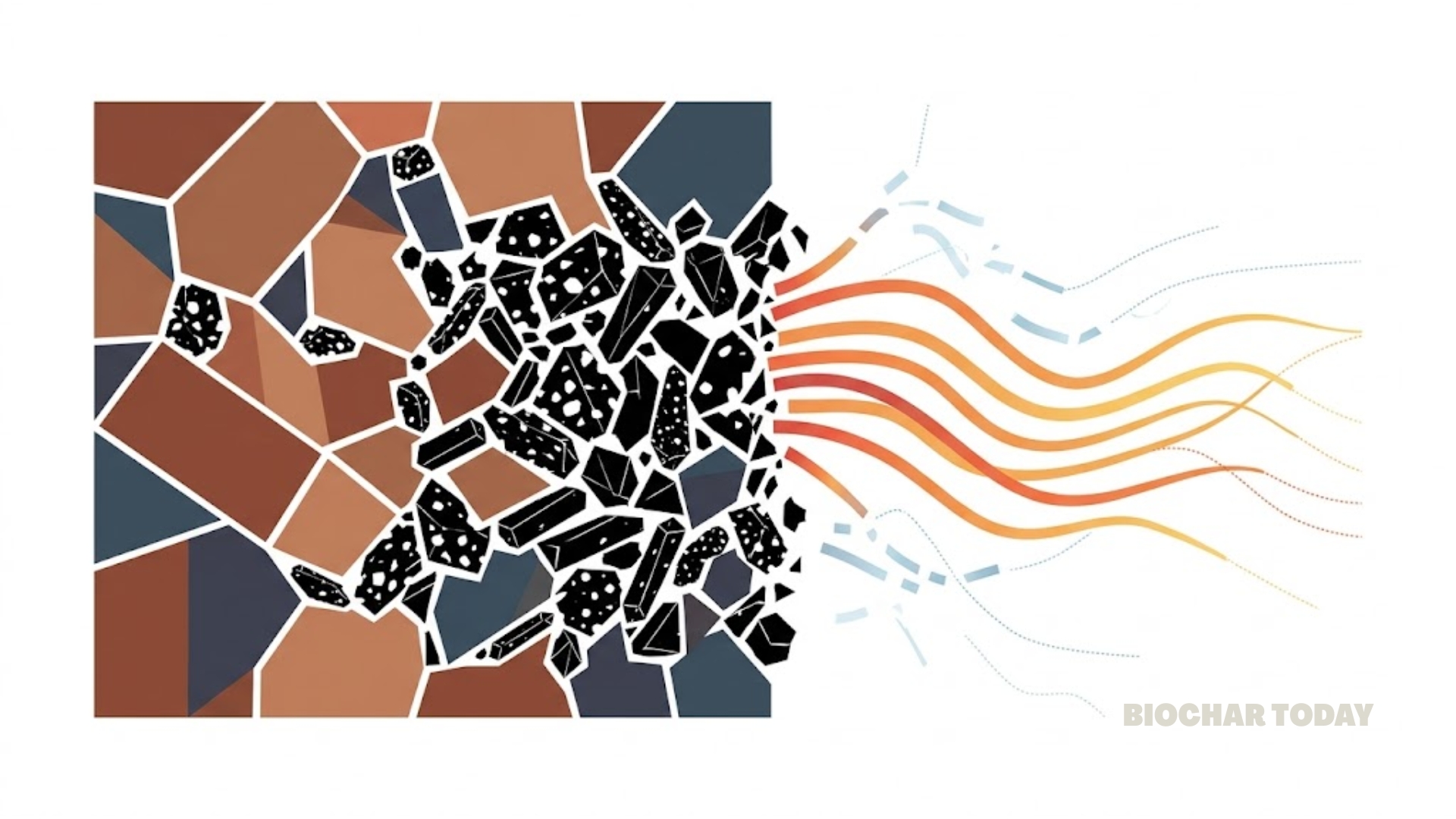
The experimental findings reveal a distinct non-linear relationship between the volume of biochar reinforcement and the resulting mechanical performance of the stabilized bricks. Incorporating the biochar component up to an optimal threshold of four percent by weight steadily enhances both the internal cohesion and particle adhesion within the clay matrix. Beyond this concentration, the extreme accumulation of carbon particles alters matrix uniformity and increases overall void volume, which subsequently degrades internal loading patterns. Temperature also operates as a critical variable in modifying material properties. Processing the broad bean stalks at five hundred degrees Celsius ensures a complete degradation of organic volatile compounds, leaving behind a highly stable carbon skeleton with increased surface roughness that fosters superior mechanical interlocking with the surrounding soil.
Under these optimized synthesis conditions, the engineered masonry blocks deliver exceptional structural performance metrics that comfortably surpass baseline international regulatory criteria. The optimized bricks display a compressive strength of four point forty-one megapascals, representing an immediate one hundred percent increase over the plain soil control specimens, which collapsed at just two point twenty megapascals. This structural upgrade satisfies the minimum thresholds established by regulatory authorities for non-load-bearing masonry units. Similarly, the bending capacity of the composite bricks reaches one point forty-seven megapascals under optimal conditions, marking a prominent one point ninety-four percent gain compared to the unreinforced reference mortars. When under extreme stress, visual analysis confirms a ductile failure pattern rather than brittle cracking, as the raw Broad bean fibers act as continuous structural bridges that stitch the internal earth matrix together across developing fractures.
Simultaneously, the physical integration of the porous biochar byproduct significantly upgrades the energy-saving insulation performance of the final blocks. Incorporating the microporous carbon particles steadily increases the accessible water porosityPorosity of biochar is a key factor in its effectiveness as a soil amendment and its ability to retain water and nutrients. Biochar’s porosity is influenced by feedstock type and pyrolysis temperature, and it plays a crucial role in microbial activity and overall soil health. Biochar More from four point ninety-six percent up to nearly eight percent. This intentional introduction of microscopic voids acts as a physical barrier to heat transfer, effectively disrupting continuous thermal pathways through the dense clay matrix. As a result, the thermal conductivity values plummet from zero point sixty-nine watts per meter-kelvin in the plain soil references down to a mere zero point thirty-six watts per meter-kelvin in the heavily reinforced samples, achieving a forty-eight percent drop in overall heat transmission. This dynamic combination of lightweight thermal shielding and upgraded crushing durability makes the composite bricks highly competitive for bioclimatic housing applications.
To validate these physical outcomes, the researchers contrasted statistical response surface equations with complex artificial neural networks. The artificial intelligence architecture, processing data through hidden layer configurations, predicted the mechanical and thermophysical behaviors with superior predictive precision, yielding correlation metrics above ninety-eight percent. This predictive capability allows industrial manufacturers to systematically customize soil compaction, hydration levels, and thermal processing settings to generate predictable structural characteristics using variable agricultural waste flows.
Source: Frioui, N., Boumaaza, M., Belaadi, A., Abdullah, M. M. S., Ghernaout, D., Al-Khawlani, A., & Mukalazi, H. (2026). Optimizing the mechanical performance of adobe bricks reinforced with Vicia faba plant waste and derived biochar using ANN and RSM. Scientific Reports, 1-36.



Leave a Reply