
Key Takeaways
- Active surface sites on biocharBiochar is a carbon-rich material created from biomass decomposition in low-oxygen conditions. It has important applications in environmental remediation, soil improvement, agriculture, carbon sequestration, energy storage, and sustainable materials, promoting efficiency and reducing waste in various contexts while addressing climate change challenges. More help turn crop straw into long-lasting soil carbon instead of letting it escape quickly as gas.
- Stronger radical activity speeds up early breakdown and chemical changes in straw during the first two weeks without wasting overall carbon.
- Soil microbes shift to match these changed plant materials and help lock carbon onto tiny soil minerals.
- The amount of carbon stored depends partly on soil type, with near-neutral, carbon-rich soil holding more than drier, alkaline soil.
- More research across fields and seasons is still needed before farming rules can be set.
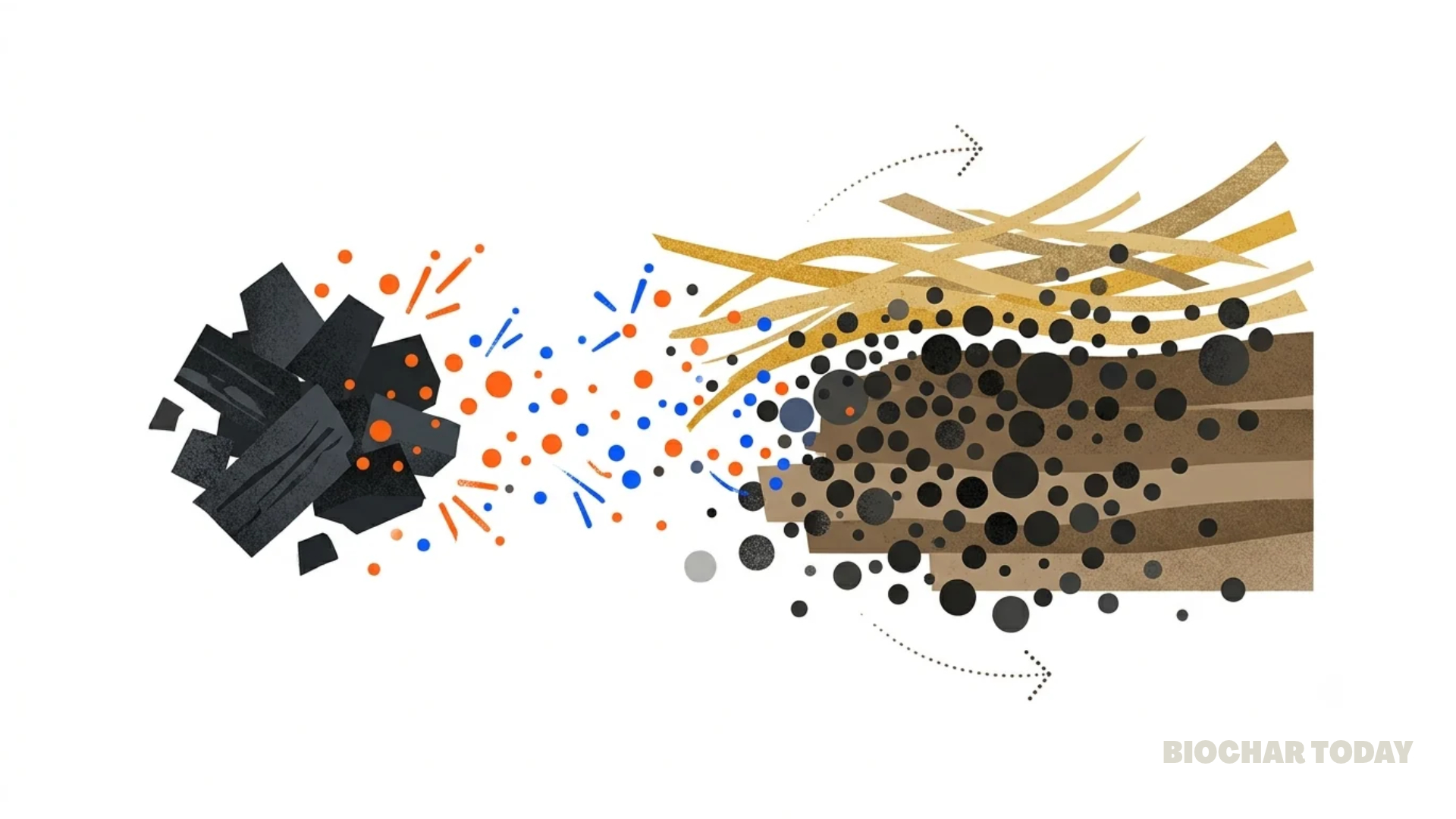
Published in Biochar, this study by Dan Yuan, Jiao Yuan, Xiangxiang Hao, Xinliang Dong, Ping Wu, Yuming Zhang, Zhenhua Yu, and Shuping Qin shows that persistent free radicals on biochar actively steer crop straw carbon toward durable mineral-associated organic matter rather than simply speeding up carbon loss. Across both tested agricultural soils, higher radical activity on biochar increased hydroxyl radical production in a dose-dependent way, reaching 6.1-fold higher levels in black soil and 18.1-fold higher levels in fluvo-aquic soil compared with straw-only controls. This early chemical oxidation raised first-order straw carbon mineralization rate constants by 49.8 percent in black soil and 47.5 percent in fluvo-aquic soil during the initial incubation window, while also increasing cumulative straw-derived carbon dioxide release by day 14 along with radical strength.
Crucially, faster early turnover did not mean greater net carbon loss over time. Instead, biochar radical activity increased dissolved organic matter aromaticity, especially during the first 14 days, and redirected straw-derived carbon into aromatic intermediates that attached to mineral surfaces. By day 84, the highest-radical biochar treatment raised the share of mineral-associated organic matter carbon coming from straw from 59.4 percent to 64.2 percent in black soil and from 53.8 percent to 60.0 percent in fluvo-aquic soil. Solid-state carbon nuclear magnetic resonance results further confirmed a higher share of aromatic straw-derived carbon inside mineral-associated organic matter under high-radical treatments.
Soil conditions shaped how strongly this pathway operated. Black soil, which had a near-neutral pHpH is a measure of how acidic or alkaline a substance is. A pH of 7 is neutral, while lower pH values indicate acidity and higher values indicate alkalinity. Biochars are normally alkaline and can influence soil pH, often increasing it, which can be beneficial More of 6.8 and higher native organic carbon of 28.5 grams per kilogram, produced stronger radical-driven responses and greater carbon accumulation in mineral-associated pools than fluvo-aquic soil, which had a pH of 8.1 and lower native organic carbon of 12.3 grams per kilogram.
Microbial communities and enzyme activity shifted alongside these chemical changes. Higher radical activity coincided with greater relative abundance of bacteria and fungi linked to aromatic compound processing and oxidative stress tolerance, such as Sphingomonadaceae, Burkholderiaceae, Comamonadaceae, Chaetomium, and Agaricomycetes, alongside drops in groups tied to rapid labile polysaccharide breakdown. Polyphenol oxidase activity also rose with radical levels and correlated positively with straw-derived carbon stored in mineral-associated organic matter. Statistical path modeling indicated that radical-driven chemical transformation acted as the primary pathway linking biochar radicals to carbon stabilization, with microbial responses functioning mainly as secondary responders that process chemically altered intermediates.
While these findings show that surface redox chemistry helps biochar turn crop residues into stable soil carbon, the authors note several limits. The exact molecular structures of intermediate compounds, individual straw components, and gene-level microbial responses were not directly resolved, and results came from a laboratory study using one straw biochar. Further work across varied biochars, climates, and long-term field conditions is needed to confirm broader applicability.
Source: Yuan, D., Yuan, J., Hao, X., Dong, X., Wu, P., Zhang, Y., Yu, Z., & Qin, S. (2026). Persistent free radicals on biochar surfaces redirect straw-derived carbon toward mineral-associated organic matter. Biochar, 8, 147.


Leave a Reply