
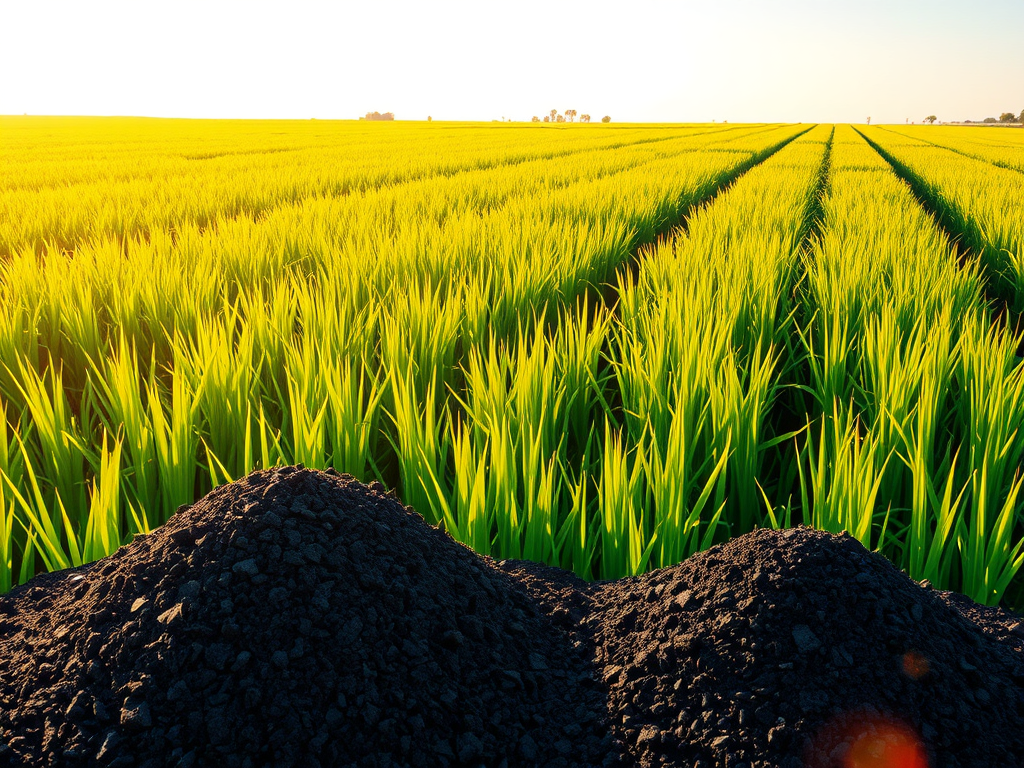
In the world of agriculture, innovation often comes from unexpected places. A recent study by Clint Mattox and Kristin Trippe, published in Crop, Forage & Turfgrass Management, delves into a technique called “carbon-seeding” that is commonly used in western Oregon for perennial ryegrass (Lolium perenne L. ssp. perenne) seed production. This method involves applying a band of activated charcoalCharcoal is a black, brittle, and porous material produced by heating wood or other organic substances in a low-oxygen environment. It is primarily used as a fuel source for cooking and heating. More (AC) over the seed row, which then absorbs preemergent herbicides broadcast over the field. This selective absorption protects the germinating grass seeds while the herbicide controls weeds between rows.
The study explores the potential of biocharBiochar is a carbon-rich material created from biomass decomposition in low-oxygen conditions. It has important applications in environmental remediation, soil improvement, agriculture, carbon sequestration, energy storage, and sustainable materials, promoting efficiency and reducing waste in various contexts while addressing climate change challenges. More as a substitute for AC in this crucial process. Biochar, a material with properties similar to AC, is produced from conifer wood in western Oregon, making it both less expensive and less energy-intensive to manufacture than AC. This presents a compelling economic and environmental advantage for local growers. To evaluate biochar’s effectiveness, the researchers conducted a field study, repeated four times, comparing AC and biochar across seven herbicide treatments: EPTC, diuron, indaziflam, rimsulfuron, pronamide, a combination of pyroxasulfone and flumioxazin, and a no-herbicide control.
The results were promising, indicating that perennial ryegrass establishment was equivalent when either biochar or AC was used in conjunction with diuron, rimsulfuron, pronamide, and the combination of pyroxasulfone and flumioxazin. This suggests that for these four herbicide treatments, conifer-based biochar can be effectively interchanged with AC for carbon-seeding, offering a viable and more sustainable option for growers.
However, the study also highlighted some important distinctions. When indaziflam was used, activated charcoal proved to be more effective than biochar in protecting perennial ryegrass. In fact, biochar never protected the seed row as well as the no-herbicide control when indaziflam was applied. This difference might be attributed to the slightly lower surface area of the biochar used in the experiment compared to the AC. Conversely, neither AC nor biochar consistently protected perennial ryegrass when EPTC was applied, suggesting that the standard application rate of 300 pounds per acre might not be sufficient for this particular herbicide.
These findings are particularly significant because this is the first field report of biochar successfully protecting a grass seed crop during carbon-seeding. The research not only validates biochar as a promising alternative for several commonly used herbicides but also updates scientific literature on carbon-seeding crop safety, a topic not extensively covered since a 1973 manuscript. The ability to use a locally produced, less expensive material like conifer-based biochar could lead to substantial benefits for stakeholders in Oregon’s grass seed production industry. Future research will focus on assessing if these establishment rates correlate with actual perennial ryegrass yield and investigating the effects of different carbon application rates for all herbicides in the system.
Source: Mattox, C., & Trippe, K. (2025). Comparing activated charcoal and biochar for carbon-seeding in grass seed production. Crop, Forage & Turfgrass Management, 11, e70049.





Leave a Reply