
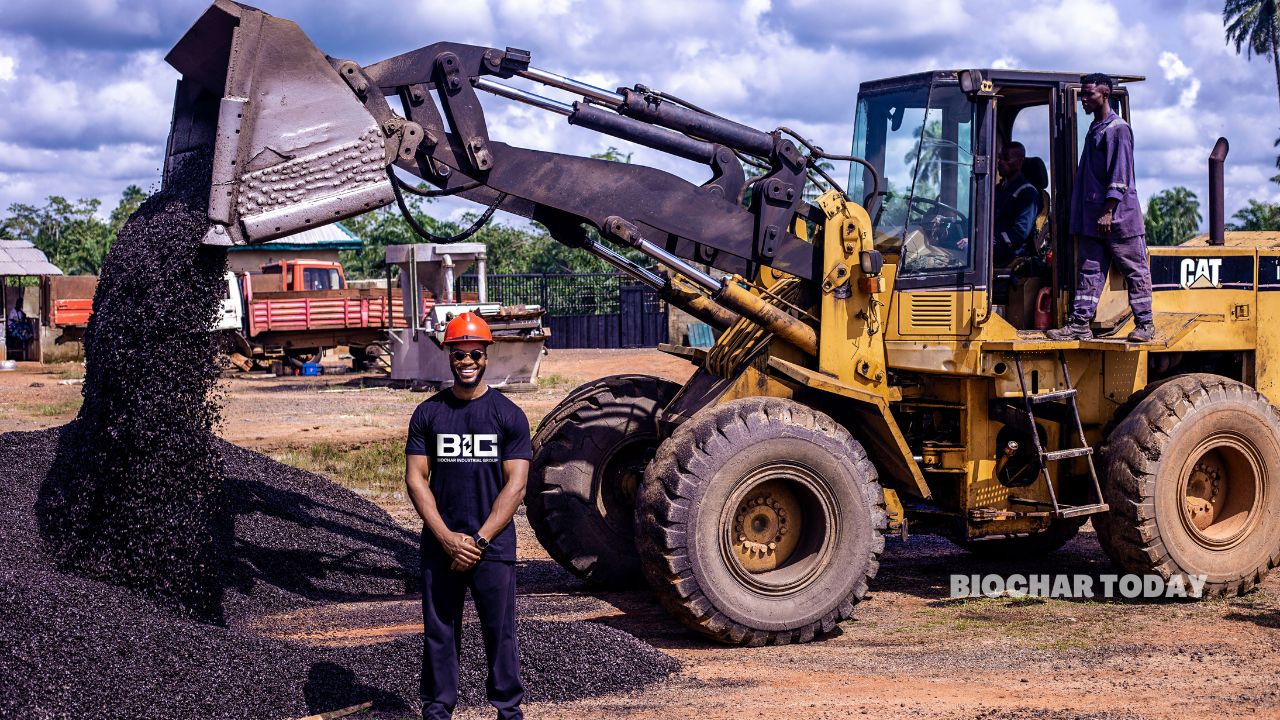
BiocharBiochar is a carbon-rich material created from biomass decomposition in low-oxygen conditions. It has important applications in environmental remediation, soil improvement, agriculture, carbon sequestration, energy storage, and sustainable materials, promoting efficiency and reducing waste in various contexts while addressing climate change challenges. More Industrial Group (BIG) has officially launched its Biochar-as-a-Service business model to transform underutilized biomassBiomass is a complex biological organic or non-organic solid product derived from living or recently living organism and available naturally. Various types of wastes such as animal manure, waste paper, sludge and many industrial wastes are also treated as biomass because like natural biomass these More into environmental and financial assets. Led by executive team members Ikenna Nzewi, Uzoma Ayogu, and Isaiah Udotong, the entity focuses on integrating specialized carbon removal solutions directly into existing supply chains. In an initial commercial deployment in Nigeria, BIG operated as the technical partner for Releaf Earth, a regional agribusiness processor. The collaboration successfully converted palm kernel shell waste into high-quality biochar, laying the foundation for scaling this waste-to-value model across diverse sub-Saharan agricultural sectors.
Agribusinesses across Africa generate millions of tonnes of agricultural residues annually, including palm kernel shells, rice husks, cashew shells, and cocoa pods. Historically, a significant portion of this biomass has been discarded, left underutilized, or disposed of via open-air burning, which contributes to atmospheric emissions without capturing economic value. Agribusinesses have long lacked the specialized operational infrastructure, engineering expertise, and financial frameworks required to independently process these dense waste streams into verified ecological commodities or to navigate complex international carbon markets.
To address these logistical and structural constraints, BIG implemented a modular Biochar-as-a-Service operational framework on-site at processing facilities. Under this model, BIG conducts systematic assessments of available biomass streams and manages the thermal conversion of suitable agricultural residues under low-oxygen conditions. In the case of Releaf Earth, BIG provided the necessary engineering oversight to continuously transform industrial volumes of palm kernel shells. Furthermore, the company managed the rigorous data documentation and compliance pathways required to develop and verify durable carbon removal credits suitable for global corporate procurement.
The operational deployment yielded clear industrial and financial outcomes. The initiative effectively mitigated a localized waste disposal challenge for Releaf Earth by repurposing bulk processing residues. The physical biochar generated from the palm kernel shells established a stable, carbon-rich soil amendmentA soil amendment is any material added to the soil to enhance its physical or chemical properties, improving its suitability for plant growth. Biochar is considered a soil amendment as it can improve soil structure, water retention, nutrient availability, and microbial activity. More capable of enhancing moisture and nutrient retention for regional agriculture. Financially, the project successfully commercialized the verified carbon removal credits generated by the process, executing sales to international technology companies and creating an entirely new, operational revenue stream from unpriced agricultural byproducts.



Leave a Reply