
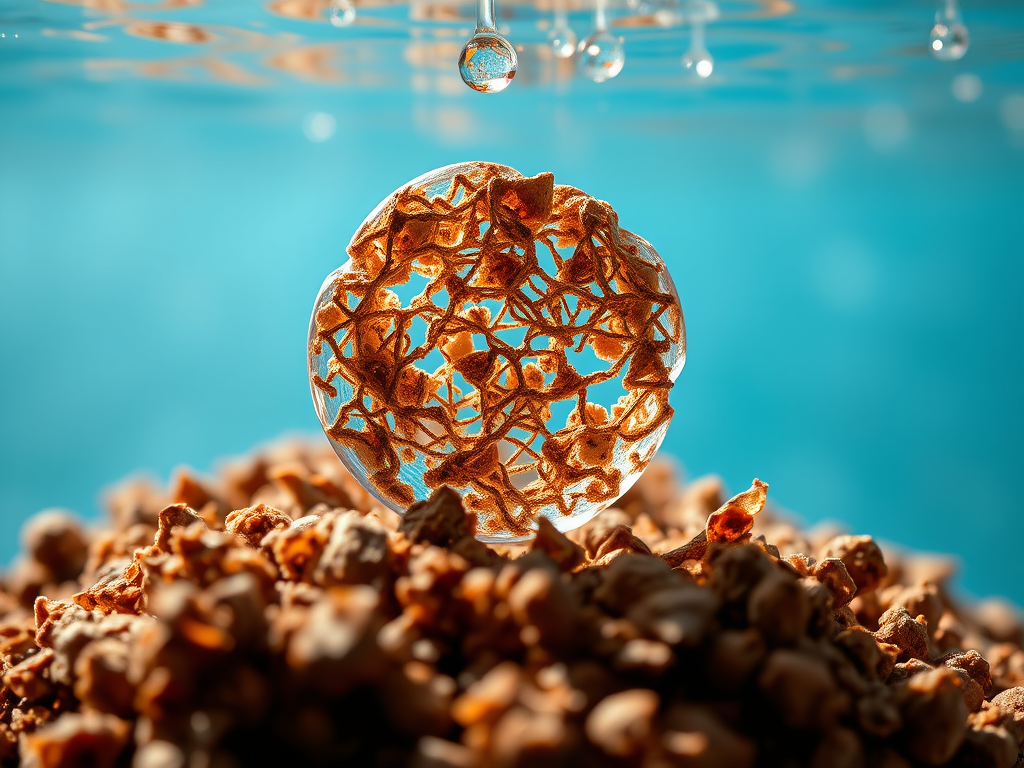
A new study published in Scientific Reports by Xiaohui Zhao, Zi Liao, Qingrui Zhao, Mingli Yang, Dongyang Li, Ke Zhang, Xiaodan Wang, Hongpei Zhang, and Binguo Zheng presents an effective and low-cost solution for a growing environmental problem. The world is facing increasing challenges with water contamination, particularly from antibiotics like tetracycline. This common antibiotic, used widely in healthcare and aquaculture, is found in water bodies globally. The researchers successfully developed a magnetic biocharBiochar is a carbon-rich material created from biomass decomposition in low-oxygen conditions. It has important applications in environmental remediation, soil improvement, agriculture, carbon sequestration, energy storage, and sustainable materials, promoting efficiency and reducing waste in various contexts while addressing climate change challenges. More (MBC) to tackle this issue. The material, which is derived solely from solid waste—peanut shells and red mud—offers a promising, environmentally friendly, and affordable way to remove these pollutants.
The MBC material’s unique properties are a result of its one-step pyrolysisPyrolysis is a thermochemical process that converts waste biomass into bio-char, bio-oil, and pyro-gas. It offers significant advantages in waste valorization, turning low-value materials into economically valuable resources. Its versatility allows for tailored products based on operational conditions, presenting itself as a cost-effective and efficient More preparation, a method that avoids chemical input and wastewater discharge, making it particularly green. The final product is a porous biochar with a rich network of microscopic channels and functional groups on its surface. These features are crucial for its high performance in attracting and trapping tetracycline molecules from water. The team’s analysis showed that the material has an average pore diameter below 50 nanometers, which is ideal for the diffusion of pollutants into the material. What makes this biochar particularly useful is its magnetic property, attributed to the even distribution of nano-Fe₃O₄ particles on its surface. This magnetism allows for the quick and easy separation of the biochar from water within 30 seconds using a magnet, a significant advantage over non-magnetic adsorbents that require time-consuming and costly filtration.
The key finding from the study is the biochar’s impressive capacity to remove tetracycline. The material achieved a maximum adsorption capacity of 87.39 mg per gram of biochar, a highly efficient rate that demonstrates its effectiveness in treating polluted water. The researchers also tested the biochar’s performance under different conditions, including varying doses, initial concentrations, and pHpH is a measure of how acidic or alkaline a substance is. A pH of 7 is neutral, while lower pH values indicate acidity and higher values indicate alkalinity. Biochars are normally alkaline and can influence soil pH, often increasing it, which can be beneficial More levels. They found that at a dosage of 30 mg, the biochar achieved a high adsorption efficiency of 92.6%, and its performance remained stable across a wide pH range, making it suitable for a variety of real-world water systems. This versatility is a major benefit for its potential application in treating industrial and municipal wastewater. The study also found that the material can be reused with high effectiveness; even after five cycles of regeneration, the biochar maintained a removal rate above 70% of its original capacity. This reusability further enhances its economic viability and environmental appeal.
The researchers also delved into the mechanism behind the biochar’s effectiveness. They determined that the adsorption process is best described by a pseudo-second-order kinetic model, which suggests that the binding of tetracycline to the biochar’s surface is a complex chemical process involving multiple interactions. The presence of oxygen-containing functional groups and π-π bonding on the biochar’s surface plays a significant role in its ability to bind with tetracycline molecules. The study confirms that the material’s porous structure and chemical composition work in tandem to efficiently remove pollutants. The one-step pyrolysis method used to create this magnetic biochar not only keeps costs down but also demonstrates good generality, meaning it can be applied to manufacture similar materials from different biomassBiomass is a complex biological organic or non-organic solid product derived from living or recently living organism and available naturally. Various types of wastes such as animal manure, waste paper, sludge and many industrial wastes are also treated as biomass because like natural biomass these More sources, opening the door for broader resource recycling. By converting solid waste into a high-performance water treatment material, this research offers a compelling solution for both waste management and water pollution.
Source: Zhao, X., Liao, Z., Zhao, Q., Yang, M., Li, D., Zhang, K., Wang, X., Zhang, H., & Zheng, B. (2025). A low cost magnetic biochar manufactured solely from solid wastes by one-step pyrolysis for removal of tetracycline. Scientific Reports, 15(1), 30035.




Leave a Reply