
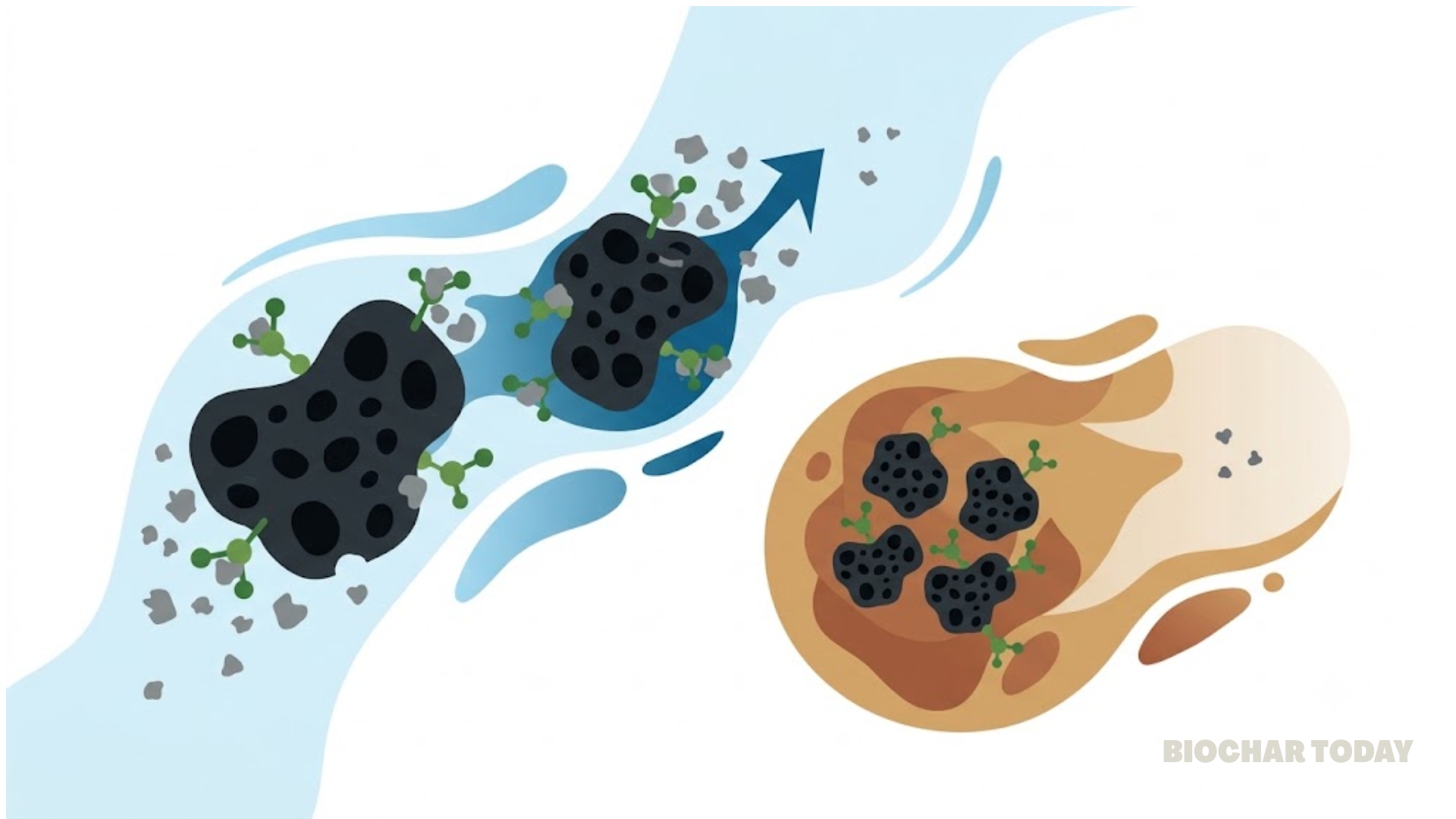
Key Takeaways
- Enzymes bound to biocharBiochar is a carbon-rich material created from biomass decomposition in low-oxygen conditions. It has important applications in environmental remediation, soil improvement, agriculture, carbon sequestration, energy storage, and sustainable materials, promoting efficiency and reducing waste in various contexts while addressing climate change challenges. More retain up to eighty-five percent of their original activity while increasing reusability across multiple operational cycles.
- Combining biological enzymes with biochar support structures eliminates up to ninety-eight percent of synthetic dyes and industrial pharmaceuticals from water.
- Engineered biochar anchors enzymes to prevent chemical leachingLeaching is the process where nutrients are dissolved and carried away from the soil by water. This can lead to nutrient depletion and environmental pollution. Biochar can help reduce leaching by improving nutrient retention in the soil. More and preserves catalytic performance across harsh acidity and temperature ranges.
- Dual adsorption and enzymatic catalysis reduces soil contaminant levels by over eighty-eight percent within sixty minutes of application.
A broad scientific synthesis published in Biochar by Sinan Zhang and co-authors highlights major technical breakthroughs in marrying biological catalysts with carbon-rich support materials. Bioremediation using free enzymes has long faced operational limits because unanchored proteins degrade rapidly, sensitive active sites lose structural stability under environmental stress, and recovering loose biological material from treated matrices remains exceptionally difficult. Binding functional enzymes onto agricultural biochar solves these legacy barriers by constructing a protective, highly porous framework that concentrates organic pollutants directly around active catalytic zones. This structural integration shields delicate protein folds from temperature spikes and acidity fluctuations while allowing the combined material to be collected and reused repeatedly.
The review emphasizes how surface modifications transform plain biochar into a precision carrier tailored for specific enzyme geometries. Chemical activation using acid or alkali treatments doubles the total surface area, while nitrogen functionalization modifies surface charge characteristics to pull proteins into tight physical bonding. When enzymes attach through covalent links or physical entrapment within microscopic pores, the carrier acts as a physical sponge and a chemical reactor simultaneously. The surrounding carbon structure captures toxic molecules from surrounding water or soil through rapid surface adsorption, holding them in place until the attached enzymes break down the chemical bonds. This continuous dual action dramatically accelerates overall cleanup speeds compared to using raw biochar or free enzymes alone.
In water purification testing, these biochar-enzyme systems demonstrate extraordinary efficiency against complex, persistent pollutants that normally resist conventional treatment. Multi-enzyme composites derived from fermented organic waste destroyed over ninety-nine percent of high-concentration pharmaceutical compounds within twenty minutes of contact time. Similarly, immobilized laccase systems achieved near-complete breakdown of hazardous synthetic dyes, bisphenol compounds, and persistent antibiotics like diclofenac. The biological pathways split complex molecular rings into simple, non-toxic byproducts without leaving secondary chemical residues in the treated effluent. Furthermore, the robust physical attachment minimizes enzyme leaching, allowing fixed-bed reactors and filtration membranes to operate continuously over prolonged periods without significant loss in performance.
Beyond liquid waste streams, biochar-bound enzymes offer transformative possibilities for soil restoration and agricultural security. In contaminated earth, composite materials achieved nearly eighty-nine percent degradation of volatile organic pollutants within one hour, relying on combined physical trapping and localized enzymatic breakdown. The porous carbon matrix simultaneously enhances the soil water holding capacityWater holding capacity is the amount of water that soil can retain. Biochar can significantly increase the water holding capacity of soil, improving its ability to withstand drought conditions and support plant growth. More, protects beneficial native soil microbes, and immobilizes fungal enzymes that would otherwise spread plant diseases to agricultural crops. While challenges remain regarding feedstockFeedstock refers to the raw organic material used to produce biochar. This can include a wide range of materials, such as wood chips, agricultural residues, and animal manure. More variability and large-scale continuous flow deployment, the technology provides a sustainable, closed-loop approach that turns agricultural waste into high-value environmental cleanup systems.
Source: Zhang, S., Cui, C., Huang, S., Wu, S., & Wang, Y. (2026). Application and mechanisms of biochar-immobilized enzymes in environmental remediation: A review. Biochar, 8(1), Article 4.


Leave a Reply