
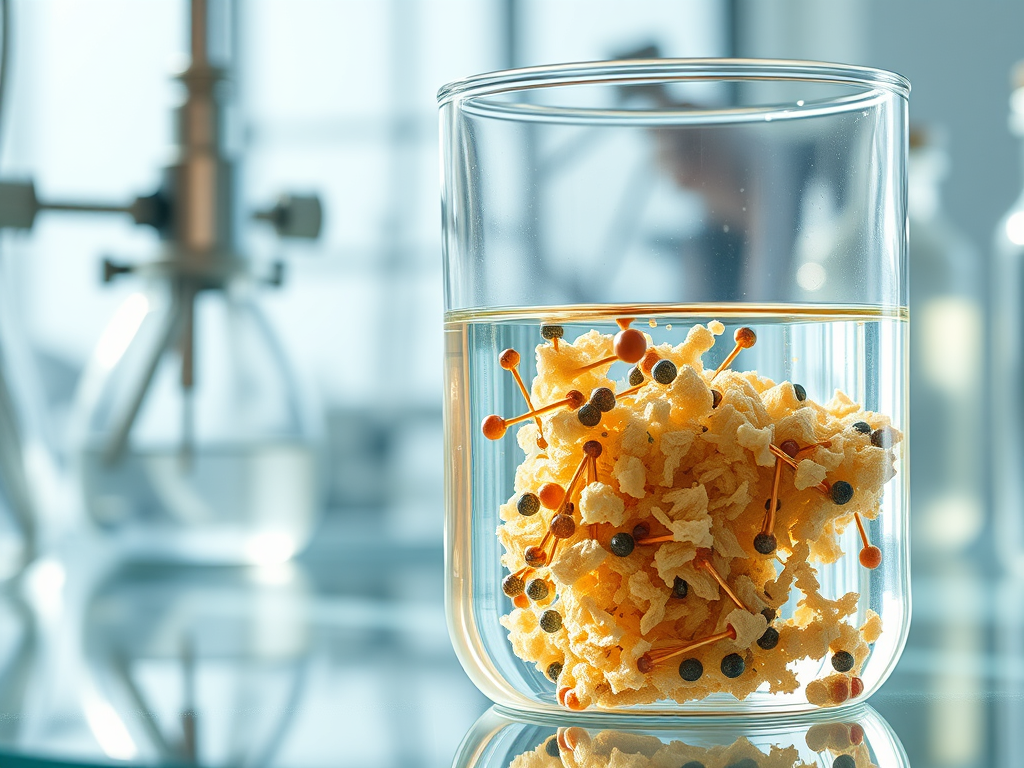
A study in ACS Omega by Khandgave Santosh Sopanrao and Inkollu Sreedhar presents a new, cost-effective phosphoric acid-modified biochar-chitosan nanocomposite (PGB-CS) for removing multiple heavy metals from wastewater. The research addresses the significant health and environmental risks posed by heavy metal contamination in industrial wastewater. Adsorption is a preferred method for wastewater treatment due to its economic viability, low sludge generation, and ease of regeneration. This study focused on developing a highly efficient adsorbent for the simultaneous removal of copper (Cu2+), nickel (Ni2+), and zinc (Zn2+).
The PGB-CS adsorbent was created from groundnut shells, chosen for their carbon-rich composition . The synthesis involved pyrolyzing the groundnut shells at an optimized temperature of 550 ∘C for two hours to create biocharBiochar is a carbon-rich material created from biomass decomposition in low-oxygen conditions. It has important applications in environmental remediation, soil improvement, agriculture, carbon sequestration, energy storage, and sustainable materials, promoting efficiency and reducing waste in various contexts while addressing climate change challenges. More . This process yielded a material with a surface area of 102.98 m2/g and a pore diameter of 7.56 nm, striking a balance between adsorption properties and energy consumption. The biochar was then modified with phosphoric acid and combined with chitosan, a biodegradable and non-toxic material rich in functional groups like amine, carboxyl, and hydroxyl . The final PGB-CS composite had an increased surface area of 167.98 m2/g and a pore diameter of 9.18 nm, confirming the success of the chemical modification .
Through a three-level optimization process, the researchers determined the optimal conditions for metal adsorption. The PGB-CS nanocomposite achieved maximum adsorption capacities of 249.78 mg/g for Cu2+, 191.48 mg/g for Ni2+, and 145.91 mg/g for Zn2+ at a pHpH is a measure of how acidic or alkaline a substance is. A pH of 7 is neutral, while lower pH values indicate acidity and higher values indicate alkalinity. Biochars are normally alkaline and can influence soil pH, often increasing it, which can be beneficial More of 5.0 . The adsorption process was best described by the pseudo-second-order kinetic model, indicating that chemisorption was the dominant rate-limiting step. The Langmuir isotherm model also provided a strong fit, suggesting that the metals formed a monolayer on the adsorbent’s surface. Thermodynamic studies confirmed that the adsorption was a spontaneous and endothermic process driven by an increase in entropy .
The PGB-CS composite’s real-world applicability was tested using actual industrial effluent from a battery manufacturing facility. The adsorbent achieved removal efficiencies of 83.19% for Cu2+, 61.94% for Ni2+, and 52.34% for Zn2+ . This demonstrated a higher selectivity for copper, which was attributed to its higher electronegativity and smaller ionic size compared to nickel and zinc . The adsorbent also showed impressive stability and reusability, maintaining considerable desorption efficiency over eight regeneration cycles . The synthesis cost was estimated at USD 8.13/g, with chitosan accounting for over 80% of the total cost, highlighting a key area for future cost reduction .
In conclusion, the PGB-CS composite offers a sustainable and efficient solution for treating heavy metal contamination in industrial wastewater. Its superior performance is due to a combination of tailored surface chemistry, a high surface area, and the availability of functional groups that facilitate surface complexation, ion exchange, and electrostatic attraction. While the study demonstrates significant potential, further research is needed on large-scale implementation, including column studies and long-term stability assessments .
Source: Khandgave, S. S., & Sreedhar, I. (2025). Novel Phosphoric Acid-Modified Biochar-Chitosan Nanocomposite for an Efficient and Cost-Effective Multimetal Removal from Wastewater. ACS Omega.





Leave a Reply