
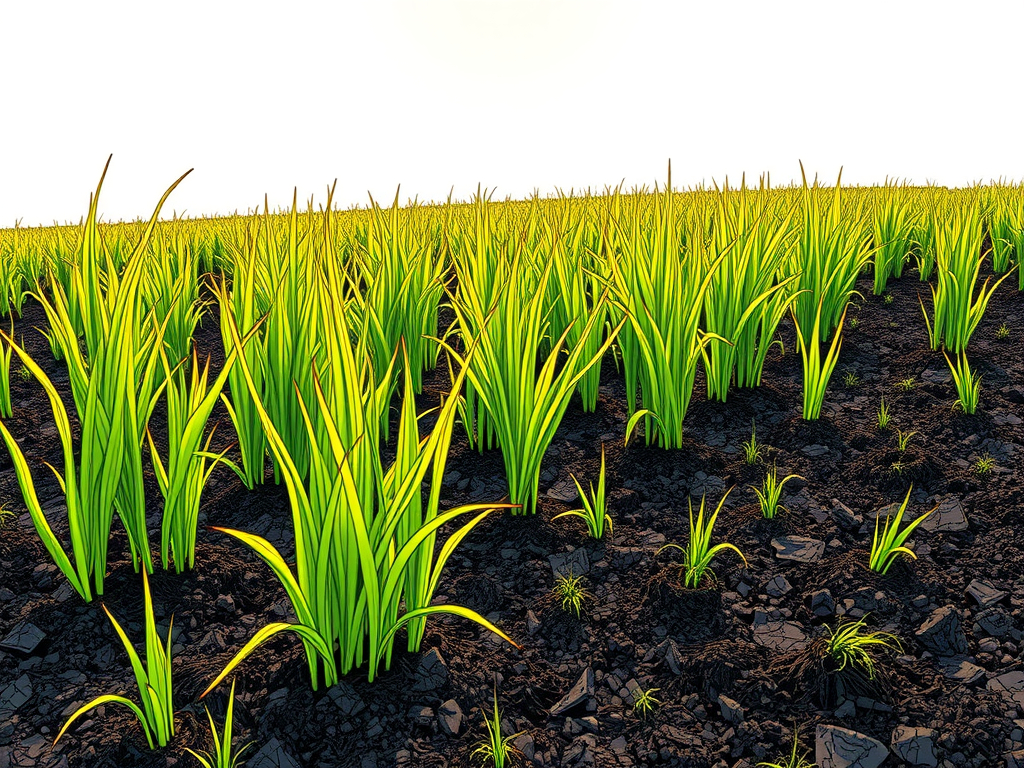
A recent study published in Environmental Chemistry and Ecotoxicology by Nurzhanova et al., explores the use of biocharBiochar is a carbon-rich material created from biomass decomposition in low-oxygen conditions. It has important applications in environmental remediation, soil improvement, agriculture, carbon sequestration, energy storage, and sustainable materials, promoting efficiency and reducing waste in various contexts while addressing climate change challenges. More to improve the growth of Miscanthus sinensis in soils contaminated with nickel (Ni) and 4,4′-DDE. The study reveals that biochar amendment can significantly enhance plant growth and reduce the bioavailability of pollutants in complexly contaminated soil.
Conventional agricultural practices often lead to the accumulation of pollutants, including potentially toxic elements (PTEs) and pesticides, in soils. In Kazakhstan, organochlorine pesticides (OCPs) have been extensively used, causing persistent environmental and health issues. These pollutants, along with PTEs like zinc (Zn), nickel (Ni), arsenic (As), and cobalt (Co), pose a significant threat to soil health and environmental safety.
PhytoremediationThis is a technique that uses plants to clean up contaminated soil or water. Biochar can enhance phytoremediation by improving soil conditions and promoting plant growth, allowing plants to absorb and break down pollutants more effectively. More, a cost-effective and sustainable approach, uses plants to stabilize or remove pollutants from the soil. Miscanthus sinensis, a promising energy crop, has shown potential for phytoremediation due to its high biomassBiomass is a complex biological organic or non-organic solid product derived from living or recently living organism and available naturally. Various types of wastes such as animal manure, waste paper, sludge and many industrial wastes are also treated as biomass because like natural biomass these More production and tolerance to pollutants.
Biochar has emerged as a valuable tool to support phytoremediation. It improves soil conditions, provides nutrients, and immobilizes pollutants. However, it is crucial to consider the potential toxicity and limitations of biochar, such as reduced soil moisture retention and increased erosion.
This study by investigated the impact of biochar on M. sinensis growth in soil contaminated with Ni and 4,4′-DDE. The results showed that biochar incorporation significantly increased plant yield, with some treatments showing up to a 121% increase. Biochar also enhanced free proline and total protein content and increased chlorophyll b levels in the plants.
Furthermore, biochar reduced the plant uptake of 4.4′-DDE, decreasing its bioavailability in the soil. In combined contamination scenarios, biochar showed selective sorption, enhancing 4.4′-DDE adsorption while reducing Ni ion retention. These findings suggest that biochar can both promote M. sinensis growth and reduce the bioavailability of pollutants, making it a promising tool for phytoremediation of complexly contaminated soils and potentially improving agricultural soils with specific nutrient deficiencies.
Source : Nurzhanova, A., Pidlisnyuk, V., Nurmagambetova, A., Zhumasheva, Z., Naizabayeva, L., & Mamirova, A. (2025). Biochar as a tool to optimise Miscanthus sinensis resilience and phytoremediation efficiency: Case study of contamination by mixture of Ni and 4.4′-DDE. Environmental Chemistry and Ecotoxicology, 7, 802-818.



Leave a Reply