
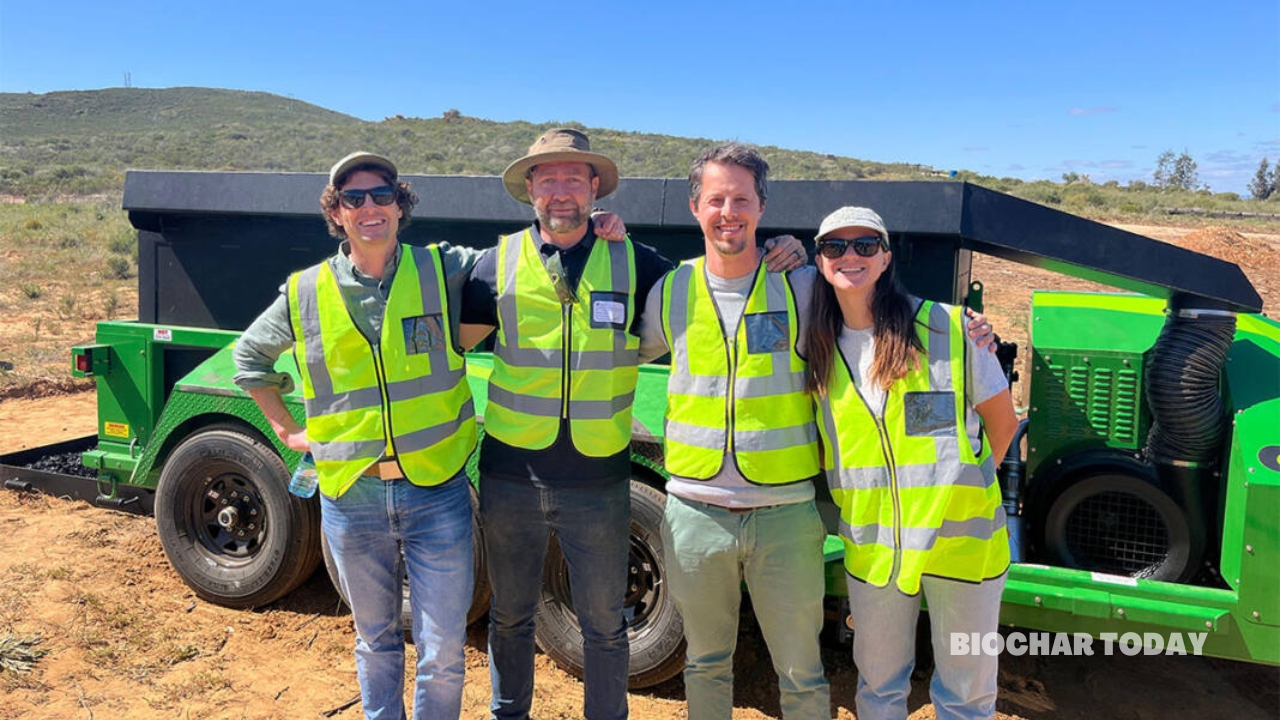
In South Africa, the restoration firm Afriwild is piloting a trailer-mounted pyrolysis system known as the CharBoss to address the management of invasive plant biomassBiomass is a complex biological organic or non-organic solid product derived from living or recently living organism and available naturally. Various types of wastes such as animal manure, waste paper, sludge and many industrial wastes are also treated as biomass because like natural biomass these More in the Western Cape. Traditionally, clearing invasive species like pine, wattle, and eucalyptus results in biomass that is either burnt in open piles or left to decompose, both of which release stored carbon into the atmosphere. The Afriwild pilot project, centered in Worcester, introduces a mobile, towable kiln that processes this waste on-site. By converting hazardous fuel loads into stable biocharBiochar is a carbon-rich material created from biomass decomposition in low-oxygen conditions. It has important applications in environmental remediation, soil improvement, agriculture, carbon sequestration, energy storage, and sustainable materials, promoting efficiency and reducing waste in various contexts while addressing climate change challenges. More, the project aims to utilize carbon finance as a primary engine for large-scale ecosystem restoration across degraded African landscapes.
The central challenge addressed by this initiative is the environmental and safety risks associated with traditional biomass disposal in fire-prone regions. Open-pile burning is a common practice that releases significant particulate matter and greenhouse gases while posing a constant threat of uncontrolled wildfires. Furthermore, the logistical costs of transporting large volumes of woody biomass from remote restoration sites to processing centers often make land clearing economically unfeasible. Without a localized and controlled method for disposal, landowners struggle to manage invasive encroachment effectively, leading to degraded soil health and diminished biodiversity in sensitive ecosystems like the Munywana Conservancy.
The solution utilizes the CharBoss, a technology developed by Air Burners Inc. in partnership with the US Forest Service, which employs a high-velocity air curtain to contain combustion. This air curtain creates a thermal barrier that reburns smoke and volatile gases at temperatures reaching 900°C, reducing particulate emissions by over 90% compared to open burning. The unit processes up to one ton of biomass per hour, utilizing a patented quenching pan to cool the resulting biochar with minimal water consumption. This mobile approach allows for the immediate conversion of 17% to 25% of the feedstockFeedstock refers to the raw organic material used to produce biochar. This can include a wide range of materials, such as wood chips, agricultural residues, and animal manure. More into high-carbon biochar, which can then be inoculated and returned to the cleared land to enhance soil moisture retention and nutrient efficiency.
The outcomes of the Afriwild pilot include the establishment of a scalable blueprint for carbon-funded restoration that benefits both the climate and local economies. By generating high-integrity soil carbon credits, the project provides a sustainable funding stream for conservation areas, such as the 30,000-hectare Munywana Conservancy, which is projected to sequester 1.1 million tons of CO2e over four decades. The resulting biochar also serves as a commercial asset, with excess material sold to compost manufacturers to improve regional agricultural productivity. Ultimately, this integration of mobile technology and carbon markets enables a regenerative cycle that reduces wildfire risk while building more resilient, carbon-stable landscapes in Southern Africa.


Leave a Reply